Portal:South Korea
Wikipedia portal for content related to South Korea
From Wikipedia, the free encyclopedia

 |
대한민국 포털
The South Korea Portal


South Korea, officially the Republic of Korea (ROK), is a country in East Asia. It constitutes the southern half of the Korean Peninsula and borders North Korea along the Korean Demilitarized Zone, with the Yellow Sea to the west and the Sea of Japan to the east. South Korea claims to be the sole legitimate government of the entire peninsula and adjacent islands. It has a population of about 52 million, of which half live in the Seoul metropolitan area, the ninth most populous metropolitan area in the world, with other major cities being Busan, Daegu, and Incheon.
The Korean Peninsula was inhabited as early as the Lower Paleolithic period. Its first kingdom was noted in Chinese records in the early seventh century BC. From the mid first century BC, various polities consolidated into the rival kingdoms of Goguryeo, Baekje, and Silla. The lattermost eventually unified most of the peninsula for the first time in the late seventh century AD, while Balhae succeeded Goguryeo in the north. The Goryeo dynasty (918–1392) achieved lasting unification and established the basis for the modern Korean identity. The subsequent Joseon dynasty (1392–1897) generated cultural, economic, and scientific achievements but maintained an isolationist policy from the mid-17th century. The succeeding Korean Empire (1897–1910) sought modernization and reform but was annexed in 1910 into the Empire of Japan. Japanese rule ended following Japan's surrender in World War II, after which Korea was divided into two zones: the Soviet-occupied northern zone and the United States-occupied southern zone.
After negotiations on reunification failed, the southern zone became the Republic of Korea in August 1948, while the northern zone became the communist Democratic People's Republic of Korea the following month. In 1950, a North Korean invasion triggered the Korean War, one of the first major proxy conflicts of the Cold War, which saw extensive fighting involving the American-led United Nations Command and the Soviet-backed People's Volunteer Army from China. The war ended in 1953 with an armistice and left three million Koreans dead and the economy in ruins; due to the lack of a peace treaty, the Korean conflict is still ongoing. South Korea endured a series of dictatorships punctuated by coups, revolutions, and violent uprisings, but also experienced a soaring economy and one of the fastest rises in average GDP per capita, leading to its emergence as one of the Four Asian Tigers. The June Democratic Struggle of 1987 ended authoritarian rule and led to the establishment of the current Sixth Republic. (Full article...)
Selected article -

Daegu (Korean: 대구 [tɛ̝.ɡu]), formerly spelled Taegu and officially Daegu Metropolitan City (대구광역시), is a city in southeastern South Korea. It is the third-largest urban agglomeration in South Korea after Seoul and Busan; the fourth-largest metropolitan city in the nation with over 2.3 million residents; and the second-largest city after Busan in the Yeongnam region in southeastern South Korea. Daegu and the surrounding North Gyeongsang Province are often referred to as Daegu-Gyeongbuk, with a total population of over 5 million.
Daegu is located in south-eastern Korea about 80 km (50 mi) from the coast, near the Geumho River and its mainstream, Nakdong River in Gyeongsang Province. The Daegu basin is the central plain of the Yeongnam region. In ancient times, the Daegu area was part of the proto-kingdom Jinhan. Subsequently, Daegu came under the control of the Silla Kingdom, which unified the Korean Peninsula. During the Joseon period, the city was the capital of Gyeongsang Province, one of the traditional eight provinces of the country.
Daegu was an economic motor of Korea during the 1960s–1980s period. The humid subtropical climate of Daegu is ideal for producing high-quality apples, thus the nickname, "Apple City". Daegu is also known as "Textile City", as textiles used to be the main industry of the city. With the establishment of the Daegu-Gyeongbuk Free Economic Zone, Daegu currently focuses on fostering fashion and high-tech industries. (Full article...)
Selected image

The 2010 G-20 Seoul summit was the fifth meeting of the G-20 heads of government to discuss the global financial system and the world economy. It was held in Seoul, South Korea.
More did you know -

- ... that South Korean boy band TVXQ (pictured) became the first foreign artist to have four number-one singles on the Japanese single charts?
- ... that director/screenwriter Kang Dae-ha from Jeju Island, South Korea, directed films related to Korean shamanism?
- ... that South Korean fashion model Daul Kim was also a keen painter and had exhibited her works at a solo exhibition in Seoul?
In the news
- 21 May 2026 – 2026 Ebola epidemic
- India, South Korea, and Thailand issue travel alerts for the Democratic Republic of the Congo (DRC) and Uganda, while South Korea plans to impose a level-4 travel ban for parts of the DRC, especially the Ituri Province, due to the Ebola outbreak in both countries. (Türkiye) (Yonhap)
- 20 May 2026 – Middle Eastern crisis
- A South Korean-flagged oil tanker safely transits the Strait of Hormuz, marking the first passage by a South Korean vessel through the waterway since the war started. (AFP via AA) (Yonhap)
- 14 May 2026 – 2026 FIFA World Cup
- It is announced that South Korean boy band BTS, American singer Madonna and Colombian singer Shakira will headline the first-ever FIFA World Cup final halftime show at the MetLife Stadium in New Jersey, United States, on July 19, 2026. (Reuters)
- 14 May 2026 – Aftermath of the Korean War
- The Seoul Central District Court in South Korea orders North Korean supreme leader Kim Jong Un to pay damages to five former Korean War prisoners who were held in North Korea after the conflict. (AFP via New Straits Times)
- 13 May 2026 – Merger of Korean Air and Asiana Airlines
- Korean Air announces plans to launch an integrated flag carrier for South Korea on 17 December following the completion of legal procedures for its acquisition of Asiana Airlines. (AA)
- 10 May 2026 – Middle Eastern crisis
- A joint investigation by South Korea concludes that two unidentified airborne projectiles struck the HMM cargo ship Namu in the Strait of Hormuz, causing a fire and damaging the vessel, while authorities continue investigating the type of weapon and the party responsible. (AFP via Arab News) (The Chosun Ilbo)
 Good article -

"Gangnam Style" (Korean: 강남스타일; pronounced [kaŋ.nam sɯ.tʰa.il]) is a K-pop song by South Korean singer Psy, released on July 15, 2012, by YG Entertainment as the lead single of his sixth studio album, Psy 6 (Six Rules), Part 1. The term "Gangnam Style" is a neologism that refers to the nouveau riche lifestyles associated with the Gangnam region of Seoul.
"Gangnam Style" was released on to Psy's YouTube channel and debuted at number one on South Korea's Gaon Chart, receiving generally positive reviews, with praise for its catchy beat and Psy's amusing dancing during live performances and in various locations around the world in its music video. The song and its music video went viral in August 2012 and have influenced popular culture worldwide. In the United States, "Gangnam Style" peaked at number two on the Billboard Hot 100, which at the time, was the highest charting song by a South Korean artist. By the end of 2012, "Gangnam Style" had topped the music charts of more than 30 countries including Australia, Canada, France, Germany, Italy, Spain, and the United Kingdom. Psy's dance in the music video itself became a cultural phenomenon.
The song subsequently won Best Video at the MTV Europe Music Awards held that year. It became a source of parodies and reaction videos by many different individuals, groups, and organizations. On December 21, 2012, "Gangnam Style" became the first YouTube video to reach a billion views. The song's music video was the most viewed video on YouTube from November 24, 2012, when it surpassed the music video for "Baby" by Justin Bieber featuring Ludacris, to July 10, 2017, when it was itself surpassed by the music video for "See You Again" by Wiz Khalifa featuring Charlie Puth. (Full article...)
General images -
 North Korean leader Kim Jong Un and South Korean President Moon Jae-in shaking hands inside the Peace House on 27 April 2018 (from History of South Korea)
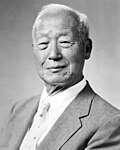 Syngman Rhee, the 1st President of South Korea (from History of South Korea)
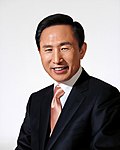 Lee Myung-bak, President of South Korea from 2008 to 2013 (from History of South Korea)
 President Park Chung Hee, who ruled South Korea from 1961 to 1979 (from History of South Korea)
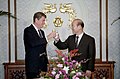 South Korean President Chun Doo-hwan with U.S. President Ronald Reagan in Seoul, November 1983 (from History of South Korea)
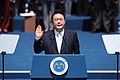 Yoon takes the presidential oath of office outside the National Assembly, 10 May 2022. (from History of South Korea)
 Inauguration of the 21st President of South Korea Lee Jae-myung. (from History of South Korea)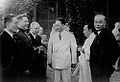
 Korean newspapers (from Culture of South Korea)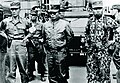
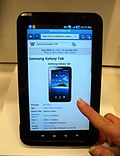 Samsung Galaxy Tab (from Culture of South Korea)
 A card portrait of Park Chung Hee during a military parade on Armed Forces Day, 1 October 1973 (from History of South Korea)
 An Internet cafe in Seoul (from Culture of South Korea)
 Fireworks during the closing ceremonies of the 1988 Summer Olympics (from History of South Korea)
 Sinchon movie theatre (from Culture of South Korea)
 Burial grounds of the victims of the Gwangju Uprising at Mangwol-dong cemetery (from History of South Korea)
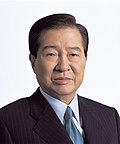 President Kim Dae-jung, the 2000 Nobel Peace Prize recipient for advancing democracy and human rights in South Korea and East Asia and for reconciliation with North Korea, was sometimes called the "Nelson Mandela of Asia." (from History of South Korea)
 President Park Geun-hye with chaebol business magnates Lee Kun-hee and Chung Mong-koo, May 2013 (from History of South Korea)


_Presidential_Portrait.jpg)

.jpg)

.jpg)


Did you know (auto-generated)

- ... that a 1586 letter from a grieving pregnant widow to her deceased husband became a sensation in South Korea after it was rediscovered in 1998?
- ... that South Korean actress Na O-mi's stage name was inspired by the song "I Dream of Naomi"?
- ... that North Korean footballer Tak Yong-bin scored the winning goal in the last match that South Korea played in the North for 29 years?
- ... that the Indonesia–Korea Comprehensive Economic Partnership Agreement covered access to South Korean online video games in Indonesia?
- ... that Imsil Cheese Theme Park cost over ₩39 billion to build?
- ... that Cho Myung-chul was the first North Korean defector to be elected to the South Korean National Assembly?
WikiProjects
See WikiProject Korea for collaborating on South Korea topics, and more broadly, on all things Korea-related.
Categories


.svg)


.svg)


Related portals


.svg)
East Asia


Associated Wikimedia
The following Wikimedia Foundation sister projects provide more on this subject:
-
 Commons
Free media repository -
 Wikidata
Free knowledge base -
 Wikiquote
Collection of quotations -
 Wikisource
Free-content library -
 Wikiversity
Free learning tools -
 Wikivoyage
Free travel guide -
 Wiktionary
Dictionary and thesaurus


Web resources
- The official website of the Republic of Korea (Korea.net)
- The Official Korea Tourism Guide Site
- Korea National Statistical Office
- Video on South Korea-US Relations from the Dean Peter Krogh Foreign Affairs Digital Archives
- "South Korea". The World Factbook (2025 ed.). Central Intelligence Agency.
- A Country Study: South Korea in the Library of Congress
- South Korea from UCB Libraries GovPubs
- Korea OECD
- South Korea profile from the BBC News
- South Korea Encyclopædia Britannica entry
- The War Memorial of Korea
- Key Development Forecasts for South Korea from International Futures
Sources


