Portal:Tornadoes
Wikipedia portal for content related to Tornadoes
From Wikipedia, the free encyclopedia

The Tornadoes Portal

Tornadoes are violently rotating columns of air that are in contact with the Earth and either a cumulonimbus or a cumulus cloud. Tornadoes are often called twisters, whirlwinds, or cyclones. While most tornadoes contain winds of less than 110 miles per hour (180 km/h), are about 250 feet (80 m) across, and travel a few miles (several kilometers), the wind speeds in the most intense tornadoes can reach 300 miles per hour (480 km/h), are more than two miles (3 km) in diameter, and stay on the ground for dozens of miles (more than 100 km). Various types of tornadoes include the multiple vortex tornado, landspout, and waterspout. Other tornado-like phenomenons that exist in nature include the gustnado, dust devil, fire whirl, and steam devil. Most tornadoes occur in North America (in the United States and Canada), concentrated in a region nicknamed Tornado Alley. Tornadoes also occur in South America, South Africa, Europe, Asia, and Oceania.
Selected tornado article -

The 1999 Bridge Creek–Moore tornado was a large, long-lived, and exceptionally violent F5 tornado that produced the highest tornado wind speed ever recorded by doppler weather radar—321 miles per hour (517 km/h), measured by a Doppler on Wheels (DoW). One of the strongest tornadoes ever recorded to affect a metropolitan area, the tornado devastated southern portions of Oklahoma City, Oklahoma as well as surrounding municipalities to the south and southwest of the city during the early evening of Monday, May 3, 1999. The tornado covered 38 miles (61 km) during its 85-minute existence, destroying thousands of homes, killing 36 people (plus another five indirectly), and causing US$1 billion (1999 USD) in damage, ranking it as the fifth-costliest on record not accounting for inflation. Its severity prompted the first-ever use of the tornado emergency statement by the National Weather Service.
The tornado first touched down at 6:23 p.m. Central Daylight Time (CDT) in Grady County, roughly two miles (3.2 km) south-southwest of the town of Amber. It quickly intensified into a violent F4, and gradually reached F5 status after traveling 6.5 miles (10.5 km), at which time it struck the town of Bridge Creek, where parts of the community were rendered unrecognizable. It fluctuated in strength, ranging from F2 to F5 status before it crossed into Cleveland County where it reached F5 intensity for a third time shortly before entering the city of Moore. By 7:30 p.m., the tornado crossed into Oklahoma County and battered southeastern Oklahoma City, Del City, and Midwest City before dissipating around 7:48 p.m. just outside Midwest City. The greatest impacts from this tornado occurred near peak intensity in the densely populated southern suburbs and exurbs of the Oklahoma City metropolitan area. A total of 8,132 homes, 1,041 apartments, 260 businesses, eleven public buildings, and seven churches were damaged or destroyed. (Full article...)
Selected tornado list -
The tornado outbreak of March 28–31, 2007, also known as the Late-March 2007 tornado outbreak, was a tornado outbreak that took place across the central United States. It developed in the High Plains from South Dakota to central Texas on March 28, 2007, which produced most of the tornadoes. Several more tornadoes were reported the next three days before the system weakened on March 31. It affected western Nebraska, western Kansas, extreme eastern Colorado, and much of Oklahoma, and Texas. It was the second major outbreak of 2007, four weeks after an outbreak farther east. The outbreak produced 80 confirmed tornadoes, with five deaths and extensive damage being reported. In addition to the tornadoes, widespread hail as large as softballs and destructive straight-line winds as strong as 90 mph (140 km/h) were reported.
The activity level was very uncertain for March 29, as it was conditional on the dry line refiring. Despite the squall line remaining intact, several more tornadoes developed. Several more tornadoes developed on March 30 and 31 before the system weakened. (Full article...)
Selected image -

Selected tornado year -

This page documents the tornadoes and tornado outbreaks of 1977, primarily in the United States. Most tornadoes form in the U.S., although some events may take place internationally. Tornado statistics for older years like this often appear significantly lower than modern years due to fewer reports or confirmed tornadoes. (Full article...)
Related portals


2026 tornado activity
(Full article...)
List of 2026 tornado articles |
|---|
Tornado anniversaries
May 1
- 1875 – A major tornado outbreak hit parts of Alabama, Georgia, and South Carolina, killing at least 58 people. The greatest loss of life was from an F3 tornado or tornado family that traveled 70 miles (110 km) across eastern Alabama and western Georgia, killing at least 22 people, including at least 13 (possibly as many as 26) on plantations in Talbot County, Georgia. Another tornado family killed at least 5 people, all in one family, in Chambers County, Alabama and another 10 in Troup and Meriwether Counties, Georgia.
- 1933 – An F4 tornado sounding like "mad lions on a speeding train" devastated Minden, Louisiana, killing 28 people, injuring 400, and damaging or destroying about 500 homes. Six others were killed when another F4 tornado devastated Arcadia, Louisiana. An F2 tornado carried away and destroyed a small house near Magnolia, Arkansas, killing an entire family of six.
May 2
- 1920 – An F4 tornado destroyed Peggs, Oklahoma, leaving only seven buildings standing. Of the population of 250 people, 71 were killed and 100 were injured. Because Peggs was not on a rail line, word of its destruction did not reach other towns for six hours.
- 1929 – The second day of a significant tornado outbreak killed at least 33 people across the Eastern United States. Thirteen people were killed when an F2 tornado caused the collapse of a school near Rye Cove, northwest of Gate City, Virginia. An F3 tornado damaged or destroyed all eight homes in the tiny town of Weaversville, Virginia, killing four, possibly five people, and killed two others in Lagrange.
May 3
- 1999 – A catastrophic F5 tornado destroyed portions of Oklahoma City and the nearby communities of Bridge Creek and Moore, killing 36 people and causing $1 billion in damage. At the time the costliest single tornado in U.S. history. A Doppler on Wheels recorded a world-record wind speed of 302 mph (486 km/h). This storm also prompted the first tornado emergency.
Did you know…
- ...that the 12-year gap between the 2013 Moore tornado and the 2025 Enderlin tornado, both of which were rated EF5, was the longest EF5 drought in recorded history?
- ...that the 2021 South Moravia tornado, an IF4 tornado with winds between 207–260 mph (333–418 km/h), was the strongest tornado to hit the Czech Republic in modern history?
- ...that five of the six people killed in the 2011 Cullman–Arab tornado were members of the same family?
- ...that Picher, Oklahoma, was hit so hard by a tornado in 2008 that it became a ghost town in 2015?
- ...that the 2022 Andover tornado injured only three people, despite damaging more than 1,000 buildings?
General images -
 Tornado debris signature from the Webberville, Michigan EF2 tornado, showing debris being lofted to about 25,000 feet (7,600 m). (from Tornadoes of 2023)
 EF4 damage to a construction company in Northwood, North Dakota. (from Tornadoes of 2007)
 Map of 2003 United States tornado paths. (from Tornadoes of 2003)
 EF1 damage to a warehouse in Montebello, California. (from Tornadoes of 2023)
 EF2 damage to a mobile home near Baskin, Louisiana. (from Tornadoes of 2019)
 A home destroyed at EF3 intensity north of Clarksville, with debris thrown 200 yards (180 m). (from Tornadoes of 2023)
 Remains of a home that was ripped from its raised pier foundation and leveled at low-end EF3 intensity in Lower Grand Lagoon, Florida. (from Tornadoes of 2024)
 A home destroyed by an EF2 tornado in Dubois County, Indiana. (from Tornadoes of 2011)
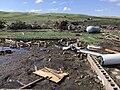 Mid-range EF3 tornado damage to a poorly constructed home southeast of Whitman, Nebraska. (from Tornadoes of 2024)
 St. John's Regional Medical Center in Joplin after the tornado. (from Tornadoes of 2011)
 Demolished home in Holly, Colorado on March 28, 2007 (from Tornadoes of 2007)
 EF2 damage to a home north of Happy, Texas. (from Tornadoes of 2021)
 A home completely swept away at EF4 intensity in Greenfield, Iowa. (from Tornadoes of 2024)
 EF3 damage to a home at a farmstead near Lake City, Iowa. (from Tornadoes of 2021)
 A poorly-anchored house that was leveled by a low-end EF3 tornado on the southeast side of Naperville, Illinois. (from Tornadoes of 2021)
 EF3 damage to a well-built brick home near Rocky Mount, Virginia. (from Tornadoes of 2019)
 Map of 1999 United States tornado paths. (from Tornadoes of 1999)
 A well-anchored two-story home swept away at low-end EF4 intensity near Tylertown, Mississippi. (from Tornadoes of 2025)
 An aircraft hangar completely swept away at low-end EF2 intensity in Seymour Airport. (from Tornadoes of 2025)
 EF4 damage to a well-built brick home in Beauregard, Alabama. This home was anchor-bolted to its foundation. (from Tornadoes of 2019)
 A large metal outbuilding that was destroyed at high-end EF2 intensity near Evansville, Wisconsin. (from Tornadoes of 2024)
 Map of tornadoes across Southeast Texas and southern Louisiana from January 1–2. (from Tornadoes of 1999)
 A manufactured home destroyed by the Nahunta, Georgia EF2 tornado. (from Tornadoes of 2024)
 High-end EF2 damage to a well-constructed shop building east of Marion, Louisiana. (from Tornadoes of 2025)
 President of Chile Gabriel Boric surveys EF1 tornado damage in Puerto Varas. (from Tornadoes of 2025)
 EF2 damage and ground scouring on the west side of Frazeysburg, Ohio. (from Tornadoes of 2024)
 Damage to homes in Norman, Oklahoma after a high-end EF2 tornado struck the area. (from Tornadoes of 2023)
 EF3 damage to the Caddo Mounds State Historic Site museum in Weeping Mary, Texas. One person was killed here and several others were injured. (from Tornadoes of 2019)
 Paths of the 148 tornadoes generated during the 1974 Super Outbreak. (from Tornadoes of 1974)
 EF3 damage to the Precision Materials manufacturing facility near Ohatchee, Alabama. (from Tornadoes of 2021)
 A pump jack that was overturned by an EF3 tornado west of Midkiff, Texas. (from Tornadoes of 2024)
 A mobile home that was destroyed at high-end EF2 intensity near Deer Lodge, Tennessee, resulting in two fatalities. (from Tornadoes of 2025)
 High-end EF2 damage to a small and poorly-anchored home near Neillsville, Wisconsin. (from Tornadoes of 2021)
 Significant damage in Rio Bonito do Iguaçu after a direct impact from an F4 tornado. (from Tornadoes of 2025)
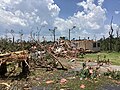 EF3 damage to a home near Louin, Mississippi. (from Tornadoes of 2023)
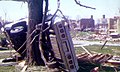 Damage from an F4 tornado in a Louisville neighborhood. (from Tornadoes of 1974)
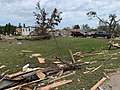 EF2 damage to houses in Port Austin, Michigan. (from Tornadoes of 2021)
 EF2 damage to electrical transmission towers west of Ripley, Mississippi. (from Tornadoes of 2023)
 High-end EF3 damage to a house in Coal City, Illinois. (from Tornadoes of 2015)
 Low-end EF3 damage to a home in Virginia Beach, Virginia. (from Tornadoes of 2023)
 High-end EF3 damage to a home where two fatalities occurred in Grissettown, North Carolina. (from Tornadoes of 2021)
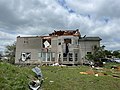 EF2 damage to a two-story house near Waxahachie, Texas. (from Tornadoes of 2021)
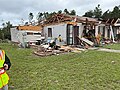 EF2 damage to a home in Crystal River, Florida. (from Tornadoes of 2023)
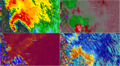 Radar scan of the EF3 Dortches, North Carolina tornado. A hook echo is visible on the top left and a debris signature on the bottom left. (from Tornadoes of 2023)
 A mobile home that was obliterated by an EF3 tornado in Waxia, Louisiana. (from Tornadoes of 2021)
 An EF3 tornado in Deuel County, South Dakota. (from Tornadoes of 2025)
 A home that was destroyed at high-end EF2 intensity north of Linneus, Missouri. (from Tornadoes of 2023)
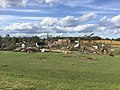 Denuded trees and EF3 damage to a home near Elk Mound, Wisconsin. (from Tornadoes of 2019)
 A two-story home south of Marion, Illinois swept away at high-end EF4 intensity. (from Tornadoes of 2025)
 Damage from an EF3 tornado in Shengze, China. (from Tornadoes of 2021)
 Doorbell camera still of a violent EF4 tornado that struck Diaz, Arkansas in the nighttime hours of March 14. (from Tornadoes of 2025)
 The Albany, New Zealand tornado caused significant damage to buildings in its path. (from Tornadoes of 2011)
 Damage in a residential area as a result of the EF4 Garland/Rowlett, Texas tornado. (from Tornadoes of 2015)
 Navy sailors cleaning up tree debris from the EF3 tornado at Fort Story, Virginia Beach. (from Tornadoes of 2023)
 A chart of the 2025 United States tornado local storm reports through December 30, compared to years 2010–2024 and the mean of those years. (from Tornadoes of 2025)
 Low-end EF4 tornado damage to a Homeland Grocery Store in Marietta, Oklahoma. (from Tornadoes of 2024)
 EF3 damage to a large metal-framed warehouse building at the Black River Electric Co-op in Fredericktown, Missouri. (from Tornadoes of 2021)
 EF3 damage to metal-truss electrical-transmission towers in Deer Park, Texas. (from Tornadoes of 2023)
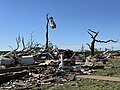 Low-end EF4 damage to a two-story home in Barnsdall, Oklahoma. (from Tornadoes of 2024)
 Severe damage to cars and an industrial building as a result of an F4 tornado in Lužice, Czech Republic. (from Tornadoes of 2021)
 A home that was swept off its foundation at low-end EF4 intensity in Newnan, Georgia. (from Tornadoes of 2021)
 Toppled trees and electrical poles from a tornado in Daet, Camarines Norte. (from Tornadoes of 2025)
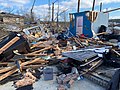 EF3 damage to a home in Fultondale, Alabama. (from Tornadoes of 2021)
 A home partially destroyed by an EF2 tornado near Mauriceville, Texas. (from Tornadoes of 2021)
 A home that was heavily damaged at EF2 intensity in Selma, Indiana. (from Tornadoes of 2024)
 The F2 tornado seen in Salt Lake City while being taken from a park nearby. (from Tornadoes of 1999)
 The remnants of Ida producing tornadoes and flash flooding in the Northeastern United States. (from Tornadoes of 2021)
 EF3 damage to a house near Columbia, Tennessee. (from Tornadoes of 2024)
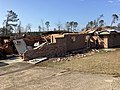 EF2 damage to a home northeast of Jonesboro, Louisiana. (from Tornadoes of 2023)
 An EF3 tornado near Lincoln, Nebraska on April 26. (from Tornadoes of 2024)
 An F3/IF1.5 tornado left a large scar through the Siberian forest. (from Tornadoes of 2025)
 Damage from the EF3 Mapleton, Iowa tornado. (from Tornadoes of 2011)
 Destroyed vehicles and equipment near Spiritwood, North Dakota. (from Tornadoes of 2025)
 A large barn completely destroyed at EF2 intensity. (from Tornadoes of 2025)
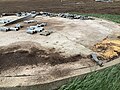 Remnants of a grain bin destroyed southwest of Lyons, Nebraska by an EF2 tornado. (from Tornadoes of 2023)
 Map of 2002 United States tornado paths. (from Tornadoes of 2002)
 EF2 damage to a structure west of Vichy, Missouri. (from Tornadoes of 2023)
 NEXRAD velocity imagery showing the paths of six tornadoes near Griffin, Georgia. The circulation in the red circle produced the main EF3 Griffin tornado, and the one in the pink produced the EF2 Jackson Lake tornado. (from Tornadoes of 2023)
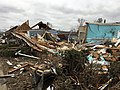 High-end EF2 damage to the First Presbyterian Church in Wetumpka, Alabama. (from Tornadoes of 2019)
 A double-wide mobile home destroyed by an EF2 tornado in Sand Springs, Oklahoma
 EF2 damage to a house near Custer City, Oklahoma. (from Tornadoes of 2019)
 EF2 damage to a church in Port Arthur, Texas. (from Tornadoes of 2024)
 A mobile home that was destroyed by an EF2 tornado in Hamilton, Georgia. (from Tornadoes of 2011)
 3D NEXRAD velocity scans showing the tornadogenesis of an EF1 tornado near Hollister, Oklahoma. (from Tornadoes of 2024)
 Photograph of the Rogers–Little Flock, Arkansas EF2 tornado on November 4. (from Tornadoes of 2024)
 EF3 damage to a house in Van, Texas. (from Tornadoes of 2015)
 High-end EF2 damage to a home near Watertown, South Dakota. (from Tornadoes of 2025)
 Damage to a hunting lodge near Taylor Landing, Texas from an EF3 tornado. (from Tornadoes of 2024)
 Cleanup after the tornado in Dumas, Arkansas. (from Tornadoes of 2007)
 A debarked tree just north El Reno, Oklahoma with various debris, including a car, piled at its base and severe ground scouring in the foreground. (from Tornadoes of 2011)
 EF5 tornado southeast of Enderlin, North Dakota on June 20. (from Tornadoes of 2025)
 All tornadoes confirmed during 2011. (from Tornadoes of 2011)
 EF3 tornado in Bennington, Nebraska. (from Tornadoes of 2025)
 A steel carport that was destroyed at EF3 intensity in Sanderson, Texas. (from Tornadoes of 2024)
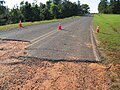 Road surface stripped by an EF5 tornado near Philadelphia, Mississippi. (from Tornadoes of 2011)
 A large multi-vortex tornado in rural Iowa. This EF4 tornado later struck Greenfield, Iowa. (from Tornadoes of 2024)
 A sports gymnasium partially destroyed by the tornado. (from Tornadoes of 2025)
 Major tree damage and an obliterated mobile home following an EF3 tornado near Whistler, Mississippi. (from Tornadoes of 2025)
 EF3 damage to a church in Lutts, Tennessee. (from Tornadoes of 2015)
 EF2 damage to an industrial building in Pasadena, Texas. (from Tornadoes of 2015)
 Map of mesocyclone/tornado paths during the 'Veterans Day outbreak' (from Tornadoes of 2002)
 Building at a chemical plant that was leveled by the second EF3 tornado near Pampa, Texas. (from Tornadoes of 2015)
 Tornado damage from the EF3 tornado at the Bear Paw Resort in northern Wisconsin. (from Tornadoes of 2007)
 EF2 damage to a garage near Bryant, Indiana. (from Tornadoes of 2021)
 The Cortijo El Sequero warehouse that collapsed, killing three workers inside. (from Tornadoes of 2025)
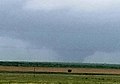 A large EF3 tornado that stuck the town of Ballinger, Texas on May 18, 2019. (from Tornadoes of 2019)
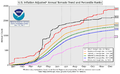 A graph of the number of tornadoes in 2011 compared to the average tornado season. (from Tornadoes of 2011)
 High-end EF2 damage to a home near McDonough, Georgia. (from Tornadoes of 2025)
 EF2 damage to a house in Mount Zion, Illinois. (from Tornadoes of 2025)
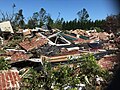 EF3 damage to a home in Mullica Hill, New Jersey. (from Tornadoes of 2021)
 Damage from one of the tornadoes near Tampa. (from Tornadoes of 2011)
 EF2 damage to a home that was shifted off its foundation and sustained partial roof loss southwest of Douglas, Georgia. (from Tornadoes of 2021)
 A farm outbuilding swept away by an EF4 tornado west of Pocahontas, Iowa on April 9. (from Tornadoes of 2011)
 A landspout tornado over Rusty Point, Alaska. (from Tornadoes of 2024)
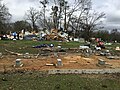 A mobile home destroyed by a high-end EF2 tornado near Kirby, Arkansas. (from Tornadoes of 2023)
 EF2 damage to a hotel in Henderson, Louisiana. (from Tornadoes of 2024)
 A two-story farmhouse was swept off its foundation near Gary, South Dakota. (from Tornadoes of 2025)
 A home completely destroyed at F5 intensity in Bridge Creek, Oklahoma. (from Tornadoes of 1999)
 A poorly constructed home destroyed at low-end EF3 intensity in Westmoreland, Kansas. (from Tornadoes of 2024)
 One of the many tornadoes to impact north-central Colorado on June 4th (from Tornadoes of 2015)
 The cyclone responsible for the historic outbreak on April 27. (from Tornadoes of 2011)
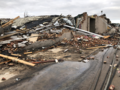 EF4 damage to well-built brick buildings in downtown Mayfield, Kentucky. (from Tornadoes of 2021)
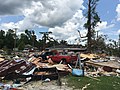 EF2 damage to mobile homes in East Brewton, Alabama. (from Tornadoes of 2021)
 EF3 damage to a house near Mize, Mississippi. (from Tornadoes of 2019)
 EF4 damage to the Rolling Fork, Mississippi, water tower. (from Tornadoes of 2023)
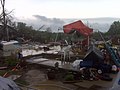 A house that was completely destroyed at EF4 intensity in the suburbs of St. Louis, Missouri. (from Tornadoes of 2011)
 Mobile home swept away at low-end EF2 intensity in Grinnell, Kansas. (from Tornadoes of 2025)
 EF2 damage to a home and trees on the southwest side of Jasper, Texas. (from Tornadoes of 2024)
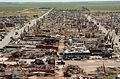 The center of Greensburg, Kansas, 12 days after being hit by an EF5 tornado. (from Tornadoes of 2007)
 High-end EF3 damage to a house east of Boscobel, Wisconsin. (from Tornadoes of 2021)
 High-end EF2 damage in Rome, New York on July 16, 2024. (from Tornadoes of 2024)
 The EF3 Springfield, Massachusetts tornado. (from Tornadoes of 2011)
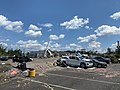 Flipped vehicles and EF3 damage to the Faulkner auto dealership in Trevose, Pennsylvania. (from Tornadoes of 2021)
 An EF3 tornado near Yuma, Colorado on August 8. (from Tornadoes of 2023)
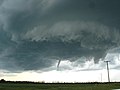 Funnel cloud that later produced the F5 tornado near Elie, Manitoba on June 22, 2007. (from Tornadoes of 2007)
 A mobile home that was destroyed at EF2 intensity on the east side of Valdosta, Georgia. (from Tornadoes of 2024)
 The windows of Cabalantian Church in Bacolor, Pampanga that were damaged by a tornado. (from Tornadoes of 2023)
 A mobile home swept away near Lubbock, Texas. (from Tornadoes of 2025)
 EF3 damage to a grocery store in Columbus, Mississippi. One person was killed at this location. (from Tornadoes of 2019)
 EF2 damage in Movico, Alabama. (from Tornadoes of 2023)
 A deadly EF5 tornado exiting Phil Campbell, Alabama shortly after causing devastating damage on April 27. (from Tornadoes of 2011)
 EF1 damage to homes and trees in Romeville, Louisiana. (from Tornadoes of 2024)
 High-end EF3 tree damage near Nickerson, Kansas. (from Tornadoes of 2015)
 Extensive tornado damage in Eastern Kansas on February 28, 2007. (from Tornadoes of 2007)
 A manufactured home slid off its foundation by the Eldorado, Illinois EF2 tornado. (from Tornadoes of 2024)
 An EF4 tornado near Hayti, Missouri. (from Tornadoes of 2021)
 The Dortches tornado captured by a dash-cam near Battleboro. (from Tornadoes of 2023)


.jpg)


.jpg)


.png)


.jpg)


.jpg)


.jpg)


.jpg)


.jpg)


.jpg)


 Featured Article or List -


The U.S state of Iowa experiences multiple tornadoes every year. There have been at least 3,422 recorded tornadoes since 1950. At least 2,340 people have been injured, and 100 people have died due to these tornadoes. There have been multiple tornadoes before 1950, but most of them are not recorded accurately or at all, but the most violent and deadliest tornadoes before 1950 have been recorded. The deadliest tornado was the Camanche tornado, which killed 72 people in Iowa.
2024 was a record-breaking year in Iowa. Iowa saw 125 tornadoes in 2024 which beat the previous record of 120 tornadoes in 2004. In April and May alone, Iowa saw 98 tornadoes, giving the months of April 2024 and May 2024 the second and third most tornadoes in a month, just before May 2004 which saw 57 tornadoes. (Full article...)
Topics
Subcategories

Related WikiProjects
The scope of WikiProject Severe weather is to write articles about severe weather, namely thunderstorms and tornadoes. Their talk page is located here.
WikiProject Weather is the main hub for all articles that are weather-related. WikiProject Weather strives to improve articles in a variety of weather topics, including Tropical Cyclones, Severe Weather, General meteorology, Non-tropical Storms, Climate, Floods, Droughts and wildfires, Meteorological instruments and data, Meteorological Biographies, and Space Weather. If you would like to help, please visit the project talk page.
WikiProject Meteorology is a collaborative effort by dozens of Wikipedians to improve the quality of meteorology- and weather-related articles. If you would like to help, visit the project talk page, and see what needs doing. The project is currently being merged into WikiProject Weather.
WikiProject Tropical cyclones is a daughter project of WikiProject meteorology. The dozens of semi-active members and several full-time members focus on improving Wikipedia's coverage of tropical cyclones.
Wikipedia is a fully collaborative effort by volunteers. So if you see something you think you can improve, be bold and get to editing! We appreciate any help you can provide!
Things you can do
 |
Here are some tasks awaiting attention:
|
Wikimedia
The following Wikimedia Foundation sister projects provide more on this subject:
-
 Commons
Free media repository -
 Wikidata
Free knowledge base -
 Wikiquote
Collection of quotations -
 Wikisource
Free-content library -
 Wikiversity
Free learning tools -
 Wikivoyage
Free travel guide -
 Wiktionary
Dictionary and thesaurus


