489 series
From Wikipedia, the free encyclopedia
| 489 series | |
|---|---|
 489 series on a Noto service in May 2007 | |
| In service | 1972–2012 |
| Replaced | KiHa 80 series |
| Constructed | 1971–1979 |
| Number in service | None |
| Number preserved | 2 vehicles |
| Operators | JNR (1972–1987) JR East(1987–2000) JR-West (1987–2012) |
| Depots | Kanazawa |
| Specifications | |
| Maximum speed | 120 km/h (75 mph) |
| Traction system | Resistor control |
| Electric system(s) | 1,500 V DC / 20 kV AC, 50/60 Hz |
| Current collection | overhead catenary |
| Braking system(s) | Dynamic brake, electro-pneumatic brake |
| Safety system(s) | ATS |
| Track gauge | 1,067 mm (3 ft 6 in) |
The 489 series (489系, 489-kei) was a limited express electric multiple unit (EMU) train type introduced in March 1972 by Japanese National Railways (JNR) in Japan, and later operated by East Japan Railway Company (JR East) and West Japan Railway Company (JR-West) until 2012.[1]
The 489 series trains were developed from the earlier 485 series specially for use on the Hakusan and Asama limited express services operating over the steeply graded Usui Pass (Yokokawa Station - Karuizawa Station of old JNR Shinetsu Main Line). They were designed to operate in multiple with the JNR Class EF63 electric banking locomotives.[1]
 A 489 series EMU on an Asama service in August 1997
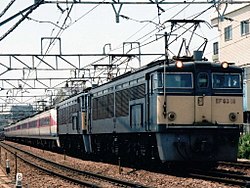 A 489 series EMU hauled by EF63 banking locomotives on an Hakusan service in June 1997


Formations
The nine-car sets operated by JR-West and based at Kanazawa depot for use on Noto and Hakutaka services were formed as shown below.[2]
| Car No. | 1 | 2 | 3 | 4 | 5 | 6 | 7 | 8 | 9 |
|---|---|---|---|---|---|---|---|---|---|
| Numbering | KuHa 489-500 | MoHa 488 | MoHa 489 | SaRo 489 | MoHa 488-200 | MoHa 489 | MoHa 488 | MoHa 489 | KuHa 489 |
| Facilities | Toilet | Phone / Toilet | Toilet | Lounge area | Toilet | ||||
Cars 2, 5, and 7 were each fitted with two lozenge-type pantographs.[2]


