Portal:Germany
Wikipedia portal for content related to Germany
From Wikipedia, the free encyclopedia

Welcome to the Germany Portal!
Willkommen im Deutschland-Portal!
.svg) |
 |
 | |
Germany (German: Deutschland), officially the Federal Republic of Germany (German: Bundesrepublik Deutschland), is a country in Central and Western Europe, lying between the Baltic Sea and the North Sea to the north with the Alps to the south. It borders Denmark to the north, Poland and the Czech Republic to the east, Austria and Switzerland to the south, France to the southwest, and Luxembourg, Belgium and the Netherlands to the west.
Germany includes 16 constituent states, covers an area of 357,596 square kilometres (138,069 sq mi) and has a largely temperate seasonal climate. With over 83 million inhabitants, it is the second most populous state of Europe after Russia, the most populous state lying entirely in Europe, as well as the most populous member state of the European Union. Germany is a very decentralized country. Its capital and most populous city is Berlin, while Frankfurt serves as its financial capital and has the country's busiest airport.
In 1871, Germany became a nation-state when most of the German states unified into the Prussian-dominated German Empire. After World War I and the Revolution of 1918–19, the Empire was replaced by the parliamentary Weimar Republic. The Nazi seizure of power in 1933 led to World War II and the Holocaust. After the end of World War II in Europe and a period of Allied occupation, two new German states were founded: West Germany, formed from the American, British, and French occupation zones, and East Germany, formed from the western part of the Soviet occupation zone, reduced by the newly established Oder-Neisse line. Following the Revolutions of 1989 that ended communist rule in Central and Eastern Europe, the country was reunified on 3 October 1990.
Germany is a federal parliamentary republic led by a chancellor. It is a great power with the largest economy in Europe. As a global leader in several industrial, scientific and technological sectors, it is a major trading nation. The Federal Republic of Germany was a founding member of the European Economic Community in 1957 and the European Union in 1993. Read more...
Selected article
.jpg)
Ludwigsburg Palace, nicknamed the "Versailles of Swabia", is a 452-room palace complex of 18 buildings located in Ludwigsburg, Baden-Württemberg, Germany. Its total area, including the gardens, is 32 ha (79 acres) – the largest palatial estate in the country. The palace has four wings: the northern wing, the Alter Hauptbau, is the oldest and was used as a residence of the Duke of Württemberg; the east and west wings were used for court purposes and housing guests and courtiers; the southern wing, the Neuer Hauptbau, was built to house more court functions and was later used as a residence.
Eberhard Louis, Duke of Württemberg, appointed Philipp Joseph Jenisch to direct the work, and construction began in 1704. In 1707, Jenisch was replaced by Johann Friedrich Nette, who completed most of the palace and surrounding gardens. Nette died in 1714, and Donato Giuseppe Frisoni finished much of the palace façades. In the final year of construction, Eberhard Louis died, and the Neue Hauptbau's interiors were left incomplete. Charles Eugene's court architect, Philippe de La Guêpière, completed and refurbished parts of the New Hauptbau in the Rococo style, especially the palace theatre. Charles Eugene abandoned the palace for Stuttgart in 1775. Duke Frederick II, later King Frederick I, began using Ludwigsburg as his summer residence in the last years of Charles Eugene's reign. Frederick and his wife Charlotte, Princess Royal, resided at Ludwigsburg and employed Nikolaus Friedrich von Thouret to renovate the palace in the Neoclassical style. Thouret converted much of Ludwigsburg's interiors over the reign of Frederick and the later life of Charlotte. As a result of each architect's work, Ludwigsburg is a combination of Baroque, Rococo, Neoclassical, and Empire style architecture. (Full article...)
Selected picture
 Painting credit: Karl Friedrich SchinkelKarl Friedrich Schinkel (1781–1841) was a Prussian architect and city planner. He was one of the most prominent architects in Germany and designed both Neoclassical and Neo-Gothic buildings, the most famous of which are found in and around Berlin. He was also a painter and a designer of furniture and stage sets.
This oil-on-canvas painting, entitled Castle by the River, was created by Schinkel in 1820. As an artist, his architectural talent shone through, and his buildings and landscapes are carefully drafted and meticulously executed. The painting is in the collection of the Alte Nationalgalerie in Berlin. Photograph credit: Lt. Moore; restored by Adam CuerdenThe German Instrument of Surrender was the legal document that effected the termination of the Nazi regime and ended World War II in Europe. A July 1944 draft version had also included the surrender of the German government, but this was changed due to concern that there might be no functional German government that could surrender; instead, the document stated that it could be "superseded by any general instrument of surrender imposed by, or on behalf of the United Nations", which was done the next month.
This photograph shows Field Marshal Wilhelm Keitel signing the German Instrument of Surrender in Berlin. The first surrender document was signed on 7 May 1945 in Reims by General Alfred Jodl, but this version was not recognized by the Soviet High Command and a revised version was required. Prepared in three languages on 8 May, it was not ready for signing in Berlin until after midnight; consequently, the physical signing was delayed until nearly 1:00 a.m. on 9 May, and backdated to 8 May to be consistent with the Reims agreement and public announcements of the surrender already made by Western leaders. Photograph: Henry W. LaurischKadavar are a rock band from Berlin, Germany, founded in 2010. Their retro sound, incorporating psychedelic rock and stoner rock, has been compared to bands of the 1970s hard rock/heavy metal era. Kadavar currently consists of three members: guitarist and lead vocalist Christoph "Lupus" Lindemann, drummer Christoph "Tiger" Bartelt, and bassist Simon "Dragon" Bouteloup.
 Wanderer above the Sea of Fog is an 1818 painting by Caspar David Friedrich, a German Romantic. It has been read as a metaphor for the uncertainty of the future.

Wind beeches on the Schauinsland in the Black Forest 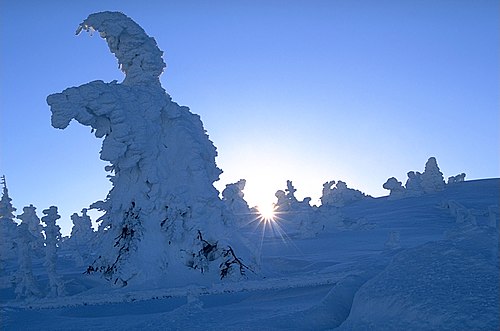
Snowed trees on the Brocken Snowed trees on the Brocken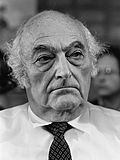 Photograph: Marcel Antonisse / AnefoHelmut Flieg (1913–2001) was a German writer best-known by the pseudonym Stefan Heym. He lived in the United States (or served in its army abroad) between 1935 and 1952, before moving back to his native Germany. He published works in English and German at home and abroad, including Nazis in the U.S.A. (1938), Goldsborough (1953), and Five Days in June (1977).
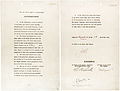 The German Instrument of Surrender, the main portion of which was signed at Reims, France, at 02:41 on 7 May 1945, was the legal instrument that established the armistice ending World War II in Europe. It was signed by representatives of the Oberkommando der Wehrmacht, the Allied Expeditionary Force and Soviet High Command. Another act of military surrender was signed, shortly before midnight, on 8 May in the outskirts of Berlin, Germany, at the insistence of the Soviets.
 Photo credit: Karsten DörreA twilight panorama of Regensburg, Bavaria, Germany with the 12th century bridge Steinerne Brücke and Regensburg Cathedral on the left and the river Danube in the foreground. Located at the confluence of the Danube and Regen rivers, the first settlements in the area date to the Stone Age. A Roman fort was constructed in 179. In contrast to almost all other major German cities, Regensburg had little damage from Allied air raids in World War II and thus has an almost intact medieval city center, which is listed as a UNESCO World Heritage Site.
Bamberg Cathedral Credit: Unknown authorBamberg Cathedral in 1880 Photo credit: Daniel SchwenSparrenburg Castle, located in Bielefeld, Germany, as seen from the western lawn. The castle was constructed between 1240 and 1250 by the Counts of Ravensberg. The castle has been rebuilt many times. Although often under siege, it was never stormed. After extensive restoration work, the castle now presents itself as an imposing historic site.
 Banknote design credit: Danzig Central Finance Department; photographed by Andrew ShivaThe Papiermark is the name given to the German currency from 4 August 1914, when the link between the Goldmark and gold was abandoned. In particular, the name is used for the banknotes issued during the period of hyperinflation in Germany in 1922 and especially 1923. During this period, the Papiermark was also issued by the Free City of Danzig. The last of five series of the Danzig mark was the 1923 inflation issue, which consisted of denominations of 1 million to 10 billion issued from August to October 1923. The Danzig mark was replaced on 22 October 1923 by the Danzig gulden.
This ten-billion-mark banknote, issued on 11 October 1923, is in the National Numismatic Collection of the Smithsonian Institution's National Museum of American History.
Other denominations:
'"`UNIQ--templatestyles-0000001A-QINU`"'
Interior of the Ulm Minster Interior of the Ulm Minster, Ulm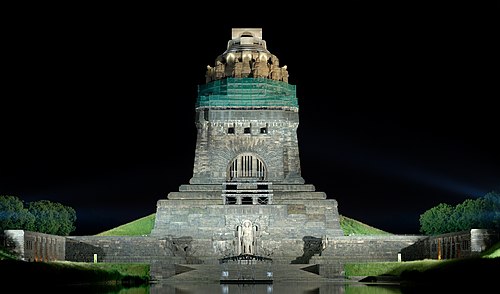
Völkerschlachtdenkmal in Leipzig A night shot of the Völkerschlachtdenkmal (Monument of the Battle of the Nations) in Leipzig, Germany.
Shaft 12 of Zollverein Coal Mine Industrial Complex, Essen Shaft 12 of Zeche Zollverein, a coal mine in Essen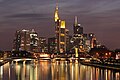 The night skyline of Frankfurt, showing the Commerzbank Tower (centre) and the Maintower (right of centre). Frankfurt is the fifth-largest city in Germany, and the surrounding Frankfurt Rhein-Main Region is Germany's second-largest metropolitan area.
 Photograph credit: Nicola Perscheid; restored by Adam CuerdenPaul von Hindenburg (2 October 1847 – 2 August 1934), was a German general and statesman who led the Imperial German Army during World War I. In 1925, he returned to public life to become the second elected president of the Weimar Republic. While he was personally opposed to Adolf Hitler and his Nazi Party, he nonetheless played a major role in the political instability that resulted in their rise to power, ultimately agreeing to appoint Hitler as Chancellor of Germany in January 1933 after the Nazis had become the largest party in the Reichstag. This 1914 photograph of Hindenburg in military uniform was taken by the German photographer Nicola Perscheid.
 Painting: Hans BaluschekCity of Workers is an oil painting on canvas completed by the Berlin Secessionist painter Hans Baluschek in 1920. It depicts a dark and dirty working class sector of the German capital, Berlin, in which industrial smoke dominates the skyline and the few lights of windows are drowned in the gloom. The 48.44 × 36.25 in (123 × 92.1 cm) work is held at the Milwaukee Art Museum.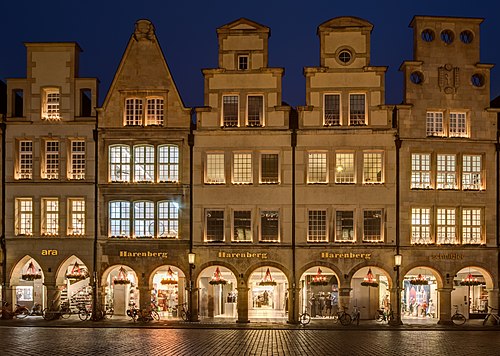
The Prinzipalmarkt in Münster The Prinzipalmarkt in Münster at night Photograph: Thomas WolfCharlottenburg Palace is a large palace in Charlottenburg, a part of the Charlottenburg-Wilmersdorf borough of Berlin, Germany. The palace was built at the end of the 17th century and expanded during the 18th century. It includes much exotic internal decoration in baroque and rococo styles. It was badly damaged during the Second World War, but has since been reconstructed, becoming a major tourist attraction.
 Photo credit: Chris 73The Cathedral of Magdeburg (known as Magdeburger Dom in German) is the first gothic cathedral in Germany and with a height of 104 m the highest cathedral in Eastern Germany. The current cathedral was constructed over the period of 300 years starting from 1209, and the completion of the steeples took place only in 1520. In 2004 a funding drive for a new organ that was started in 1997 was completed, collecting 2 Million Euro. The new organ has been ordered from a company near Potsdam, constructing a 36 ton instrument with 93 registers and approximately 5000 pipes. The construction is planned to be completed in 2007, and the new organ will hopefully be used for the first time in 2008.
 Design credit: German New Guinea Company; photographed by the National Numismatic CollectionGerman New Guinea was a German colonial protectorate established in 1884 in the northeastern part of the island of New Guinea and several nearby island groups. The German New Guinea Company was founded in Berlin by Adolph von Hansemann and a syndicate of German bankers for the purpose of colonizing and exploiting the protectorate's resources. This gold coin, worth 20 New Guinean marks, was issued by the German New Guinea Company in 1895, and is now part of the National Numismatic Collection at the Smithsonian Institution.


.jpg)


.jpg)

.jpg)


_von_Nicola_Perscheid.jpg)
.jpg)

.jpg)


Related portals
- Parent portals
.svg)

- Regional


- History
 Holy Roman Empire (900–1806)
 East Germany (1949–1990)


- Neighbouring countries


Anniversaries for June 20
.crop.jpg)
- 1808 – Birth of rabbi Samson Raphael Hirsch
- 1819 – Birth of composer Jacques Offenbach
- 1887 – Birth of artist Kurt Schwitters
- 1940 – Birth of theologian Eugen Drewermann
- 1941 – Birth of astronaut Ulf Merbold, first West German in space
Did you know...

- ... that Beethoven's "Tremate, empi, tremate" was not performed for ten years after it was written?
- ... that the 1935 Free City of Danzig parliamentary election was seen as a setback for the Nazi Party, even though it won an absolute majority of seats?
- ... that every year in July, a whole German town is taken over by the Rudolstadt Festival and swept up in "folk fever"?
- ... that the pianist Alide Topp (pictured) once responded to claims that women lacked the "biceps of a man" for great music by stating she broke her pianos as well as any man?
- ... that Bernhard Waldenfels discussed "black holes of everyday life" in a book subtitled Challenges of Phenomenology?
- ... that Agostino Steffani missed the 1709 premiere of his opera Amor vien dal destino because he was in Rome mediating between the pope and the emperor?
- ... that Ruth Wagner, the minister of culture in Hesse from 1999 to 2003, was nicknamed Mother Courage of Hesse?
- ... that mathematician Grete Hermann wrote political philosophy articles for Der Funke and Sozialistische Warte under various pseudonyms during the German resistance to Nazism?
Germany news

- 16 June 2026 – 2026 FIFA World Cup
- In association football, Argentine forward and captain Lionel Messi becomes the first male player to appear in six FIFA World Cups and joins Germany's Miroslav Klose as the tournament's all-time leading scorer with 16 goals after scoring a hat-trick in Argentina's 3–0 win against Algeria in their opening match. (AFP via ABS-CBN News)
- 14 June 2026 – 2026 FIFA World Cup, Curaçao at the FIFA World Cup
- In association football, Curaçao, the smallest nation to qualify for a FIFA World Cup, make their tournament debut and score their first-ever goal in a 7–1 defeat against Germany. (Yahoo! Sports)
- 8 June 2026 – Sudanese civil war
- A U.S.-led coalition consisting of Belgium, France, Germany, Greece, Italy, Norway, and the United Kingdom endorses a civilian-led political dialogue for Sudan to end the war under the facilitation of the African Union, the Arab League, the European Union, IGAD, and the United Nations. (Capital FM Kenya) (Radio Tamazuj)
- 6 June 2026 – 2026 Ebola epidemic
- The American physician who contracted Ebola in the Democratic Republic of the Congo is discharged from the Charité hospital in Berlin, Germany. (The Independent)
- 3 June 2026 –
- German filmmaker Wim Wenders withdraws his 1975 film The Wrong Move from distribution after actress Nastassja Kinski objected to a nude scene filmed when she was 13 years old, calling for the film to be re-edited. (AP)
Selected cuisines, dishes and foods

Sauerbraten (pronounced [ˈzaʊ̯ɐˌbʁaːtn̩] ⓘ) is a traditional German roast of heavily marinated meat. It is regarded as a national dish of Germany, and is frequently served in German-style restaurants internationally. It can be cooked from a variety of meats, most often from beef, but also from chicken, lamb and mutton, pork and horse. Before cooking, the raw meat is marinated for 5 to 15 days in a mixture of wine or vinegar, water, herbs, spices, and seasonings. Usually, tougher cuts of meat, such as rump roast or bottom round of beef, are used, and the long marinating tenderizes the meat. A Sauerbraten dinner is almost always accompanied by a hearty gravy resulting from its roasting and is most often served with potato pancakes (Kartoffelpuffer), potato dumplings (Kartoffelklöße), or Spätzle.
Ingredients used in the marinade, and accompaniments served with sauerbraten, vary across regions. Regional variants of the dish include those from Baden, Franconia, Thuringia, Rhineland, Saarland, Silesia, and Swabia. (Full article...)Topics
Categories

Things you can do

A list of articles needing cleanup associated with this project is available. See also the tool's wiki page and the index of WikiProjects.
Here are some tasks you can do. Please remove completed tasks from the list.
- Requests: German Archaeological Institute at Rome, Deutsche Familienversicherung, Hermann Bachmann (Journalist), Dietlof von Arnim-Boitzenburg, Rolf von Bargen, Hennes Bender, Eduard Georg von Bethusy-Huc, Rolf Brandt (1886–1953), Jan Philipp Burgard, Rudolf Epp, Lisa Feller, Georg Gafron, Ferdinand Heribert von Galen, Gundula Gause, Wolfgang von Geldern, Karl-Heinz Hagen, Herbert Helmrich, Nils von der Heyde, Monty Jacobs (1875–1945), Siegfried Kauder, Klimbim Matze Knop, Wolfgang Kryszohn, Claus Larass, Isidor Levy (1852–1929), Richard Lewinsohn (1894-1968), Markus Löning, Tobias Mann, Julius Meyer (Kunsthistoriker), Mathias Müller von Blumencron ,Günther Nonnenmacher, Nord bei Nordwest, Günter von Nordenskjöld, Anke Plättner, Hans Heinrich X. Fürst von Pless, Günter Prinz, Ulrich Reitz, Hans Sauer (inventor), Franz August Schenk von Stauffenberg, Paul Schlesinger (1878-1928), Hajo Schumacher, Der Seewolf (1971), Otto Theodor von Seydewitz, Christoph Sieber (comedian), Dorothea Siems, Werner Sonne, Udo zu Stolberg-Wernigerode, Christoph Strässer, Karl Trimborn, Joseph von Utzschneider, Hedda von Wedel, Jürgen Wieshoff, Hans Wilhelmi, Dietmar Wischmeyer, Doris Wittner (1880-1937), Alexandra Würzbach
- Unreferenced: especially Unreferenced BLPs
- Cleanup: 53541 issues in total as of 2024-03-03
- Translate: Articles needing translation from German Wikipedia
- Stubs: the largest stub category is Category:German history stubs; see also 108 articles in Category:German MEP stubs
- Update: Deutsches Wörterbuch
- Portal maintenance: Update News, Did you know, announcements and the todo list
- Orphans:
Orphaned articles in Germany

- Photo: Take/Add requested photographs
- Help assess the quality of 834 unassessed articles

Associated Wikimedia
The following Wikimedia Foundation sister projects provide more on this subject:
-
 Commons
Free media repository -
 Wikidata
Free knowledge base -
 Wikiquote
Collection of quotations -
 Wikisource
Free-content library -
 Wikiversity
Free learning tools -
 Wikivoyage
Free travel guide -
 Wiktionary
Dictionary and thesaurus


