Portal:20th Century Studios
Wikipedia portal for content related to 20th Century Studios
From Wikipedia, the free encyclopedia

The 20th Century Studios Portal
.svg)

20th Century Studios, Inc., formerly Twentieth Century Fox Film Corporation, is an American film production and distribution company currently owned by the Walt Disney Studios, the film studios division of the Disney Entertainment business segment of the Walt Disney Company. It was headquartered at the Fox Studio Lot in the Century City area of Los Angeles, until its lease with Fox Corporation ended and it was relocated to the Walt Disney Studios in Burbank. Walt Disney Studios Motion Pictures distributes and markets the films produced by this studio in theatrical markets.
For 90 years, 20th Century has been one of the major American film studios. It was founded on May 31, 1935, by the merger of Fox Film Corporation and Twentieth Century Pictures, and was one of the original "Big Five" among eight majors of Hollywood's Golden Age. In 1985, it was acquired by Rupert Murdoch's News Corporation, which was renamed 21st Century Fox in 2013 after it spun off its publishing assets. Disney purchased most of 21st Century Fox's assets, which included 20th Century Fox, on March 20, 2019. The studio adopted its current name on January 17, 2020, in order to avoid confusion with Fox Corporation, and subsequently started to use it for the copyright of 20th Century and Searchlight Pictures productions on December 4. 20th Century is currently one of five live-action film studios within the Walt Disney Studios, alongside Walt Disney Pictures, Marvel Studios, Lucasfilm, and its sister speciality unit, Searchlight Pictures. 20th Century also releases animated films produced by its animation division, 20th Century Animation.
The most commercially successful film franchises from 20th Century include the first six Star Wars films, X-Men, Ice Age, Avatar, and Planet of the Apes. Additionally, the studio's library includes many notable films such as The Sound of Music and Titanic, both of which won the Academy Award for Best Picture and became the highest-grossing films of all time during their initial releases. (Full article...)
Selected article


Following the release of Return of the Jedi, Lucas was unmotivated to return to the franchise and continue the story beyond Return of the Jedi, though the backstory he created on Anakin sparked interest in him to develop a prequel trilogy. After he determined that computer-generated imagery (CGI) had advanced to the level he wanted for the prequel trilogy's visual effects, Lucas began writing The Phantom Menace in 1993 and production began in 1994. Filming started on June 26, 1997, at locations including Leavesden Film Studios and the Tunisian desert and ended on September 30. The film was Lucas's first directorial effort after a 22-year hiatus following the original Star Wars in 1977.
The Phantom Menace was released in theaters on May 19, 1999, almost 16 years after the premiere of Return of the Jedi. The film's premiere was extensively covered by media and was greatly anticipated because of the large cultural following the Star Wars saga had cultivated. Upon its release, The Phantom Menace received mixed reviews. While the visual effects, action sequences, musical score, and some performances (particularly Neeson and McGregor) were praised, criticism was largely focused on the screenplay, direction, tone, pacing, and characters, most notably Jar Jar Binks. Despite the mixed reception, The Phantom Menace was a box office success and broke numerous box office records during its debut. It grossed more than $924.3 million worldwide during its initial theatrical run, becoming the highest-grossing film of 1999, the second-highest-grossing film worldwide and in North America (behind Titanic), and the highest-grossing Star Wars film at the time.
Selected image

Photo from the 1942 film Ten Gentlemen From West Point; Maureen O’Hara is shown at center.
General images -
 Alice Faye as Baroness Cecilia Duarte, Don Ameche as Larry Martin and Baron Manuel Duarte, and Carmen Miranda as Carmen in That Night in Rio, produced by Fox in 1941 (from 20th Century Studios)
 Former Fox Studio Lot in Century City, Los Angeles (from 20th Century Studios)
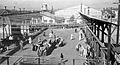 This large stage at the Fox Studio on North Western Avenue was used as the men's dressing room when more than 2,000 people were needed for the Jerusalem street scenes in Theda Bara's Salomé (1918) (from Fox Film)
 From the 1952 film Viva Zapata! (from 20th Century Studios)
 Founder William Fox (from Fox Film)
 A horizontal version of 20th Century Studios' current print logo, used for branding films (mainly Hulu/Star originals produced by them). The first film to use this was Vacation Friends. (from 20th Century Studios)
 The 20th Century-Fox logo depicted in a 1939 advertisement in Boxoffice (from 20th Century Studios)
 Title card from a 1935 Fox Movietone News newsreel (from Fox Film)
 Carmen Miranda as Dorita in The Gang's All Here. In 1946, she was the highest-paid actress in the United States. (from 20th Century Studios)
 Logo used as Twentieth Century Fox from 1985 to 2020. (from 20th Century Studios)
.jpg)

.jpg)

.svg)


Selected biography

Fonda made his mark early as a Broadway actor and made his Hollywood film debut in 1935. He rose to film stardom with performances in such films as; Jezebel (1938), Jesse James (1939), and Young Mr. Lincoln (1939). His career further progressed with his portrayal of Tom Joad in The Grapes of Wrath (1940), receiving a nomination for the Academy Award for Best Actor.
In 1941 he starred opposite Barbara Stanwyck in the screwball comedy classic The Lady Eve. Book-ending his service in WWII were his starring roles in two highly regarded Westerns: The Ox-Bow Incident (1943) and My Darling Clementine (1946), the latter directed by John Ford, and he also starred in Ford's Western Fort Apache (1948). After a seven-year break from films, during which Fonda focused on stage productions, he returned with the WWII war-boat ensemble Mister Roberts (1955). In 1956, at the age of fifty-one, he played the title role as the thirty-eight-year-old Manny Balestrero in Alfred Hitchcock's thriller The Wrong Man. In 1957, he starred as Juror 8, the hold-out juror, in 12 Angry Men. Fonda, who was also the co-producer of this film, won the BAFTA award for Best Foreign Actor.
Did you know (auto-generated)

No recent additions
Selected quote

Topics
Recognized content


Subcategories

Related portals


.svg)


WikiProjects

- Parent projects
- Arts • Animation • Disney • Entertainment • Film • Television • Visual arts
- Main project
- 20th Century Studios
- Sub-projects
- Blue Sky Studios • Diary of a Wimpy Kid • Family Guy • Marvel
- Related Projects
- Alien • Biography • Comics • Fictional characters • Media franchises • Music • Video games • The Simpsons • Star Wars
Things you can do

- Requested articles: More...
- Stubs: Work on stubs in articles in 20th Century Studios stubs.
- Attention: See Category:20th Century Studios articles needing attention for any articles which may require attention.
- AfD Discussions: Monitor 20th Century Studios-related AfD discussions at Wikipedia:WikiProject Deletion sorting/20th Century Studios.
- Cleanup: A Century Studios.html cleanup listing for this project is available. See also Century Studios.html the list by category, the tool's wiki page and the index of WikiProjects.
- Infobox: See Category:20th Century Studios articles needing infoboxes for any articles which may require an infobox.
- Article alerts subpage - Monitor article alerts, for more information see Wikipedia:Article alerts
- Tag the talk pages of 20th Century Studios-related articles with the {{WikiProject 20th Century Studios}} banner.
- Rate the Unassessed 20th Century Studios articles, Unknown-importance 20th Century Studios articles and articles where an assessment has been requested.
- Notability: Articles with notability concerns, listed at WikiProject Notability
Associated Wikimedia
The following Wikimedia Foundation sister projects provide more on this subject:
-
 Commons
Free media repository -
 Wikidata
Free knowledge base -
 Wikiquote
Collection of quotations -
 Wikisource
Free-content library -
 Wikiversity
Free learning tools -
 Wikivoyage
Free travel guide -
 Wiktionary
Dictionary and thesaurus


_01.jpg)

_-_Restoration.jpg)