Portal:Television
Wikipedia portal for content related to Television
From Wikipedia, the free encyclopedia

The Television Portal

Television (TV) is a telecommunication medium for transmitting moving images and sound. Additionally, the term can refer to a physical television set rather than the medium of transmission. Television is a mass medium for advertising, entertainment, news, and sports. The medium is capable of more than "radio broadcasting", which refers to an audio signal sent to radio receivers.
Television became available in crude experimental forms in the 1920s, but only after several years of further development was the new technology marketed to consumers. After World War II, an improved form of black-and-white television broadcasting became popular in the United Kingdom and the United States, and television sets became commonplace in homes, businesses, and institutions. During the 1950s, television was the primary medium for influencing public opinion. In the mid-1960s, color broadcasting was introduced in the U.S. and most other developed countries.
In 2013, 79% of the world's households owned a television set. The replacement of earlier cathode-ray tube (CRT) screen displays with compact, energy-efficient, flat-panel alternative technologies such as LCDs (both fluorescent-backlit and LED), OLED displays, and plasma displays was a hardware revolution that began with computer monitors in the late 1990s. Most television sets sold in the 2000s were still CRT, and it was only in early 2010s that flat-screen TVs decisively overtook CRT. Major manufacturers announced the discontinuation of CRT, Digital Light Processing (DLP), plasma, and even fluorescent-backlit LCDs by the mid-2010s. LEDs are being gradually replaced by OLEDs. Also, major manufacturers have started increasingly producing smart TVs in the mid-2010s. Smart TVs with integrated Internet and Web 2.0 functions became the dominant form of television by the late 2010s.[better source needed] (Full article...)
Selected article -

Selected image -

A newscast typically consists of the coverage of various news events and other information, either produced locally in a radio or television station newsroom, or by a broadcast network. It may also include such additional material as sports coverage, weather forecasts, traffic reports, commentary and other material that the broadcaster feels is relevant to their audience.
Did you know (auto-generated) -

- ... that the angel's wings in the live-action television-drama adaptation of One Room Angel took about a month to construct?
- ... that Pedro Berroeta Morales, a diplomat and later the president of a Venezuelan television channel, has also written fiction and essays on topics from science to esotericism?
- ... that Episode 8055 of the Australian television soap opera Neighbours is the first episode in the show's history to star and be directed and written entirely by women?
- ... that a Nebraska TV station stopped carrying live studio wrestling after wrestlers kicked a TV monitor?
- ... that to comply with broadcasting regulations, some American TV stations claimed that tabloid shows and a Christmas special were educational?
- ... that CBS executive Laurence Tisch found out on a tennis court in the U.S. Virgin Islands that rival network NBC had bought his company's affiliate station in Miami?
Selected quote -

More did you know

- ...that The Simpsons' history began when Matt Groening conceived of the dysfunctional family in the lobby of James L. Brooks's office?
- ...that Anne Montgomery, who has been a sportscaster for several local television stations as well as SportsCenter, was the first female football referee in Arizona?
- ...that Augie Hiebert not only built Alaska's first television station, KTVA, but also founded the state's first FM radio station, KNIK-FM?
- ...that the color signals of Israel Broadcasting Authority television transmissions were erased until 1981, to insure equality for families who couldn't afford color-tv?
- ...that British television programmes including Cluedo and The Forsythe Saga were partly filmed at Arley Hall in Cheshire?
Selected biography -
.jpg)
Aaron Benjamin Sorkin (born June 9, 1961) is an American screenwriter, playwright, and filmmaker. As a writer for stage, television, and film, he is recognized for his trademark fast-paced dialogue and extended monologues, complemented by frequent use of the storytelling technique called the "walk and talk". Sorkin has earned numerous accolades including an Academy Award, a BAFTA Award, five Primetime Emmy Awards, three Golden Globes, and two WGA Awards, in addition to a Laurence Olivier Award nomination.
Born in New York City, Sorkin developed a passion for writing at an early age. He rose to prominence as a writer-creator and showrunner of the television series Sports Night (1998–2000), The West Wing (1999–2006), Studio 60 on the Sunset Strip (2006–2007), and The Newsroom (2012–2014). He is also known for his work on Broadway including the plays A Few Good Men (1989), The Farnsworth Invention (2007), To Kill a Mockingbird (2018), and the revival of Lerner and Loewe's musical Camelot (2023). (Full article...)
General images
 An early Smart TV from 2012 running the discontinued Orsay platform (from History of television)
 Family watching TV, 1958 (from History of television)
 Manfred von Ardenne in 1933 (from History of television)
 An RCA Victor Color TV ad featuring milliner Lilly Daché in 1959. (from Color television)
 The earliest photograph of a television picture, showing the face of Oliver Hutchinson in June 1926. The television picture was projected using Baird's television camera. (from History of television)
 Hovannes Adamian c. 1900s (from Color television)
 RCA CT-100 at the SPARK Museum of Electrical Invention playing Superman. The RCA CT-100 was the first mass-produced color TV set. (from Color television)
 Samsung Smart TVs on display (from Smart TV)
 John Logie Baird in 1925 with his televisor equipment and dummies "James" and "Stooky Bill" (right) (from History of television)
 DBS satellite dishes (from History of television)
 The first mass-produced Czechoslovak TV-set Tesla 4001A (1953–57) (from History of television)
- Samsung's discontinued Orsay platform (from Smart TV)
 LG smart TV using the Web browser (from Smart TV)
 Philo Farnsworth in 1924 (from History of television)
 Comparison of image quality between ISDB-T (1080i broadcast, top) and NTSC (480i transmission, bottom) (from Digital television)
 This live image of actress Paddy Naismith was used to demonstrate Telechrome, John Logie Baird's first all-electronic color television system, which used two projection CRTs. The two-color image would be similar to the basic Telechrome system. (from Color television)
 LG Electronics smart TV from 2011 (from Smart TV)
 The Philco Predicta, 1958. In the collection of The Children's Museum of Indianapolis (from History of television)
 Tihanyi' Radioskop patent (1926) was recognized as Document of Universal Significance by the UNESCO (from History of television)
 First television test broadcast transmitted by the NHK Broadcasting Technology Research Institute in May 1939 (from History of television)
 Ad for the beginning of experimental television broadcasting in New York City by RCA in 1939 (from History of television)
 RCA 630-TS, the first mass-produced television set, which sold in 1946–1947 (from History of television)
 Color bars used in a test pattern, sometimes used when no program material is available (from History of television)
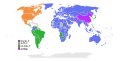 A map depicting digital terrestrial television standards (from Digital television)
 The Nipkow disk. This schematic shows the circular paths traced by the holes, which may also be square for greater precision. The area of the disk outlined in black shows the region scanned. (from History of television)
.jpg)


 Featured lists -


Swift at the 2024 Golden Globes
The American singer-songwriter Taylor Swift has appeared in various visual media. She has starred in 62 music videos, 15 of which she self-directed; released six documentaries, including four feature-length concert films; and acted in a number of fictional films, television shows, and commercial advertisements.
Trey Fanjoy directed several of Swift's award-winning music videos during her early career from 2006 to 2009. The music video for "Our Song" won Video of the Year at the 2008 CMT Music Awards. Swift's second studio album, Fearless (2008), was supported by the music videos for "Love Story" and "You Belong with Me". In 2009, the former won Video of the Year at both the CMT Music Awards and the Country Music Association Awards, and the latter won Best Female Video at the MTV Video Music Awards. Swift's first self-directed music video was for her 2010 album Speak Now's lead single, "Mine", which she directed with Roman White. (Full article...)- The Best Male Athlete with a Disability ESPY Award is an annual award honoring the achievements of a male individual from the world of disabled sports. Established with the aid of disability advocate and former United States Paralympic soccer player Eli Wolff, the accolade's trophy, designed by sculptor Lawrence Nowlan, is presented to the disabled sportsman adjudged to be the best at the annual ESPY Awards ceremony in Los Angeles. The Best Male Athlete with a Disability ESPY Award was first bestowed as part of the ESPY Awards in 2005 after the non-gender specific Best Athlete with a Disability ESPY Award was presented the previous three years (all won by sportsmen). Balloting for the award is undertaken by fans over the Internet from between three and five choices selected by the ESPN Select Nominating Committee, which is composed of a panel of experts. It is conferred in July to reflect performance and achievement over the preceding twelve months.
The inaugural winner of the Best Male Athlete with a Disability ESPY Award in 2005 which was won by Paralympic track and field competitor Marlon Shirley, who won two medals at the 2004 Summer Paralympics and was the first para-athlete to go below eleven seconds in the men's 100-meter category with a time of 10.97 seconds. In 2015, South African wheelchair racer Krige Schabort was selected as the recipient of the award. As of 2018[update], he is the only athlete born outside of the United States to have won the accolade, though three additional foreign sportsmen have since earned nominations. Track and field athletes have won more awards than any other sport with four with three triathlon winners and two winners each coming in sledge hockey, mixed martial arts, and wrestling. It was not awarded in 2020 due to the COVID-19 pandemic. The most recent winner of the award was American para-swimmer Brad Snyder in 2022. (Full article...) - The first season of The O.C. commenced airing in the United States on August 5, 2003, concluded on May 5, 2004, and consisted of 27 episodes. It tells the story of "the Cohen and Cooper families, and Ryan Atwood, a troubled teen from the wrong side of the tracks" who is thrust into the wealthy, harbor-front community of Newport Beach, Orange County, California and "will forever change the lives of the residents".
The first seven episodes of The O.C. aired in the United States on Tuesdays at 9:00 p.m. on Fox. Following a seven-week mid-season hiatus, the remainder of the season aired on Wednesdays at 9:00 pm. The season was released on DVD as a seven disc boxed set under the title of The O.C.: The Complete First Season on September 26, 2004, by Warner Home Video. On June 17, 2008, the season became available to purchase for registered users of the US iTunes Store. (Full article...) 
Beyoncé at the Renaissance World Tour in 2023. Performances from this tour were filmed for the self-directed theatrical release Renaissance: A Film by Beyoncé (2023).
American singer-songwriter Beyoncé has appeared in numerous music videos, documentaries and films. She has also directed eight full-length films, including five concert films and two musical films. Her films have grossed over $3.2 billion worldwide at the box office. She first appeared in the 1997 music video for Destiny's Child's "No, No, No", after which she made her film debut as the lead in the direct-to-video musical Carmen: A Hip Hopera (2001). Beyoncé's first solo music video was the soundtrack single "Work It Out" for Austin Powers in Goldmember (2002), which also featured her debut theatrical film role. She released her first music video as a solo artist for "Crazy in Love" from Dangerously in Love (2003).
In 2006, Beyoncé starred in two films: The Pink Panther, which spawned the single "Check on It" and its pink-themed video, and the musical drama Dreamgirls, which earned her a Golden Globe Award for Best Actress nomination. Her second solo album B'Day (2006) was her first "visual album" project — music videos for thirteen of the album's songs were released via the B'Day Anthology Video Album. Music videos were also released for singles from I Am... Sasha Fierce (2008); the black-and-white video for "Single Ladies (Put a Ring on It)" inspired a dance craze. Beyoncé ended the decade with the lead role in the thriller film Obsessed (2009). (Full article...)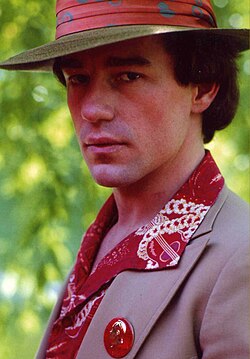
Actor Phil Hartman, who died in 1998, was the most recurring male guest actor on the show, appearing 52 times.
In addition to the show's regular cast of voice actors, celebrity guest stars have been a staple of The Simpsons, an American animated television sitcom created by Matt Groening for the Fox Broadcasting Company, since its first season. The Simpsons focuses on the eponymous family, which consists of Homer, Marge, Bart, Lisa and Maggie. The family was initially conceived by Groening for a series of animated shorts, which originally aired as a part of The Tracey Ullman Show between 1987 and 1989. The shorts were developed into a half-hour prime time series which began in December 1989. The series' 37th season premiered on September 28, 2025, and 807 episodes of The Simpsons have aired. A feature film adaptation of the series called The Simpsons Movie, was released in 2007. (Full article...)
Grey's Anatomy is an American medical drama television series that premiered on the American Broadcasting Company (ABC) as a mid-season replacement on March 27, 2005. The series focuses on the fictional lives of surgical interns and residents as they evolve into seasoned doctors while trying to maintain personal lives. The show's premise originated with Shonda Rhimes, who serves as an executive producer, along with Betsy Beers, Mark Gordon, Krista Vernoff, Rob Corn, Mark Wilding, and Allan Heinberg. The series was created to be racially diverse, utilizing a color-blind casting technique. It is primarily filmed in Los Angeles. The show's title is a play on Gray's Anatomy, the classic human anatomy textbook.
Episodes have been broadcast on Thursday nights since Grey's third season. The first two seasons aired after Desperate Housewives in the Sunday 10:00 pm EST time-slot. All episodes are approximately forty-three minutes, excluding commercials, and are broadcast in both high-definition and standard. Episodes are also available for download at the iTunes Store in standard and high definition, and Amazon Prime Video, with new episodes appearing the day after their live airings. ABC Video on demand also releases episodes of the show, typically one to two days after their premieres. Recent episodes are available on ABC's Android/iTunes app or at ABC's official Grey's Anatomy website, and Hulu. (Full article...)- BBC Young Musician is a televised national music competition broadcast biennially on BBC Television and BBC Radio 3. Originally BBC Young Musician of the Year, its name was changed in 2010.
The competition, a former member of the European Union of Music Competitions for Youth (EMCY), is open to UK-resident percussion, keyboard, string, brass and woodwind players, who are eighteen years of age or under on 1 January in the relevant year. (Full article...) - The fourth and final season of The O.C., an American teen drama television series, aired in the United States from November 2, 2006, to February 22, 2007, and consisted of 16 episodes. The O.C.'s final season aired Thursdays at 9:00 p.m. ET in the United States on Fox, a terrestrial television network. Fox tested a new timeslot by airing the second episode on Wednesday at 9:00 p.m. ET against ABC's Lost and CBS's Criminal Minds. With Lost about to enter a three-month hiatus, Fox hoped that changing the timeslot for The O.C. would attract back viewers it had lost since the end of the previous season; however, the move was unsuccessful and the show returned to its Thursday timeslot.
The season was released on DVD as a five-disc boxed set under the title The O.C.: The Complete Fourth Season on May 22, 2007, by Warner Home Video. The season was also made available in the American versions of Zune and iTunes Store. Before the season premiered on television, it was available through on demand streaming. In the US, streaming was available from October 26, 2006, at 3:01 a.m. ET onwards, through Fox Interactive Media's MySpace and MyFoxLocal stations. (Full article...) 
Family Guy creator Seth MacFarlane also provides the voices of Peter Griffin, Stewie Griffin, Brian Griffin, and Glenn Quagmire.
Family Guy is an American animated sitcom that features five main voice actors, and numerous regular cast and recurring guest stars. The principal voice cast consists of show creator Seth MacFarlane, Alex Borstein, Mila Kunis (who replaced Lacey Chabert after the first season (her last episode is "Holy Crap," now marketed as the second episode of season two)), Seth Green, and Mike Henry; Patrick Warburton and Arif Zahir were later added to the main cast (the former being promoted from recurring cast); Recurring voice actors include Adam West, Sam Elliott, John G. Brennan, Nicole Sullivan and Jennifer Tilly, and repeat guest stars include Phyllis Diller, Charles Durning, Rush Limbaugh, James Woods and Phil LaMarr.
Many cast members provide voices for multiple characters. The voice actors, in portraying the various character personalities on the show, draw inspiration from celebrities and pop culture. Family Guy characters have been played by more than one actor, after members of the show left the series or had conflicting obligations. (Full article...)
The Office is an American television sitcom developed by Greg Daniels and based on the British series of the same name created by Ricky Gervais and Stephen Merchant. The show premiered on NBC on March 24, 2005, and concluded on May 16, 2013, after airing 201 episodes across nine seasons. Filmed as a mockumentary, the series depicts the everyday lives of a group of office employees in the Scranton, Pennsylvania, branch of the fictional Dunder Mifflin Paper Company. The Office initially featured Steve Carell as Michael Scott, Rainn Wilson as Dwight Schrute, John Krasinski as Jim Halpert, Jenna Fischer as Pam Beesly, and B. J. Novak as Ryan Howard; the show's cast changed significantly during its run.
Despite premiering to mixed reviews during its first season, The Office's subsequent seasons received widespread acclaim and became a success for NBC, though later seasons were criticized for a dip in quality. From 2006 to 2011, the show was nominated six consecutive times for the Primetime Emmy Award for Outstanding Comedy Series, winning for its second season. The show was also nominated for three Golden Globe Awards for Best Television Series – Musical or Comedy; five Producers Guild of America Awards for Best Episodic Comedy, winning once; the 2006 TCA Award for Program of the Year; and four TCA Awards for Outstanding Achievement in Comedy, winning twice. The Office was named as one of the top television programs of 2006 and 2008 by the American Film Institute, and in 2007, the series was recognized with a Peabody Award. (Full article...)- The fourth season of Degrassi: The Next Generation commenced airing in Canada on September 7, 2004, concluded on February 14, 2005 and contains twenty-two episodes. Degrassi: The Next Generation is a Canadian serial teen drama television series. This season depicts the lives of a group of high school sophomores and juniors as they deal with some of the challenges and issues teenagers face such as bullying, dysfunctional families, school shootings, mental disorders, STDs, disabilities, gambling, homosexuality, and inappropriate student-teacher relationships.
Every episode is titled after a song from the 1980s, except for the two-part season finale "Goin' Down the Road", which took its name from the 1970 Canadian film Goin' Down the Road. Filming took place between April and November 2004. (Full article...) - Project Runway is an American reality television show in which contestants compete to be the best fashion designer, as determined by the show's judges. The series first broadcast in 2004, and twenty one regular seasons and seven all-stars seasons have aired as of October 2025. The first five seasons aired on Bravo, while the succeeding seasons aired on Lifetime. Project Runway contestants are chosen by the show's producers through an application process that includes a videotape submission and "virtual portfolio" of sketches and completed designs, semi-final interviews at select cities, and a final interview.
Two hundred contestants have competed, three of whom have competed twice—Daniel Franco competed in both season 1 and season 2 and Kate Pankoke in season 11 and season 12 in addition to Amanda Valentine in season 11 and season 13. This is with the exception of all season 20 contestants, as this season used exclusively past contestants despite not being a part of the All Stars series. Angela Keslar and Vincent Libretti were originally eliminated in Episodes 8 and 9, respectively, of season 3, but were brought back due to that season's twist. Justin LeBlanc would have originally been eliminated in episode 6 of season 12, but was given a second chance due to the newly instituted "Tim Gunn Save". During season 13, the "Tim Gunn Save" was used to retroactively bring Charketa Glover back into the competition for Episode 7 after she was eliminated in Episode 6. Seven contestants left Project Runway for reasons other than being eliminated by the show's judges. Keith Michael was disqualified in season 3 for bringing design books to the contest, which is prohibited. On the other hand, Jack Mackenroth of season 4, Maya Luz of season 7, Cecilia Motwani of season 9, Andrea Katz of season 10, Kooan Kosuke of season 10, and Sandro Masmanidi of season 12 all withdrew from the show for personal reasons. (Full article...) - The Adventures of Mini-Goddess, also known as Ah! My Goddess: Being Small Is Convenient, is a Japanese animated TV series that aired 48 episodes between 1998 and 1999. It was directed by Hiroko Kazui and Yasuhiro Matsumura and was produced by Oriental Light and Magic. The series premiered on WOWOW as a part of the omnibus show Anime Complex. It was formerly distributed in North America by Geneon Entertainment. It is part of the Oh My Goddess! series, which follows the adventures of three goddesses (Belldandy, Urd, and Skuld) and their rat companion Gan-chan.
In Japan, the series aired on WOWOW between April 6, 1998 and March 29, 1999. The season was then released on DVD and VHS by Pony Canyon. Six VHS tapes were released between December 18, 1998, and October 20, 1999, and six DVDs were released between May 19, 1999, and October 20, 1999. A DVD box set was released in Japan on February 20, 2008. For Region 1, the season was licensed to Pioneer Entertainment (now Geneon Entertainment), and was released between February 12, 2002, and August 13, 2002, in four DVD compilations, each of which contained twelve episodes. Geneon released a limited-edition box set on July 1, 2003. (Full article...) - The Substitute Shinigami arc (死神代行篇, Shinigami Daikō-hen) is the first season of the Bleach anime television series. The episodes are directed by Noriyuki Abe, and produced by TV Tokyo, Dentsu, and Studio Pierrot. In the English release by Viz Media, the title is changed to simply The Substitute. The season adapts the first eight volumes (chapters 1–70) of Tite Kubo's Bleach manga series, spanning twenty episodes. The episodes' plot covers the adventures of a high school student Ichigo Kurosaki after becoming a Soul Reaper and assuming the duties of Soul Reaper Rukia Kuchiki.
The first season aired from October 2004 to February 2005 on TV Tokyo. The first English airing of the series was from September 2006 to January 2007. It was shown on YTV's Bionix programming block in Canada and Cartoon Network's Adult Swim in the United States, with Bionix airing the show one day sooner. The arc started airing in the United Kingdom starting in September 2007 on AnimeCentral. (Full article...) 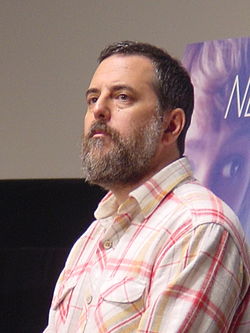
Romanek at the 2010 Tokyo International Film Festival
American filmmaker Mark Romanek directed his first music video in 1986, for The The's "Sweet Bird of Truth". He earned his first MTV Video Music Award for Best Direction nomination for "Free Your Mind", performed by En Vogue, in 1993. Romanek later directed "Closer" for the industrial rock band Nine Inch Nails, which contains imagery involving terror, sexuality, and animal cruelty. In 1995, he directed the video for "Scream", set in space and performed by Michael and Janet Jackson, as well as the New Age surrealistic "Bedtime Story", performed by Madonna. They are two of the most expensive music videos ever made, costing $7 million and $5 million, respectively. "Scream" gained 11 nominations at the 1995 MTV Video Music Awards, including Romanek's second Best Direction nomination, and his first Grammy Award for Best Music Video, Short Form.
In 1996, Romanek directed the Mary Poppins-inspired "Novocaine for the Soul" for the rock band Eels. The following year, he directed Fiona Apple's "Criminal", which explores themes of voyeurism and adolescence; and won his second Grammy Award for Best Music Video, Short Form for "Got 'til It's Gone", performed by Janet Jackson, Q-Tip and Joni Mitchell. For his work in "Hurt" (2003), performed by Johnny Cash, Romanek earned another MTV nomination, and won his third Grammy. In 2004, he directed the auto-biographical music video for Jay-Z's "99 Problems", for which he won his first MTV award. Their subsequent collaborations—the installation-style 10-minute short film for "Picasso Baby" (2013), and the animation video for "The Story of O.J." (2017)—were nominated for Grammy Award for Best Music Video. (Full article...)

.png)
_(52946284715)_(cropped).jpg)


Television news
- 22 June 2026 – Mass media in the Czech Republic
- Employees of the Czech public broadcasters Czech Television and Czech Radio are on a 24-hour warning strike to protest against the abolition of licence fees and tying of the public media budget to the government budget. (AP) (Swissinfo)
- 10 June 2026 – Protests against the 2026 Iran war
- Hundreds of people rally in Hezbollah strongholds in southern suburbs of Beirut, Lebanon, in support of Iran and its allies during the war. Additionally, the Al-Masirah, a TV channel run by the Houthis, reports a similar gathering in Sanaa, Yemen. (AFP via Arab News)
- 10 May 2026 – Middle Eastern crisis
- Iranian state TV says that Iran has sent its response to the latest ceasefire proposal from the United States via Pakistan. Pakistani prime minister Shehbaz Sharif confirms that his country received the response. (Reuters) (Arab News PK)
- 18 April 2026 –
- Three people are killed in a stabbing attack during the filming of the TV series Sin senos sí hay paraíso in Laches, Bogotá, Colombia. (People en Español)
- 25 March 2026 – 2026 Iran war
- According to Press TV, Iran has rejected a United States proposal to end the war and sets out five conditions for a ceasefire. (bne IntelliNews) (AP)
Featured content


Main topics

History of television: Early television stations • Geographical usage of television • Golden Age of Television • List of experimental television stations • List of years in television • Mechanical television • Social aspects of television • Television systems before 1940 • Timeline of the introduction of television in countries • Timeline of the introduction of color television in countries
Inventors and pioneers: John Logie Baird • Alan Blumlein • Walter Bruch • Alan Archibald Campbell-Swinton • Allen B. DuMont • Philo Taylor Farnsworth • Charles Francis Jenkins • Boris Grabovsky • Paul Gottlieb Nipkow • Constantin Perskyi • Boris Rosing • David Sarnoff • Kálmán Tihanyi • Vladimir Zworykin
Technology: Comparison of display technology • Digital television • Liquid crystal display television • Large-screen television technology • Technology of television
Terms: Broadcast television systems • Composite monitor • HDTV • Liquid crystal display television • PAL • Picture-in-picture • Pay-per-view • Plasma display • NICAM • NTSC • SECAM
Categories

WikiProjects
 |
You are invited to participate in WikiProject Television, a WikiProject dedicated to developing and improving articles about Television. |
- Main projects

- Sub-projects
Television Stations • American animation • American television • Australian television • British TV • BBC • Canadian TV shows • Television Game Shows • ITC Entertainment Productions • Digimon • Buffyverse • Doctor Who • Degrassi • EastEnders • Episode coverage • Firefly • Futurama • Grey's Anatomy • Indian television • Lost • Nickelodeon • The O.C. • Professional Wrestling • Reality TV • The Simpsons • Seinfeld • South Park • Stargate • Star Trek • Star Wars • Soap operas • Avatar: The Last Airbender • House
- Related projects
Animation • Anime and manga • Comedy • Comics • Fictional characters • Film • Media franchises
What are WikiProjects?
Things you can do

- Place the {{WikiProject Television}} project banner on the talk pages of all articles within the scope of the project.
- Write: Possible Possum
- Cleanup: color television, Alien Nation: Body and Soul, The Sopranos, Alien Nation: Dark Horizon, Alien Nation: The Enemy Within, Alien Nation: Millennium, Aang
- Expand: Timeline of the introduction of color television in countries
- Stubs: Flow (television), Just for Kicks (TV series), Play of the Month, Nova (Dutch TV series), More stubs...
Subportals

.svg)


Related portals


Associated Wikimedia
The following Wikimedia Foundation sister projects provide more on this subject:
-
 Commons
Free media repository -
 Wikidata
Free knowledge base -
 Wikiquote
Collection of quotations -
 Wikisource
Free-content library -
 Wikiversity
Free learning tools -
 Wiktionary
Dictionary and thesaurus


