Portal:Bosnia and Herzegovina
Wikipedia portal for content related to Bosnia and Herzegovina
From Wikipedia, the free encyclopedia

Welcome to the Bosnia and Herzegovina Portal
 |
 |
 | |
Bosnia and Herzegovina, often referred to as Bosnia-Herzegovina or simply Bosnia, is a country in Southeast Europe. Situated on the Balkan Peninsula, it borders Serbia to the east, Montenegro to the southeast, and Croatia to the north and southwest, with a 20-kilometre-long (12-mile) coast on the Adriatic Sea in the south. Bosnia has a moderate continental climate with hot summers and cold, snowy winters. Its geography is largely mountainous, particularly in the central and eastern regions, which are dominated by the Dinaric Alps. Herzegovina, the smaller, southern region, has a Mediterranean climate and is mostly mountainous. Sarajevo is the capital and the largest city.
The area has been inhabited since at least the Upper Palaeolithic, with permanent human settlement traced to the Neolithic cultures of Butmir, Kakanj, and Vučedol. After the arrival of the first Indo-Europeans, the area was populated by several Illyrian and Celtic civilisations. Most of modern Bosnia was incorporated into the Roman province of Dalmatia by the mid-first century BCE. The ancestors of the modern South Slavic peoples arrived between the sixth and ninth centuries. In the 12th century, the Banate of Bosnia was established as the first independent Bosnian polity. It gradually evolved and expanded into the Kingdom of Bosnia, which became the most powerful state in the western Balkans by the 14th century. The Ottoman Empire annexed the region in 1463 and introduced Islam. From the late 19th century until World War I, the country was under Austro-Hungarian rule. In the interwar period, Bosnia and Herzegovina was part of the Kingdom of Yugoslavia. After World War II, it was granted full republic status in the newly formed Socialist Federal Republic of Yugoslavia. In 1992, following the breakup of Yugoslavia, the republic proclaimed independence. This was followed by the Bosnian War, which lasted until late 1995 and ended with the signing of the Dayton Agreement.
Bosnia and Herzegovina has around 3.4 million inhabitants, composed chiefly of three main ethnic groups: Bosniaks, who form one half of the population, followed by Serbs at one-third and Croats at one-sixth; minorities include Jews, Roma, Albanians, Montenegrins, Ukrainians and Turks, who are among 17 recognized "national minorities". Bosnia and Herzegovina has a bicameral legislature and a presidency made up of one member from each of the three major ethnic groups (directorial system). The central government's power is minimal, as the country is largely decentralised; it consists of two highly autonomous confederal entities—the Federation of Bosnia and Herzegovina and Republika Srpska—and a third unit, the Brčko District, nominally under joint control, albeit governed by its own local government.
Bosnia and Herzegovina is a developing country and an upper-middle income economy, dominated by industry and agriculture, followed by tourism and services; tourism has increased significantly in recent years. The country has a social security and universal healthcare system, while primary and secondary education is free. It is a member of the United Nations, Council of Europe, OSCE, CEFTA, and is also a founding member of the SEECP. Bosnia and Herzegovina has been an EU candidate country since 2022, and a NATO membership candidate since 2010. (Full article...)
Selected article -
.svg)
The Independent State of Croatia (Croatian: Nezavisna Država Hrvatska (NDH)) was a World War II– puppet state of Fascist Italy from 1941 to 1943, and a puppet state of Nazi Germany from 1941 to 1945. It was established in parts of occupied Yugoslavia on 10 April 1941, after the invasion of the country by the Axis powers. Its territory consisted mostly of modern-day Croatia and Bosnia and Herzegovina, as well as some parts of modern-day Serbia and Slovenia, but also excluded many Croat-populated areas in Dalmatia, Istria, and Međimurje.
During its entire existence, the NDH was governed as a one-party state by the fascist Ustaše organization under its Poglavnik, Ante Pavelić. The regime targeted Serbs, Jews and Roma as part of a large-scale campaign of genocide, as well as anti-fascist or dissident Croats and Bosnian Muslims. The NDH was considered Germany's closest regional ally with strong ideological alignment. Out of the 22 concentration camps in NDH-controlled territory, Jasenovac was the largest while Jastrebarsko and Sisak held only children. (Full article...)
General images

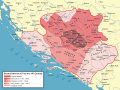 Bosnia in the Middle Ages spanning the Banate of Bosnia and the succeeding Kingdom of Bosnia (from Bosnia and Herzegovina)
 Coat of Arms of the Republic of Bosnia and Herzegovina (from History of Bosnia and Herzegovina)
 Željko Komšić, Croat member of the Bosnian Presidency, and Hillary Clinton, U.S. Secretary of State, 13 December 2011 (from Bosnia and Herzegovina)
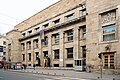 The Central Bank of Bosnia and Herzegovina in Sarajevo (from Bosnia and Herzegovina)
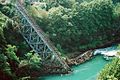 The railway bridge over the Neretva River in Jablanica, twice destroyed during the 1943 Operation Weiss offensive (from Bosnia and Herzegovina)
 Administrative division of modern Bosnia and Herzegovina. (from History of Bosnia and Herzegovina)
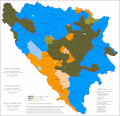 Ethnic structure of Bosnia and Herzegovina by municipalities in 2013, Green for Bosniaks, Orange for Croats and Blue for Serbs (from Bosnia and Herzegovina)
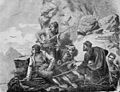 The Herzegovina Uprising of 1875–77 (from History of Bosnia and Herzegovina)
- Bosnia and Herzegovina consists of the Federation of Bosnia and Herzegovina (FBiH), Republika Srpska (RS) and Brčko District (BD) (from Bosnia and Herzegovina)
 Illustration from the French magazine Le Petit Journal on the Bosnian Crisis: Bulgaria declares its independence and its prince Ferdinand is named Tsar, Austria-Hungary, in the person of Franz Joseph, annexes Bosnia and Herzegovina, while the Ottoman Sultan Abdul Hamid II looks on helplessly (from History of Bosnia and Herzegovina)
 The Emperor's Mosque is the first mosque to be built (1457) after the Ottoman conquest of Bosnia. (from History of Bosnia and Herzegovina)
- Territorial evolution of the Bosnian Kingdom (from History of Bosnia and Herzegovina)
 Kingdom of Bosnia 1377-1463 (from History of Bosnia and Herzegovina)
 The Banate in 1373, shortly before its elevation to kingdom (from History of Bosnia and Herzegovina)
 Bosnian and Herzegovinian Partisans flag (1941-1945) (from History of Bosnia and Herzegovina)
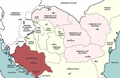 The Bosnia Eyalet in 1683 (from Bosnia and Herzegovina)
 Bosnian meat platter that contains, among other things, ćevapi, which is considered the national dish of Bosnia and Herzegovina (from Bosnia and Herzegovina)
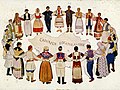 "Keep/Protect Yugoslavia" (Čuvajte Jugoslaviju), a variant of the alleged last words of King Alexander, in an illustration of Yugoslav peoples dancing the kolo. (from History of Bosnia and Herzegovina)
 Coat of arms of Bosnia and Herzegovina (from History of Bosnia and Herzegovina)
 A lamb roast and "kolo" (circle) dancing - Bosnia and Herzegovina, 1895 (from Culture of Bosnia and Herzegovina)
 The Asim Ferhatović Hase Stadium in Sarajevo hosted the opening ceremony of the 1984 Winter Olympics (from Bosnia and Herzegovina)
 Ledger stone to Queen Catherine of Bosnia, the last queen of the House of Kosača. (from Bosnia and Herzegovina)
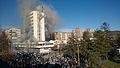 Tuzla government building burning after anti-government clashes on 7 February 2014 (from Bosnia and Herzegovina)
 BHRT headquarters in Sarajevo (from Bosnia and Herzegovina)
 Hval's Codex, illustrated Slavic manuscript from medieval Bosnia (from Bosnia and Herzegovina)
 The Avaz Twist Tower in Sarajevo, the tallest building in Bosnia and Herzegovina (from Bosnia and Herzegovina)
 The Jahorina Ski Resort, a 1984 Winter Olympics venue, is the biggest and most popular ski resort in Bosnia and Herzegovina (from Bosnia and Herzegovina)
 Bosnia and Herzegovina's flag while part of the Socialist Federal Republic of Yugoslavia (from Bosnia and Herzegovina)
 Vedran Smailović, the cellist of Sarajevo. (from Culture of Bosnia and Herzegovina)
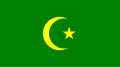 Ottoman Bosnia - flag from 1878 (from History of Bosnia and Herzegovina)
 Dissolution of Yugoslavia (from Bosnia and Herzegovina)
 People of Sarajevo in 1883 (from Bosnia and Herzegovina)
 Coat of arms of Bosnia and Herzegovina during Habsburg times. (from History of Bosnia and Herzegovina)
- "Keep/Protect Yugoslavia" (Čuvajte Jugoslaviju), a variant of the alleged last words of King Alexander I, in an illustration of Yugoslav peoples dancing the kolo (from Bosnia and Herzegovina)
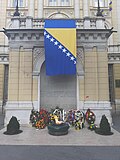 Eternal flame memorial to military and civilian World War II victims in Sarajevo (from Bosnia and Herzegovina)
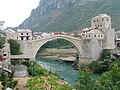 The Mostar Bridge was commissioned by Suleiman the Magnificent in 1557 (from Bosnia and Herzegovina)

 Coat of arms of the Socialist Republic of Bosnia and Herzegovina (from History of Bosnia and Herzegovina)
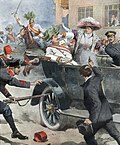 The assassination of Archduke Franz Ferdinand of Austria and Sophie, Duchess of Hohenberg by Gavrilo Princip in Sarajevo, 28 June 1914 (from Bosnia and Herzegovina)
 Počitelj Citadel in Čapljina, built by King Tvrtko I of Bosnia in 1383. (from Bosnia and Herzegovina)
 Ivo Andrić with his wife Milica, upon learning he had won the Nobel Prize in Literature (from Bosnia and Herzegovina)
 Tuzla government building burning after anti-government clashes on 7 February 2014 (from History of Bosnia and Herzegovina)
 Coat of arms of the Banate of Bosnia (from History of Bosnia and Herzegovina)
 Mogorjelo, an ancient Roman suburban Villa Rustica from the 4th century, near Čapljina (from Bosnia and Herzegovina)
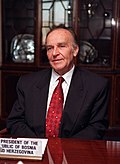 Alija Izetbegović during his visit to the United States in 1997. (from History of Bosnia and Herzegovina)
 UN troops in front of the Executive Council Building, burned after being struck by tank fire during the siege of Sarajevo, 1995 (from Bosnia and Herzegovina)
 Bosnia within the Independent State of Croatia (NDH), 1942 (from History of Bosnia and Herzegovina)
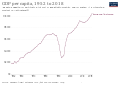 Estimated development of real GDP per capita of Bosnia and Herzegovina, since 1952 (from Bosnia and Herzegovina)
 Austro-Hungarian troops enter Sarajevo, 1878 (from Bosnia and Herzegovina)


.svg)
.jpg)
.jpg)


.jpg)


_dancing_-_Bosnia_and_Herzegovina_1895.jpg)


_building,_Sarajevo.jpg)


.svg)


.svg)


.jpg)

.jpg)

.jpg)
_10.JPG)


More did you know
- ... that Teodora Krajewska, one of the first female physicians in Bosnia-Herzegovina, rode a pony to visit her patients in remote mountain villages?
Cities
- Banja Luka
- Bihać
- Berkovići
- Bijeljina
- Bosanska Krupa
- Bosanski Petrovac
- Brčko
- Brod
- Bugojno
- Cajnice
- Cazin
- Derventa
- Doboj
- Donji Vakuf
- Dubica
- Foča
- Goražde
- Gornji Vakuf
- Gračanica
- Gradačac
- Gradiška
- Ilidža
- Istočno Sarajevo
- Jajce
- Jablanica
- Kakanj
- Kalesija
- Konjic
- Kotor Varoš
- Laktaši
- Livno
- Ljubuški
- Lukavac
- Modriča
- Mostar
- Nevesinje
- Neum
- Novi Grad
- Novi Travnik
- Olovo
- Petrovo
- Prijedor
- Prnjavor
- Sanski Most
- Sarajevo
- Srebrenik
- Srebrenica
- Teslić
- Tešanj
- Travnik
- Trebinje
- Tuzla
- Velika Kladuša
- Visoko
- Vitez
- Zavidovići
- Zenica
- Zvornik
- Živinice
- Žepče
Selected biography -
Petar Baćović (Serbo-Croatian Cyrillic: Петар Баћовић; 1898 – April 1945) was a Bosnian Serb Chetnik commander within occupied Yugoslavia during World War II. From the summer of 1941 until April 1942, he headed the cabinet of the Ministry of Internal Affairs for Milan Nedić's puppet Government of National Salvation in the German-occupied territory of Serbia. In May and June 1942, Baćović participated in the joint Italian-Chetnik offensive against the Yugoslav Partisans in Montenegro. In July 1942, Baćović was appointed by the Chetnik leader Draža Mihailović and his Supreme Command as the commander of the Chetnik units in the regions of eastern Bosnia and Herzegovina within the Axis puppet state, the Independent State of Croatia (NDH). In this role, Baćović continued collaborating with the Italians against the Yugoslav Partisans, with his Chetniks formally recognised as Italian auxiliaries from mid-1942.
Along with other Chetniks, in August and September 1942 Baćović and his Chetniks carried out massacres of Bosnian Muslim and Croat civilians and those sympathetic to the Partisan movement, amounting to more than 5,000 dead. The following month, while participating in a joint Italian-German operation around Prozor, Operation Alfa, Baćović and his Chetniks burnt Croat and Muslim villages and killed between 500 and 2,000 Croats and Muslims. The Italians reacted strongly to this and threatened to withdraw their support for the Chetniks, after which Baćović attempted to distance himself from the killings. Baćović's Chetniks committed further atrocities against Croats and Muslims in Mostar and Konjic in November and Vrlika in January 1943. In early 1943, Baćović was appointed as a vojvoda (warlord) by the ailing principal Chetnik leader in Herzegovina, Ilija Trifunović-Birčanin. Baćović engaged in considerable anti-Semitic propaganda aimed at the Partisan leadership. (Full article...)
List of selected biographies |
|---|
Did you know (auto-generated)

- ... that the May 1995 Pale air strikes during the Bosnian War were the first offensive operations carried out by the Spanish Air Force since 1957?
- ... that swimmer Anja Margetić refused to participate at the Mediterranean Games after learning she would not be able to compete under the flag of Bosnia and Herzegovina?
- ... that Bosnian sitting volleyball players Sabahudin Delalić, Ismet Godinjak, Adnan Manko, Asim Medić, and Dževad Hamzić have won medals at every Paralympics this century?
- ... that Ivan Ančić was the first Bosnian Franciscan to use the Latin script to write in his native language?
- ... that Bosnian Olympic runners Islam Ðugum and Kada Delić were both nearly killed by snipers during their training?
- ... that Miroslav Kvočka was convicted of war crimes and crimes against humanity against non-Serb detainees in the Omarska concentration camp during the Bosnian War?
Subcategories

Related portals


Religions in Bosnia and Herzegovina


Ex-Yugoslav countries


Other countries


Topics
Recognized content

.jpg)
Things you can do

- Request images:
- Request maps:
- Sarajevo city location map
- Articles wanted:
- Clinical Center University of Sarajevo (Koševo hospital);
- Articles needing major work, Be Bold!: **
- Architecture of Bosnia and Herzegovina
- Health in Bosnia and Herzegovina
- Literature of Bosnia and Herzegovina
- List of universities in Bosnia and Herzegovina
- Foreign relations of Bosnia and Herzegovina
- Cinema of Bosnia and Herzegovina
- Subpages of List of settlements in the Federation of Bosnia and Herzegovina
- Stubs needing expansion:
- Featured Portals:
- Featured Pictures:
- Articles with Featured Article Candidate's status within reach:
- Current Featured Candidates:
- Featured Articles: (Don't be too bold!)
- Current Good Article Candidates:
- Good Articles:
- Former Good Articles:
Web resources
- B&H Tourism - Official Web Site
- Tourism Association of the Federation of Bosnia and Herzegovina - Official Web Site
- Tourism Association of Republika Srpska - Official Web Site
- Duga-Tehna
Other links:
- Bosnian National Monument - Muslibegovica House
- "Bosnia and Herzegovina". The World Factbook (2025 ed.). Central Intelligence Agency.
- Bosnia & Herzegovina Economy
- Bosnia and Herzegovina Map
- Bosnia News
- rjecnik.ba English-Bosnian and German-Bosnian On-line Dictionary (in Bosnian, English, and German)
- The State of Media Freedom in Bosnia and Herzegovina: The Public Service Broadcasting Report by the OSCE Representative on Freedom of the Media
Associated Wikimedia
The following Wikimedia Foundation sister projects provide more on this subject:
-
 Commons
Free media repository -
 Wikidata
Free knowledge base -
 Wikiquote
Collection of quotations -
 Wikisource
Free-content library -
 Wikiversity
Free learning tools -
 Wikivoyage
Free travel guide -
 Wiktionary
Dictionary and thesaurus


