Portal:Libertarianism
Wikimedia portal
From Wikipedia, the free encyclopedia

Introduction
Libertarianism (from French: libertaire, lit. 'libertarian'; or from Latin: libertas, lit. 'freedom') is a political philosophy that holds liberty and personal sovereignty as primary values. Many libertarians believe that the concept of freedom is in accord with the non-aggression principle, according to which each individual has the right to live as they choose, as long as they do not violate the rights of others by initiating force or fraud against them.
Libertarianism has been broadly shaped by liberal ideas. Libertarians advocate the expansion of individual autonomy and political self-determination, emphasizing the principles of equality before the law and the protection of civil rights, including the rights to freedom of association, freedom of speech, freedom of thought and freedom of choice. They generally support individual liberty and oppose authority, state power, warfare, militarism and nationalism, but some libertarians diverge on the scope and nature of their opposition to existing economic and political systems. (Full article...)
Selected article
Libertarian Marxism refers to a broad scope of economic and political philosophies that emphasize the anti-authoritarian aspects of Marxism. Early currents of libertarian Marxism, known as left communism, emerged in opposition to Marxism–Leninism and its derivatives, such as Stalinism and Maoism.
Libertarian Marxism is also often critical of reformist positions, such as those held by social democrats. Libertarian Marxist currents often draw from Karl Marx and Friedrich Engels' later works, specifically the Grundrisse and The Civil War in France, emphasizing the Marxist belief in the ability of the working class to forge its own destiny without the need for a revolutionary party or state to mediate or aid its liberation. Along with anarchism, libertarian Marxism is one of the main currents of libertarian socialism.
Libertarian Marxism includes such currents as council communism, De Leonism, Socialisme ou Barbarie, Lettrism/Situationism and workerism/autonomism and parts of the New Left. Libertarian Marxism has often had a strong influence on both post-left and social anarchists. Notable theorists of libertarian Marxism have included Anton Pannekoek, Raya Dunayevskaya, CLR James, E. P. Thompson, Rosa Luxemburg, Antonio Negri, Cornelius Castoriadis, Maurice Brinton, Guy Debord, Daniel Guérin, Fredy Perlman, Ernesto Screpanti and Raoul Vaneigem.
Selected quote
| “ | My idea of a perfect government is one guy who sits in a small room at a desk, and the only thing he's allowed to decide is who to nuke. The man is chosen based on some kind of IQ test, and maybe also a physical tournament, like a decathlon. And women are brought to him, maybe...when he desires them. | ” |
| — Ron Swanson (2009) Parks and Recreation (Season 1) |
Selected picture
.svg) |
General images
 Tea Party movement protest in Washington, D.C., September 2009 (from Libertarianism)
 Murray Bookchin, a left-libertarian (formerly) of the social anarchist school (from Left-libertarianism)
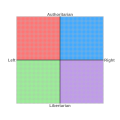 The Political Compass: the green quadrant represents left-libertarianism and the purple right-libertarianism (from Libertarianism)
 Murray Bookchin, American libertarian socialist theorist and proponent of libertarian municipalism and communalism (from Libertarianism)
 A diagram of the typology of beliefs in libertarianism (both left and right, respectively) (from Libertarianism)
 The Nolan Chart, created by American libertarian David Nolan, expands the left–right line into a two-dimensional chart classifying the political spectrum by degrees of personal and economic freedom. (from Libertarianism)
 Thomas Paine, whose theory of property showed a libertarian concern with the unequal distribution of resources under statism (from Libertarianism)
 Former congressman Ron Paul, a self-described libertarian, whose presidential campaigns in 2008 and 2012 garnered significant support from youth and libertarian Republicans (from Libertarianism)
 Members of the Spanish anarcho-syndicalist trade union Confederación Nacional del Trabajo marching in Madrid in 2010 (from Libertarianism)
 Gary Chartier, a left-libertarian of the free-market anti-capitalist school (from Left-libertarianism)
 17 August 1860 edition of Le Libertaire, Journal du mouvement social, a libertarian communist publication in New York City (from Libertarianism)
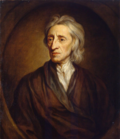 John Locke, regarded as the father of liberalism (from Libertarianism)
 Sébastien Faure, prominent French theorist of libertarian communism as well as atheist and freethought militant (from Libertarianism)


.jpg)


Selected biography -
.jpg)
Ronald Ernest Paul (born August 20, 1935) is an American author, activist, medical doctor, and former politician who served as the U.S. representative for Texas's 22nd congressional district from 1976 to 1977, and again from 1979 to 1985, as well as for Texas's 14th congressional district from 1997 to 2013. On three occasions, he sought the presidency of the United States, first as the Libertarian Party nominee in 1988, and then as a candidate for the Republican Party in 2008 and 2012.
A self-described constitutionalist, Paul is a critic of several of the federal government's policies, especially the existence of the Federal Reserve and tax policy, as well as the military–industrial complex, the war on drugs, and the war on terror. He has also been a vocal critic of mass surveillance policies such as the Patriot Act and the NSA surveillance programs. In 1976, Paul formed the Foundation for Rational Economics and Education (FREE), and in 1985 was named the first chairman of the conservative PAC Citizens for a Sound Economy, both free-market groups focused on limited government. He has been characterized as the "intellectual godfather" of the Tea Party movement, a fiscally conservative political movement started in 2007 and popularized in 2009 that is largely opposed to interventionism. (Full article...)
Related portals
Parent portals


Socio-political portals


Topics
Categories

Points of interest
 | Points of interest related to Libertarianism on Wikipedia: History – Portal – Category – WikiProject – Alerts – Deletions – Assessment |
Associated Wikimedia
The following Wikimedia Foundation sister projects provide more on this subject:
-
 Commons
Free media repository -
 Wikidata
Free knowledge base -
 Wikiquote
Collection of quotations -
 Wikisource
Free-content library -
 Wikiversity
Free learning tools -
 Wiktionary
Dictionary and thesaurus


