Portal:Scotland
Wikipedia portal for content related to Scotland
From Wikipedia, the free encyclopedia

| Main Page | Selected articles 1 | Selected articles 2 | Selected biographies | Selected quotes | Selected pictures | Featured Content | Categories & Topics |
Introduction
 |
 |
|
 | ||
Scotland is a country that is part of the United Kingdom. It contains nearly one-third of the United Kingdom's land area, consisting of the northern part of the island of Great Britain and more than 790 adjacent islands, principally in the archipelagos of the Hebrides and the Northern Isles. In 2022, the country's population was about 5.4 million. Its capital city is Edinburgh, whilst Glasgow is the largest city and the most populous of the cities of Scotland. Scotland shares a land border with England to the south-east and is surrounded by the Atlantic Ocean to the north and west, the North Sea to the north-east and east, and the Irish Sea to the south. The legislature, the Scottish Parliament, elects 129 members to represent 73 constituencies. The Scottish Government is the executive arm of the devolved government, headed by the first minister, who chairs the cabinet and is responsible for government policy and international engagement.
The Kingdom of Scotland emerged as a sovereign state in the 9th century. Independence from England was maintained partly through an alliance with France. In 1603, James VI succeeded to the thrones of England and Ireland, forming a personal union of the three kingdoms. On 1 May 1707, Scotland and England combined to create the new Kingdom of Great Britain, with the Parliament of Scotland subsumed into the Parliament of Great Britain. In 1999, a Scottish Parliament was re-established, and has devolved authority over many areas of domestic policy. The country has its own distinct legal system, education system and religious history, which have all contributed to the continuation of Scottish culture and national identity. Scottish English and Scots are the most widely spoken languages in the country, existing on a dialect continuum with each other. Scottish Gaelic speakers can be found all over Scotland, but the language is largely spoken natively by communities within the Hebrides; Gaelic speakers now constitute less than 2% of the total population, although state-sponsored revitalisation attempts have led to a growing community of second language speakers.
The mainland of Scotland is broadly divided into three regions: the Highlands, a mountainous region in the north and north-west; the Lowlands, a flatter plain across the centre of the country; and the Southern Uplands, a hilly region along the southern border. The Highlands are the most mountainous region of the British Isles and contain its highest peak, Ben Nevis, at 4,413 feet (1,345 m). The region also contains many lakes, called lochs; the term is also applied to the many saltwater inlets along the country's deeply indented western coastline. The geography of the many islands is varied. Some, such as Mull and Skye, are noted for their mountainous terrain, while Tiree and Coll are flatter.
Selected article
The Scottish wars were a series of military campaigns in the late 13th and 14th centuries in order to protect the independence and sovereignty of the Kingdom of Scotland which had been threatened by the Kingdom of England. The wars were part of a great crisis for Scotland, and the period became one of the most defining times in its history. At the end of both extended wars, Scotland retained its status as an independent, sovereign country.
The First War (1296–1328) began with the English invasion of Scotland and ended with the signing of the Treaty of Edinburgh–Northampton. The Second War (1332–1357) began with the English-supported invasion by Edward Balliol and the "Disinherited" and ended with the signing of the Treaty of Berwick. Notable figures during the Wars of Scottish Independence included several of the Kings of Scotland such as Alexander III of Scotland, John Balliol, Robert the Bruce and David II of Scotland, with other prominent figures such as William Wallace who served as Guardian of Scotland from 1297–1298. Key figures on the English side include monarchs Edward I, Edward II and Edward III, as well as the contested King of Scotland, Edward Balliol.
The wars were important for other reasons, such as the emergence of the longbow as a key weapon in medieval warfare. (... Read the full article)
Selected quotes

" ... All political parties die at last of swallowing their own lies ... "
— Dr John Arbuthnot
" ... Where all is compulsion and enforcement, it’s the bully that rules ... "
— Neil M. Gunn
" ... All government is a monopoly of violence ... "
— Sir Walter Scott
" ... In order to enjoy leisure, it is absolutely necessary it should be preceded by occupation ... "
— Hugh MacDiarmid
" ... Men are immortal till their work is done ... "
— David Livingstone
" ... America would have been a poor show had it not been for the Scots ... "
— Andrew Carnegie
" ... Oh, what a tangled web we weave,
When first we practice to deceive ... "
— Sir Walter Scott
" ... Look to your consciences and remember that the theatre of the world is wider than the realm of England ... "
— Mary, Queen of Scots
" ... My theory is that all of Scottish cuisine is based on a dare ... "
— Mike Myers
" ... A man may well be condemned, not for doing something, but for doing nothing ... "
— William Barclay
" ... Biography should be written by an acute enemy ... "
— A. J. Balfour
" ... We live in a Newtonian world of Einsteinian physics ruled by Frankenstein logic ... "
— David Russell
" ... Biography: One of the new terrors of death ... "
— John Arbuthnot
" ... It requires a surgical operation to get a joke well into a Scotch understanding ... "
— Sydney Smith
" ... Freedom is best, I tell thee true, of all things to be won ... "
— William Wallace
" ... The Irish gave the bagpipes to the Scots as a joke, but the Scots haven't seen the joke yet ... "
— Oliver Herford
" ... No man can become rich without himself enriching others ... "
— Andrew Carnegie
" ... The old cathedrals are good, but the great blue dome that hangs over everything is better ... "
— Thomas Carlyle
" ... All I've got against golf is that it takes you so far from the clubhouse ... "
— Eric Linklater
" ... I have always found that the man whose second thoughts are good is worth watching ... "
— J. M. Barrie
" ... A man without a goal is like a ship without a rudder ... "
— Thomas Carlyle
" ... I am prepared to go anywhere, provided it be forward ... "
— David Livingstone
" ... We look to Scotland for all our ideas of civilisation ... "
— Voltaire
" ... Many a clever boy is flogged into a dunce and many an original composition corrected into mediocrity ... "
— Sir Walter Scott
" ... The greatest of faults, I should say, is to be conscious of none ... "
— Thomas Carlyle
" ... This is our land, this is our Scotland, these are our people, these are our men, our works, our women and children: can you beat it? ... "
— James Maxton
" ... I have forgot a great deal more than most other men know ... "
— Lord Monboddo
" ... I tell you truly, liberty is the best of things; never live under the halter of slavery ... "
— William Wallace
" ... One can love a country until it hurts ... "
— Alexander McCall Smith
" ... I thought he was a young man of promise, but I see he was a young man of promises ... "
— A. J. Balfour
" ... Fashion as King is sometimes a very stupid ruler ... "
— Eric Temple Bell
" ... There is nothing new to be discovered in physics now. All that remains is more and more precise measurement ... "
— Lord Kelvin, address to the British Association for the Advancement of Science, 1900
" ... History is the essence of innumerable biographies ... "
— Thomas Carlyle
" ... for, as long as but a hundred of us remain alive, never will we on any conditions be brought under English rule.
It is in truth not for glory, nor riches, nor honours that we are fighting, but for freedom – for that alone, which no honest man gives up but with life itself ... "
— Declaration of Arbroath
" ... Teach a parrot the terms "supply and demand" and you've got an economist ... "
— Thomas Carlyle
" ... A man’s real possession is his memory. In nothing else is he rich, in nothing else is he poor ... "
— Alexander McCall Smith
" ... Beauty in things exists in the mind which contemplates them ... "
— David Hume
" ... We often discover what will do, by finding out what will not do; and probably he who never made a mistake never made a discovery ... "
— Samuel Smiles
" ... We think the world is ours for ever, but we are little more than squatters ... "
— Alexander McCall Smith
" ... A custom loathsome to the eye, hateful to the nose, harmful to the brain, dangerous to the lungs, and in the black, stinking fume thereof, nearest resembling the horrible Stygian smoke of the pit that is bottomless ... "
— James VI King of Scots (on Tobacco)
" ... I could not be a traitor to Edward, for I was never his subject ... "
— William Wallace
" ... People in Scotland have a queer idea of the arts. They think you can be an artist in your spare time, though nobody expects you to be a spare-time dustman, engineer, lawyer or brain surgeon ... "
— Alasdair Gray
" ... No man is useless while he has a friend ... "
— Robert Louis Stevenson
" ... Scottish separation is part of England's imperial disintegration ... "
— John MacLean
" ... When Scotland forgets Burns, then history will forget Scotland ... "
— John Stuart Blackie
" ... Women do not find it difficult nowadays to behave like men, but they often find it extremely difficult to behave like gentlemen ... "
— Compton Mackenzie
" ... Preparing youngsters for failure is easy; it’s preparing them for success that’s really difficult ... "
— Sir Alex Ferguson
" ... The battle for conservation will go on endlessly. It is part of the universal battle between right and wrong ... "
— John Muir
" ... He uses statistics as a drunken man uses lamp posts — for support rather than illumination ... "
— Andrew Lang
" ... We come here with no peaceful intent, but ready for battle, determined to avenge our wrongs and set our country free.
Let your masters come and attack us: we are ready to meet them beard to beard ... "
— William Wallace

In the news

- 19 March 2026 –
- An Iranian man and a Romanian woman are arrested by Police Scotland for attempting to enter Royal Navy base HMNB Clyde. (AP) (BBC News)
- 8 March 2026 –
- A fire occurs in a historic building adjoining the Glasgow Central railway station in Scotland, United Kingdom. The building collapses, destroying a number of businesses and shops. The fire also causes the disruption and cancellation of many train services, with Glasgow Central promptly shutting down until further notice. (BBC News)
Selected biography

John Maclean (24 August 1879 – 30 November 1923) was a Scottish schoolteacher and revolutionary socialist of the Red Clydeside era. He was notable for his outspoken opposition to World War I, which caused his arrest under the Defence of the Realm Act and loss of his teaching post, after which he became a full-time Marxist lecturer and organiser. In April 1918 he was arrested for sedition, and his 75-minute speech from the dock became a celebrated text for Scottish left-wingers. He was sentenced to five years' penal servitude, but was released after the November armistice.
Maclean believed that Scottish workers were especially fitted to lead the revolution, and talked of "Celtic communism", inspired by clan spirit. But his launch of a Scottish Workers Republican Party and a Scottish Communist Party were largely unsuccessful. Although he had been appointed Bolshevik representative in Scotland, he was not in harmony with the Communist Party of Great Britain, even though it had absorbed the British Socialist Party, to which he had belonged. In captivity, Maclean had been on hunger strike, and prolonged force-feeding had permanently affected his health. He collapsed during a speech and died of pneumonia, aged forty-four. (... Read the full article)
Selected picture

The parliament building viewed from Salisbury Crags
The Scottish Parliament Building (Scottish Gaelic: Pàrlamaid na h-Alba, Scots: Scots Pairlament Biggin) is the home of the Scottish Parliament at Holyrood, within the UNESCO World Heritage Site in central Edinburgh. It was designed by Enric Miralles, the Catalan architect,.and has won a number of awards, including an award at the VIII Biennial of Spanish Architecture, the RIAS Andrew Doolan Award for Architecture, and the 2005 Stirling Prize, the UK's most prestigious architecture award.
Photo credit: Photo Credit: Wangi
The Room de Luxe at the Willow Tearooms
The Willow Tearooms are tearooms at 217 Sauchiehall Street, Glasgow, designed by internationally renowned architect Charles Rennie Mackintosh, which opened for business in October 1903.
Photo credit: Dave souza
View over Edinburgh, with the Dugald Stewart Monument in the foreground
Calton Hill is a hill in central Edinburgh, just to the east of the New Town. The hill is home to several iconic monuments and buildings: the National Monument, Nelson's Monument, the Dugald Stewart Monument, the Royal High School, the Robert Burns Monument, the Political Martyrs' Monument and the City Observatory.
Photo credit: Andrewyuill
A walker slacklining at the Old Man of Hoy
Walker Alex Schulz slacklining at the Old Man of Hoy, a 449-foot (137-metre) sea stack on Hoy, part of the Orkney archipelago .
Photo credit: AlexSchulz91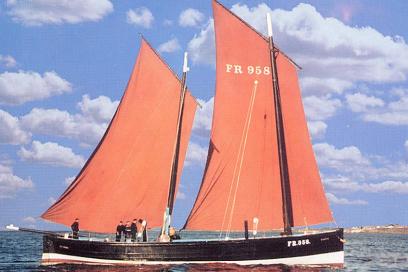
Reaper under full sail.
Reaper is a restored historic Fifie herring drifter which is registered by the National Historic Ships Committee as part of the Core Collection of historic vessels in the UK, and currently operates as a museum ship.
Photo credit: Scottish Fisheries Museum Boats Club
Balmoral Castle
Balmoral Castle. Aberdeenshire a residence of the British royal family in the Scottish baronial style.
Photo credit: Ejdzej
Eilean Donan Castle
The castle on Eilean Donan (Scottish Gaelic: Eilean Donnain), a small tidal island where three sea lochs meet, Loch Duich, Loch Long and Loch Alsh, in the western Highlands.
Photo credit: Gillfoto
Satellite image of Scotland
The geography of Scotland is highly varied, from rural lowlands to barren uplands, and from large cities to uninhabited islands. Aside from the mainland, Scotland is surrounded by 790 islands encompassing the major archipelagoes of the Shetland Islands, Orkney Islands and the Outer Hebrides.
Photo credit: NASA
View of Canisp and Suilven from nearby Clachtoll
Canisp and Suilven seen from the coastal fishing and crofting village of Clachtoll in Sutherland county, on the north western edge of Scotland.
Photo credit: Louis_Daillencourt
Overview of Holyrood Palace
Holyrood Palace is the official residence of the British monarch in Scotland. Located at the bottom of the Royal Mile in Edinburgh, at the opposite end to Edinburgh Castle, Holyrood has served as the principal royal residence in Scotland since the 16th century, and is a setting for state occasions and official entertaining.
Photo credit: Christoph Strässler
RRS Discovery docked at Dundee
RRS Discovery was the last traditional wooden three-masted ship to be built in Britain. Designed for Antarctic research, she was launched as a Royal Research Ship (RRS) in 1901. Her first mission was the British National Antarctic Expedition, carrying Robert Falcon Scott and Ernest Shackleton on their first, successful journey to the Antarctic, known as the Discovery Expedition. She is now the centrepiece of a visitor attraction in her home, Dundee.
Photo credit: Mactographer
Evening view across Calton Hill towards the Castle
Evening view from Calton Hill towards an illuminated Edinburgh Castle with the Bank of Scotland headquarters and the Balmoral Hotel illuminated in the intermediate foreground. The sillhouettes of the Scott Monument and the tall gothic spire of the Hub are both prominent in the frame.
Photo credit: Chris Fleming
St Ninian's Isle
The tied island of St Ninian's Isle is joined to the Shetland Mainland by the largest tombolo in the UK.
Photo credit: ThoWi
Blackrock cottage, Rannoch Moor
A view of Blackrock Cottage on Rannoch Moor with Buachaille Etive Mor in the background.
Photo credit: Andrewmckie
Plane arrival at Barra Airport
Barra Airport (Scottish Gaelic: Port-adhair Bharraigh) (IATA: BRR, ICAO: EGPR) (also known as Barra Eoligarry Airport) is a short-runway airport (or STOLport) situated in the wide shallow bay of Traigh Mhòr at the north tip of the island of Barra in the Outer Hebrides, Scotland. The airport is unique, being the only one in the world where scheduled flights use a beach as the runway.
Photo credit: Steve Holdsworth
The second chamber of the Smoo Cave, Durness in Sutherland, Scotland 
The Skating Minister.
The Reverend Robert Walker Skating on Duddingston Loch, better known by its truncated title The Skating Minister, is an oil painting by Sir Henry Raeburn in the National Gallery of Scotland in Edinburgh.
Credit: Sir Henry Raeburn (1790s painting)
The Black Cuillin viewed from Sgùrr na Strì
The Black Cuillin, a range of rocky mountains located on the Isle of Skye, viewed from Sgùrr na Strì.
Photo credit: User:YaoAxton
Eilean Glas lighthouse
Eilean Glas Lighthouse, built by engineer Thomas Smith, was one of the original four lights to be commissioned by the Commissioners of the Northern Lights and the first in the Hebrides (the others were Kinnaird Head, Mull of Kintyre and North Ronaldsay).
Photo credit: Richard Baker
Traigh Iar (Horgabost beach), Harris, which is part of Lewis and Harris, the largest island in the Outer Hebrides, .
Photo credit: Gordon Hatton
Ben Vorlich and Loch Tay seen from Ben Lawers
Sunrise over Ben Vorlich , a mountain in the Southern Highlands and Loch Tay, the largest body of fresh water in Perth and Kinross.
Photo credit: Michal Klajban
Edinburgh Castle
Edinburgh Castle is a fortress which dominates the skyline of the city of Edinburgh, from its position atop the volcanic Castle Rock. Human habitation of the site is dated back as far as the 9th century BC, although the nature of early settlement is unclear. There has been a royal castle here since at least the reign of King David in the 12th century, and the site continued to be a royal residence until the Union of the Crowns in 1603.
Photo credit: Saffron_Blaze
St Mary's Cathedral viewsedfrom Manor Place, Edinburgh 
National Museum of Scotland, main hall
The National Museum of Scotland is one of Scotland's national museums, on Chambers Street, in Edinburgh. The original Royal Museum began in the 19th century and was added to in the 1990s when a new building known as The Museum of Scotland was added, both merging in 2007 into The National Museum of Scotland.
Photo credit: Shimgray


.jpg)


.jpg)

.jpg)


.jpg)

_Skating_on_Duddingston_Loch.jpg)


Did You Know...

- ... that the 1830 abandonment of Chipewyan woman Matooskie by her Scottish husband was eventually settled with a dowry payment of £200?
- ... that during the First Bishops' War, the Duke of Hamilton's mother intended to shoot him with silver bullets if he landed in Scotland?
- ... that Thorpe's secluded hills provided refuge from Scottish raiders and English Civil War troops?
- ... that George Parks was president of the Royal College of Surgeons in Ireland and his son Rowan Parks became president of the Royal College of Surgeons of Edinburgh?
- ... that Thomas Kerr protested the Iraq War with his SNP-supporting aunt, later campaigned for Labour, joined the Conservatives, and defected to Reform UK?
- ... that the Scottish invasion of England in 1648 was defeated by an army less than half their size?
- ... that historically, lichens like Umbilicaria torrefacta have been used to naturally dye traditional Scottish tartans and textiles?
- ... that Colin Mackay, the political editor at Scottish Television, was "very sad" when Colin MacKay, the political editor at Scottish Television, died?
Get involved


For editor resources and to collaborate with other editors on improving Wikipedia's Scotland-related articles, see WikiProject Scotland.
To get involved in helping to improve Wikipedia's Scotland related content, please consider doing some of the following tasks or joining one or more of the associated Wikiprojects:
- Visit the Scottish Wikipedians' notice board and help to write new Scotland-related articles, and expand and improve existing ones.
- Visit Wikipedia:WikiProject Scotland/Assessment, and help out by assessing unrated Scottish articles.
- Add the Project Banner to Scottish articles around Wikipedia.
- Participate in WikiProject Scotland's Peer Review, including responding to PR requests and nominating Scottish articles.
- Help nominate and select new content for the Scotland portal.
Do you have a question about The Scotland Portal that you can't find the answer to?
Post a question on the Talk Page or consider asking it at the Wikipedia reference desk.
Related portals



Other language versions
Associated Wikimedia
The following Wikimedia Foundation sister projects provide more on this subject:
-
 Commons
Free media repository -
 Wikidata
Free knowledge base -
 Wikiquote
Collection of quotations -
 Wikisource
Free-content library -
 Wikispecies
Directory of species -
 Wikiversity
Free learning tools -
 Wikivoyage
Free travel guide -
 Wiktionary
Dictionary and thesaurus


