This article is within the scope of WikiProject Mathematics, a collaborative effort to improve the coverage of mathematics on Wikipedia. If you would like to participate, please visit the project page, where you can join the discussion and see a list of open tasks.MathematicsWikipedia:WikiProject MathematicsTemplate:WikiProject Mathematicsmathematics
This article is within the scope of WikiProject Polyhedra, a collaborative effort to improve the coverage of polygons, polyhedra, and other polytopes on Wikipedia. If you would like to participate, please visit the project page, where you can join the discussion and see a list of open tasks.PolyhedraWikipedia:WikiProject PolyhedraTemplate:WikiProject PolyhedraPolyhedra
The layman might not catch the implication of if and only if that if one definition is true then all are; I would prefer language like The following definitions of a square are equivalent. —Tamfang (talk) 07:18, 28 June 2024 (UTC)
Admins' noticeboard thread about semi-protection of this article
Please see the admins' noticeboard thread "Indefinite protection of Square about the protection status of this article. Anyone can comment there, regardless of their admin status. Graham87 (talk) 09:52, 31 January 2025 (UTC)
Lead section as summary seems a bit too niche for intended audience
@David Eppstein, thanks for working on this article, including the lead section. I'm a bit concerned that the detailed list of random topics in the lead section seems a bit arbitrary and may be confusing or overwhelming for readers. Topics such as the inscribed square problem, the square of squares, etc. don't really seem essential to the concept of a "square", and I don't think we really need to mention all of them in the lead, even if they are discussed later on. I'd recommend we try to pare the lead down to the most fundamental topics and not necessarily try to make the lead a complete summary of everything mentioned in the article. –jacobolus(t) 06:33, 17 February 2025 (UTC)
It was intended as a rough summary of the rest of the article. See MOS:INTRO: "The lead section should briefly summarize the most important points covered in an article, in such a way that it can stand on its own as a concise version of the article." Note that this is part of WP:GACR#1, so if we hope to reach GA status we need a proper lead, not just a brief paragraph. I tried to include material from most sections of the article, but some calculation-heavy parts were difficult to summarize briefly and readably. —David Eppstein (talk) 07:07, 17 February 2025 (UTC)
It is not required that every topic discussed in the article must be mentioned in the lead. I think mentioning these somewhat niche/obscure topics seems like a non sequitur and is not really helpful for many expected groups of readers who might skim the lead section without bothering to read further into the article (and frankly it seems like a bit of an NPOV problem; these topics are definitely not given such prominent place in the full range of published literature involving squares). –jacobolus(t) 07:30, 17 February 2025 (UTC)
"The published literature involving squares" mostly involves kindergarten mathematics textbooks, at least if one focuses on works directly about squares rather than covering them in passing. Is that what you think we should emulate? As for the topics you think are niche: they are topics that are directly about squares (and not about orthogonal repetition, a different topic) for which we have articles. I think we should discuss those topics in the main article on squares. Almost everything in the packing and quadrature sections is merely a brief summary of material covered in more detail at the linked articles; I think the only exception is the very recent proof of NP-hardness for square packing problems. We have a separate article on square tiling, where I think what you want to cover better belongs. It should be mentioned here, but not be the main focus of this article. And it is mentioned here, in a paragraph-length summary, like the other topics in these sections. But the current state of the square tiling article is pretty dire leaving little that can be summarized here. Your proposal to add an entire section on it here is premature until summarizing what is there would take an entire section. Also, re your opinion that square packing in a square or the square peg problem are niche: both have been the subject of publications by Fields medalists, suggesting that maybe there is more depth to them than you might have suspected. —David Eppstein (talk) 08:23, 17 February 2025 (UTC)
You don't need to get testy. The published literature involving squares is millions of items in a tremendous range, of which only a trivially tiny proportion is kindergarten books. But sure, the material from the kindergarten books is essential and must be covered, whereas topics such as inscribing squares in arbitrary curves, making squares from arrangements of smaller squares, and packing circles into a square are more or less mathematical curios, not essential to the concept of "square" and not important enough to be the first things we tell someone trying to learn the basics about squares. –jacobolus(t) 15:37, 17 February 2025 (UTC)
Says you. The Fields medalists disagree. —David Eppstein (talk) 17:48, 17 February 2025 (UTC)
Whether a problem was of interest to Fields medalists is not equivalent to whether a problem is of fundamental importance (either to mathematics or in particular to the concept of squares). [However, if you had a Fields medalist saying something like "one of the most important things about squares is that there are some packing problems ...", that opinion would be worth weighting.] –jacobolus(t) 17:58, 17 February 2025 (UTC)
I reorganized paragraph 3 so that it starts with square tiling (ubiquitous, easy to visualize) and then goes to squaring the circle (pretty famous) before getting into unsolved and comparatively obscure topics. I like having the latter in the lede, actually. It spices up mathematics, in a way, by showing that a simple idea like "square" is one step away from a question that nobody can answer yet. XOR'easter (talk) 17:59, 17 February 2025 (UTC)
Thanks, I think that was an improvement. –jacobolus(t) 18:27, 17 February 2025 (UTC)
I'm mostly OK with the introduction. I think the formula for the area is paragraph-1 material, so I added a sentence about that, thereby introducing it before we get to an unsolved problem. The sentence about ubiquitous squares could perhaps be split into a two-sentence paragraph. XOR'easter (talk) 17:26, 17 February 2025 (UTC)
Thanks. I agree that some of the formulas are lead-worthy; I just wasn't sure about how to work them into the lead without overwhelming it with technicality. —David Eppstein (talk) 17:49, 17 February 2025 (UTC)
Would be great to have a top level section about square grids
It seems to me that Wikipedia overall doesn't have particularly good discussion about square and rectangular grids. We currently have articles about Square lattice, Lattice graph, Square tiling, Checkerboard, Graph paper, Regular grid, Analytic geometry, Coordinate system, Cartesian coordinate system, Projected coordinate system, Grid (graphic design), Grid plan, UV mapping, Bitmap, Grid (a disambiguation page), etc., but most of these are relatively short and incomplete, and there's not really any place with a solid overview of basic concepts and tools, the range of applications, a clear comparison or list of trade-offs with other types of coordinates or structures for various types of data, etc. It's probably worth having a new article called Square grid (currently redirects to Square tiling which doesn't seem quite right) or maybe more generally Rectangular grid with square grids as a prominent section, but in any event to have a complete article about Square, it seems to me a significant early section should discuss square grids, since many (most?) of the applications and points of interest of squares have more specifically to do with square grids, and square grids have become really fundamental to the way modern society organizes all kinds of information and even thinks about mathematical concepts
I haven't done any kind of literature survey, but I bet there are some nice sources discussing square grids at a high level, maybe including some kind of philosophical considerations etc.
Edit: here are a few sources that pop up in a very brief search:
I disagree that most applications and points of interest about grids. They are important, but really a separate related topic. Most of the applications are about things with the shape of a (single) square. We should have an article (or two) about square and rectangular finite arrangements of points, though. Square grid is a natural title, but it points to something else. —David Eppstein (talk) 07:10, 17 February 2025 (UTC)
The applications mentioned here include tiles, square coordinates, graph paper, city grids, bitmap images, square-grid game boards, QR codes, etc. All of these are really applications of square grids in particular, more than the square shape for its own sake. I agree this is a separate related topic which should have its own article; I just think it's worth summarizing the topic here as well, since it is ubiquitous in (especially modern) human culture, including the basic structure of many areas of modern mathematics. –jacobolus(t) 07:25, 17 February 2025 (UTC)
Almost everything you mention is part of a single paragraph of a multi-paragraph section. That paragraph focuses on grids. The only exceptions in your examples, not from that paragraph, are "city grids", which are not mentioned at all in the article (they are mostly rectangular rather than square in my experience), game boards, which are primarily mentioned because the boards themselves are square and only secondarily because of the square grids some of them contain, and QR codes, where we do not even mention the grid layout of the pixels (it would be redundant to the first paragraph) and instead focus on the square overall shape and nested-square pattern of the alignment marks.
Taking a wider view, the intent of this section is to convey "squares are all around you in many familiar things", not "when you use square shaped things you are only allowed to place them in a grid". —David Eppstein (talk) 08:15, 17 February 2025 (UTC)
I feel like you are deliberately missing my point, and I'm not quite sure why. I am not talking about changing the "applications" section, which seems fine, though it could certainly keep accumulating examples if anyone wanted. I'm suggesting that this article is substantially incomplete (and Wikipedia's coverage of the topic more broadly is incomplete) insofar as it does a very poor and limited job discussing square grids.
"Squares are all around you" in large part because they fit into a grid, whether that's square kitchen tiles, square sidewalk sections, squares on a Go board or computer game grid, pixels in a bitmap image, square city blocks, squares as a unit of area, squares on a military map, etc. Other shapes (say, regular heptagons or non-rectangular trapezoids) are much less common as an organizing principle, because they are significantly less convenient for making a regular pattern with cleanly separated but equivalent directions, easily addressed by coordinates, etc. Just as triangles are culturally important to a significant extent because they are stable in a truss, squares are important because they are the basis for one of the most common types of human organizing structure. –jacobolus(t) 15:52, 17 February 2025 (UTC)
Your point in a nutshell, as it comes across to me, is, we should stop talking about these square things and instead talk about things that are periodic in square lattice patterns. Which is a fine topic for an article but to me is not really the topic of this article. —David Eppstein (talk) 17:50, 17 February 2025 (UTC)
Okay, well I'm doing a terrible job expressing myself, because no that's not it at all. What I am saying, in a nutshell, is that we should (a) have a separate article called something like Square grid, and (b) have a top-level section of this article called something like "Square grids", since that subtopic is extremely relevant and important here, but is not currently described very clearly or completely. Reframing the article titled "Square" to be entirely centered on a separate topic would be nonsensical. –jacobolus(t) 18:00, 17 February 2025 (UTC)
I agree that square grid is a reasonable topic for a separate article. (Having it redirect to square tiling as it does now doesn't quite fit.) I'm not sure that a top-level section with the heading "Square grids" would be the right way to organize the text in this article. I'll admit that the discussion in this thread has left me a little confused. It looks like a dispute over whether a chessboard should be seen as a square grid or as a grid of squares. XOR'easter (talk) 18:17, 17 February 2025 (UTC)
Things that are in the infobox but not the article
I think it goes against MOS:LEDE (in spirit if not explicitly) to state things in the infobox that the article does not elaborate upon. Currently, the infobox is generated by {{Regular polygon db}}, which dumps in a pair of Coxeter–Dynkin diagrams, two properties that the article does not define (isogonal and isotoxal), and the statement that the square is self-dual. This seems less than optimal. Defining all these terms in the article might bloat it unacceptably, but dumping unsourced and unexplained terminology into the intro for a basic shape isn't great either. XOR'easter (talk) 19:38, 18 February 2025 (UTC)
I think it would be preferable to remove the Coxeter diagrams from the infobox than to try to explain them in the article. It's just not a very significant topic for a shape of such low dimension and it's too technical for the most front-facing parts of this article. We can mention squares being isogonal and isotoxal in the symmetry section but I'm still not convinced they belong in the infobox either. —David Eppstein (talk) 21:10, 18 February 2025 (UTC)
There was a reason I wrote it in the more constrained way I did. I searched for sources that described complex-number squares in other ways and didn't find them. I hope your searches are more successful but otherwise this material may need to be removed. Additionally, it seems over-detailed for readers unlikely to care about complex nos.
After searching I agree that a lot of basic properties of squares with lattice (or Gaussian integer) vertices – or more generally, coordinate squares / squares in the complex plane – seem surprisingly difficult to come by in a skim-search of published literature, which is pretty fragmented. Perhaps some observations were considered too obvious to write down by mathematicians talking about number theoretic topics; weren't noticed by high school teachers or school curriculum designers; and the people who would most care such as programmers or artists don't bother publishing such observations in papers. I'll explain what my thought process was here:
(1) The most obvious way to characterize a particular shape of square in the complex plane (or in a square lattice in general) is using a vector or complex number representing the side, rather than the half-diagonal. This goes along with the general practice since ancient times of characterizing a square by its side. It's of course possible to instead characterize a square using the half-diagonal (directed circumradius), effectively getting an arbitrary square by scaling and rotating the one with corners at ; taking this square as a prototype is logical enough in the context of general regular polygons: the vertices are the 4th roots of unity, this square could be considered a unit-"radius" orthoplex, and it is the central cell of the lattice of "odd" Gaussian integers, congruent to 1 modulo . However, in general this origin-centric square is much less common to consider as the basic prototype than an origin-vertex "unit square" with corners (or coordinates in ). In all sorts of contexts related to geometry on grids (space groups, tessellations, computer graphics with pixel grids, data discretization, building Zometool models, working with self-similar fractal curves, ...) tiles are usually more fluently described from a perspective of vertices and edges rather than centers and radii/half-sides/half-diagonals.
(2) There are quite a lot of elementary sources mentioning squares with vertices on a square lattice, e.g. from school materials using geoboards, discussions of the Pythagorean theorem and pythagorean triples, residue classes of division in Gaussian integers, and so on. For example there are a lot of middle/high school level puzzles/activities about counting the number of tilted squares that can be made using a square lattice of some specific rectangular dimensions. So it might be worth mentioning these discrete squares specifically, not only ones of completely arbitrary size / position in a two-dimensional continuum.
(3) The easiest way to characterize arbitrary squares in the (complex) plane, including squares with lattice points or Gaussian integers for vertices, is by taking the "unit square" and then scaling/rotating and translating it to its final position, in terms of complex numbers this transformation is with scale/rotation and translation . Every pair of Gaussian integers determines a square this way.
(4) But hmmm... there's already this discussion of characterizing squares in terms of a center and half-diagonal, so maybe we should discuss that for lattice squares as well / contrast with the vertex + side characterization. Well, the parameters now can't be claimed to be Gaussian integers because they aren't necessarily. One basic obvious fact about this characterization that has come up repeatedly in my own investigations is that the center and half-diagonal always either both have integral coordinates or both have half-integral coordinates, depending on the parity of the squared norm of the side length. I assume(d) that will be trivial to find mentioned in the existing literature.
(5) To make this comprehensible, it's probably best to include a picture.
So really there were 2 main motivations: (1) mention a vertex + side characterization instead of only mentioning a center + half-diagonal characterization for squares, (2) discuss squares with their vertices on the lattice. I think trying to satisfy both of those is important, but it could probably be tightened up. Neither of these motivations is really specific to complex numbers, and transforming a unit square or lattice can also be done with other tools, though complex numbers are convenient.
I'm still fairly convinced that there must be more explicit discussion of this in sources somewhere. I'll list some of the ones I looked at when I get a chance, but I have to go for now. –jacobolus(t) 21:19, 22 February 2025 (UTC)
Re your point (2): the problems of counting squares in lattices are already covered and sourced in Square §Counting.
As for it being more natural to define complex squares by two consecutive vertices rather than center and one vertex: I thought so too until I tried to source it and found only origin+vertex in the sources. I couldn't even find sources that talked about squares with arbitrary centers. —David Eppstein (talk) 21:52, 22 February 2025 (UTC)
No, §Counting discusses a different problem, of counting axis-aligned squares that can be drawn from the lines in a grid, not the problem of counting squares with corners at arbitrary lattice points. –jacobolus(t) 23:21, 22 February 2025 (UTC)
Read it again. The second paragraph. —David Eppstein (talk) 23:24, 22 February 2025 (UTC)
I replaced the picture with one that shows both versions of the counting puzzle. —David Eppstein (talk) 07:39, 21 March 2025 (UTC)
Metric squares with alternate topology
@David Eppstein I notice you put Clifford torus in the see also. It might be worth including a section about different ways of associating the edges of a square to get different topologies, e.g. identifying two opposite sides to get a finite cylinder, identifying the opposite sides in reverse orientations to get a Möbius strip, associating both pairs of opposite sides to get a flat torus (doubly periodic square), associating both pairs of opposite sides one with reversed orientations to get a Klein bottle, associating both pairs of opposite sides each with reversed orientations to get a topological projective plane, associating pairs of adjacent sides oriented toward their shared point to get a right-triangular dihedron (topological sphere), etc. (Cf. Fundamental polygon §Examples of Fundamental Polygons Generated by Parallelograms.)
There is some literature having to do with metric squares with other topologies, such as this one about packing circles onto a square flat torus doi:10.1007/s13366-011-0029-7. There are also sources discussing dynamical billiards in a square, which can be analyzed by unfolding the square-with-reflective-edges onto a flat torus. –jacobolus(t) 00:53, 23 February 2025 (UTC)
The paper bag problem would fit this topic. And maybe we could find sourcing about square Klein bottles. But in general I think we should list material here only if it directly pertains to squares as distinct shapes from rectangles. If it is something that sources only discuss for rectangles, without saying anything specific about the square case, we should not commit original research by saying something specific ourselves that does not come from the sources.
The Möbius strip example is particularly problematic because there is a limit on the aspect ratio of rectangles that can be smoothly twisted into a Möbius strip and the square is beyond this limit. Note that the word square does not appear anywhere in the Möbius strip article. If there is anything specific to say about square Möbius strips that does not apply to rectangular Möbius strips more generally, I don't knw what it is.
The Wikipedia sourcing requirements may be annoying sometimes but they also serve as a limit on editors wanting to go into excruciating detail on personal hobbyhorse topics that are only vaguely related to the main topic. I think that going too far in this direction would be an example of that, which is in part why I have held off on adding the Clifford torus and paper bag problem already. Another reason is that I am not entirely happy with the state of the Clifford torus article. It is very focused on Clifford algebra and on a specific (but important) 4d embedding of the square flat torus. I think that the square flat torus (and separately the hexagonal flat torus) are important enough to have standalone articles that are about those tori as geometric spaces and not about their embeddings. In the same way, the square Klein bottle (or square Möbius strip) are abstract geometric spaces but not embedded surfaces. —David Eppstein (talk) 01:30, 23 February 2025 (UTC)
I think flat torus could be its own article, with sections about square and hexagonal examples (and more generally rectangle / parallelogram shape), to which Euclidean torus, Square torus, etc. should redirect. The article Clifford torus should focus on the embedding into 4-space. While we're at it we do not have an article Periodic interval, nor do we really have any article about the 2-infinite-ended cylinder (Cylinder barely mentions it). –jacobolus(t) 01:38, 23 February 2025 (UTC)
Hilbert & Cohn-Vossen (1950) use squares explicitly here p. 309, and then elaborate a bit later (p. 328) discussing putting together squares on the plane to make the universal covering of the torus, describing how the fundamental group of the torus is the same as the group of translations of the square lattice onto itself. Though this book doesn't talk too much about metrical properties of the square flat torus or other surfaces based on a metric square. –jacobolus(t) 20:12, 1 March 2025 (UTC)
I ended up adding a paragraph on square-tiled surfaces including the Clifford torus to the packing and tiling section. I didn't include the torus variation of packing squares into squares because I think that variation is the sort of detail that belongs in the square packing article rather than overloading the main square article with it. —David Eppstein (talk) 07:02, 21 March 2025 (UTC)
Dissections of a square
Still trying to make sense of it (not reading Russian, so needing to go through OCR + machine translation for any page I want to read), but Boris Kordemsky and N. V. Rusalev wrote a nice 1952 book Удивительный Квадрат [Amazing Square] discussing various topics related to squares, but which mostly seems focused on dissection of a square and rearrangements into other shapes, with a lot of specific examples. Many of them are a bit puzzle-like, as in a square can be rearranged into X other shape using only N cuts, etc. Does anyone around read Russian? Alternately, it might be worth trying to find other sources about these topics. There's some relevant material in English in Frederickson's book about dissections. –jacobolus(t) 18:59, 25 February 2025 (UTC)
The important statement in this area is the Wallace–Bolyai–Gerwien theorem according to which any two polygons of equal area can be dissected into each other. We have a link in see-also about one specific example of this, of a dissection of one square into three smaller squares, and the equilateral-triangle-to-square dissection may also be independently notable, but for the most part there is not much to say here that is very specific to squares.
For the same reason I am somewhat reluctant to incorporate Monsky's theorem into the main article text, because it generalizes to all parallelograms and all centrally symmetric polygons, so the specific connection to squares rather than to more general shapes is only based on the history of its discovery rather than having any continued mathematical significance. —David Eppstein (talk) 06:59, 21 March 2025 (UTC)
Would it be worth trying to make a "calculator" based interactive widget demonstrating the symmetries of the square?
I'm considering a diagram showing the square broken into 8 triangles, roughly along the lines of File:Wallpaper group diagram p4m square.svg but a bit less ornate and with less excessively vibrant colors, and then trying to add buttons around it for rotations by 1/4 turn anticlockwise, 1/2 turn, or 1/4 turn clockwise, as well as reflections across the vertical, horizontal, and two diagonal axes. Does anyone know if we can safely use CSS transformations along with the calculator feature? If so, we could actually make the square appear to do rotations or 3d flips between states; if not we could at least do instantaneous transitions between static images.
I was thinking we could also include a table, below the image, showing the multiplication table of the dihedral group, perhaps color coded to match the interactive square. It seems worth actually including concrete details of these symmetries instead of only mentioning them in passing in a sentence or two, since they seem to me quite important to the concept of a square.
Does this seem worthwhile? If so I can try to spend some time on it, but if not, I won't waste my time figuring out the implementation. –jacobolus(t) 04:20, 28 February 2025 (UTC)
I also think the diagram is not very legible, but my experience is that the calculators do not work on mobile apps, so you would be making the result worse for a large fraction of readers. I think the effort would be better spent on coming up with a way of showing the important information from the diagram more legibly in a static image. —David Eppstein (talk) 06:53, 21 March 2025 (UTC)
Okay, in that case what if we use a static image like:
And then put underneath a multiplication table of the symmetry group. I was thinking we could just directly use the reflected or rotated letter F, set in the matching color, as a symbol for each group element. Someone who wants to know more about the group's possible generators, Cayley graph, etc. can click through to Dihedral group of order 8. –jacobolus(t) 06:47, 25 March 2025 (UTC)
I tend to think the subgroup structure of D4 and its connection with the type of quadrilateral that each subgroup corresponds to is more important than presenting the composition of symmetry operations as a giant table of 64 unrelated cases, among other reasons because it emphasizes the position of the square as most symmetrical, not merely because it has a big number of symmetries but because they subsume the symmetries of all the the other quadrilaterals. That would be lost in your proposed approach, I think. —David Eppstein (talk) 06:54, 25 March 2025 (UTC)
The diagram showing the various types of quadrilaterals is inscrutable, poorly explained, and seems mostly off topic. It would be more useful here to put a diagram showing a classification of quadrilaterals, at some other place in the article, and leave detailed discussion of the different symmetries of various quadrilaterals to the article quadrilateral. It would probably also be helpful to do a much better job discussing subgroups (including some geometric interpretations) at Dihedral group of order 8. –jacobolus(t) 06:56, 25 March 2025 (UTC)
I agree that it is a bad to read graphic, but I think the point it is trying to make is an important one, not off topic. And the classification by symmetry is very relevant to the topic of the symmetry of the square (because all other symmetries of quadrilaterals come from symmetries of a square), but the classification of quadrilaterals in general is a big mess that is best relegated to the quadrilateral article rather than reiterating here. —David Eppstein (talk) 06:58, 25 March 2025 (UTC)
It seems to me that there are quite a few other points we could make about the symmetry group D4 at this article that seem more important trying to delve into its subgroups. This feels like an undue emphasis on one subpoint while skipping a lot of the meatier core of the topic. (As an aside, I'd also cut or try to rewrite for clarity and concision "More strongly, the symmetries of the square and of any other regular polygon act transitively on the flags of the polygon, pairs of a vertex and edge that touch each other. This means that there is a symmetry taking each of the eight flags of the square to each other flag." which seems overly technical and somewhat inaccessible.) –jacobolus(t) 07:01, 25 March 2025 (UTC)
It both strengthens and unifies the other two transitivity properties on sides and vertices. Unlike the others it is a free and faithful group action. Maybe it could be expressed more concisely but I think it is important to mention, and flags are necessary to describe in some form since they are the things being acted on in this way. —David Eppstein (talk) 07:08, 25 March 2025 (UTC)
This comes pretty near the top of the page, and I would not expect most readers of this page to necessarily know the correct senses of the words "transitively", "flags", "symmetry". This is just one of several possible ways of describing what the symmetries do to the square (for example, we could say that if we break the square into 8 small triangles along its lines of reflective symmetry, then the eight symmetries take one of the triangles to each of the others). Overall this whole subsection is extremely jargon-heavy and technical ("isogonal figure", "congruence transformation", "point group", "dihedral group", "period lattice", etc.) while the subject it is discussing can be straight-forwardly described without any special jargon to schoolchildren, though it requires a bit more extensive explanation. It's nice to link to relevant other wikipedia pages describing the related technical topics in detail, but there must be ways of covering this section so that e.g. an average high school student can somewhat fluently read it. –jacobolus(t) 07:28, 25 March 2025 (UTC)
"Giant table" seems like an exaggeration. I'd call it a very small 8x8 table with one of the following symbols in each space: F FFFFFFF (or perhaps alternately some 2ish-letter abbreviations describing what the transformations do, expanded below). –jacobolus(t) 07:34, 25 March 2025 (UTC)
The point is less how compactly the table can be presented while still making sense to those who already understand what it is presenting, and more that it is describing the composition of symmetries in a very non-conceptual way, as "look up each of these 64 compositions of symmetry by another to find the third" rather than conceptually such as for instance making the point that a composition with an odd number of reflections produces another reflection while a composition with an even number of reflections can only be a rotation or the identity.
Do you think students better understand multiplication (note: not are they able to calculate better, a different thing) by having to memorize decimal multiplication tables? What if we made it sexagesimal. It's a similar issue. Or maybe worse, since memorizing decimal multiplication tables is actually useful despite its conceptual vacuousness (it helps people perform arithmetic) whereas this table would neither convey understanding nor help perform a calculation people are actually going to want to calculate. —David Eppstein (talk) 07:45, 25 March 2025 (UTC)
I'd be fine if we also spend 2 paragraphs on describing "conceptually" what the symmetries are and how they compose. But the point of a table is not to be a substitute for an explanation or a tool for memorization. The point of a table is to make the full structure explicit, so that people can see the many patterns inside.
I think memorizing a 10x10 digit-by-digit multiplication table (as my 3rd grader is currently being asked to do in school) is an utter waste of time (in particular since my kid has already learned all of the individual digit multiplication facts in the course of working nontrivial word problems, solving numerical puzzles, etc., that happen to involve multiplication as a step). I would likewise urge people not to try to memorize the composition table of the symmetry group of the square – which would be similarly pointless. But that doesn't mean there's no value in ever looking at such tables, which contain a ton of very interesting structure.
If you think it's clearer, some other abbreviations of prose phrases could be substituted as an alternative to graphical images, though I think you underestimate the value of the direct graphical images per se. –jacobolus(t) 08:02, 25 March 2025 (UTC)
I don't think anyone is going to see any patterns in a table of d4 multiplication and that it is off-topic for squares. If I were reviewing this for Good Article it would go on my list of GACR 3b violations.
Tables can be useful computational tools. But if you have to resort to a table of cases to explain something then the explanation is a failure. They have no explanatory value.
Additionally, the focus on the group composition operation is misplaced here. It's an important topic, for group theory, and should be briefly mentioned here as it already is, but composition of symmetries is not an important part of understanding the ways that squares are symmetric. —David Eppstein (talk) 17:13, 25 March 2025 (UTC)
Counterproposal: We use something like this.
The axes of reflection symmetry and centers of rotation symmetry of a square (top), rectangle and rhombus (center), isosceles trapezoid, kite, and parallelogram (bottom) —David Eppstein (talk) 17:39, 25 March 2025 (UTC)
This is much better than the previous picture. It would probably be worth putting textual description of these subgroups into the text (and possibly tightening the caption). For example, we could say that the symmetries of a square can be generated by two reflections across lines one eighth of a turn (45°) apart, which compose to a quarter-turn (90°) rotation. A kaleidoscope with the same symmetry can be made from two mirrors at a dihedral angle of one-eighth turns, and the fundamental domain of the symmetry group is a triangular sector of the square between these two mirrors. The rhombus and rectangle have symmetries of the digon, generated by two reflections across lines a quarter turn apart, giving them also half-turn rotational symmetry. The non-rectangular isosceles trapezoid and non-rhombic kite have only a single reflective symmetry with no rotational symmetry, and the parallelogram has only half-turn rotational symmetry but no reflective symmetry.
More explicitly describing the symmetries of the square and their composition structure is also independently valuable, of core importance to an article about squares, and this table is easily sourceable to a wide variety of sources aimed at various audiences discussing squares, symmetry, etc. Including a table is not "resorting" to anything; tables complement rather than replace explanation (and "no explanatory value" is an absurd exaggeration), and the purpose of such a table is not mainly to be a "computational tool", and describing it as such is missing the point. It might even be worth explicitly indicating these subgroups in a table, or explicitly writing sub-tables, though substituting textual description is probably also sufficient. Bell (1966), p. 128 uses as his names for the specific group elements. Fass (1975), p. 297 uses in a book for primary school teachers. I came across a more explicit set of symbols in a different book aimed at a high school audience a couple weeks ago, but now I'm not finding it. Open University (2007), p. 7 has a nice picture showing each of the symmetries as a separate small picture, which is probably better (more explicit) than trying to show them all in one square. –jacobolus(t) 18:24, 25 March 2025 (UTC)
Again, I think we should focus on the individual symmetries, not on the groups. The group composition operation is important in group theory, but it is not important for squares, and discussing the topic at the level of groups rather than individual symmetries makes it unnecessarily technical. Introducing complicated subscripted notation schemata for the group elements is also a way of making the subject unnecessarily technical.
There is a time and place for all this material about abstract groups and their group operations but this article is not it. The actual symmetries of a square, their rotations and reflections, are a very basic concept that does not require university-level abstract algebra to present. We can present it at a level appropriate to schoolchildren, and so we should. —David Eppstein (talk) 18:56, 25 March 2025 (UTC)
We don't need "university level abstract algebra" to talk about composition of symmetries. This is a topic sometimes discussed in books for elementary school students. –jacobolus(t) 19:26, 25 March 2025 (UTC)
Abstract group theory is part of abstract algebra, a sophomore-level mathematics-major university level subject. Likely some bright students have seen some of it earlier depending on their curriculum but it is an unnecessary added level of abstraction. —David Eppstein (talk) 19:32, 25 March 2025 (UTC)
Group theory can be made as abstract as you like, but composition of symmetries is as concrete and tangible as it gets. We have a physical object which we can literally flip around in our hands and examine. (Indeed, taking elementary tangible subjects which can be straightforwardly described to anyone with no special prerequisites and obfuscating them as "advanced" topics requiring many years of prerequisites hidden by layers of abstraction and jargon is one of the biggest problems with mathematical writing both on Wikipedia and more generally.) –jacobolus(t) 19:34, 25 March 2025 (UTC)
The flipping is the important part. Those are the individual transformations. Why is it important, to someone trying to understand squares, to figure out exactly which flip would replicate a different combination of flips, beyond the bare fact that if you perform multiple steps that each preserve the square shape then they all preserve the square shape? Why do we need to step up another level from symmetries to groups of symmetries, and then another level beyond that from individual groups to group homomorphisms, etc etc? There is mathematics to be done that way but each step away from squares comes at a cost of being less immediately relevant to squares. —David Eppstein (talk) 20:11, 25 March 2025 (UTC)
Thinking about which flips of the square compose in which ways is not inherently less helpful to "someone trying to understand squares" than the isoperimetric inequality for quadrilaterals, a formula relating the circumradius and the four distances to the vertices from an arbitrary point in the plane, squares inscribed in a triangle, packings of squares inside squares, etc. Indeed, I would say the composition of symmetries is much more directly about the structure inherent in a square than most of the topics discussed on this page (which also seem fine to discuss). Sure we could just say to the reader "the symmetries form a group, go work the details out for yourself or click through to our much more abstract and difficult pages about that topic if you want to learn more", but it's probably even better to be explicit about it, as some readers may find the details interesting or useful, and the rest can skim past. –jacobolus(t) 21:19, 25 March 2025 (UTC)
There are lots of things in this article that we're not explicit about because the details are off-topic for squares. For instance, the "Definitions" section discusses rectangles, rhombi, etc., without separately defining what each of those things is. The "Measurement" section discusses area and perimeter without going into detail about real analysis and how it may be used to put those concepts on a rigorous footing. Making the article itself more abstract and difficult is not an improvement over suggesting clicking through to another more abstract and difficult article; that way lies an encyclopedia where every article contains the entire content of the encyclopedia, not helpful. We have separate articles for separate topics for a reason. —David Eppstein (talk) 21:28, 25 March 2025 (UTC)
These comparisons seem like non sequiturs. I'm talking about a small amount of concrete, explicit detail (neither abstract nor difficult) of the structure inherent in a square, and you're comparing that to the content of a year-long college course because someone might consider studying it to clarify the nature of measurement in general, or something. –jacobolus(t) 21:44, 25 March 2025 (UTC)
Yale (1968), p. 17 has an additional table showing the permutations of the sides and vertices induced by various symmetries. –jacobolus(t) 19:35, 25 March 2025 (UTC)
There is a reason we no longer print big books of log tables. Tables encode the information they encode but they do not explain it.
My preferred conceptual description of the symmetries of a hypercube, btw, is a signed permutation acting on points whose coordinates are all ±1. You can describe any face of the hypercube by its centroid (setting some of the coordinates to 0) and the signed permutations act in the same way on those. No tables needed! Just negate and permute coordinates.
But I think this is also too abstract for the article on squares. —David Eppstein (talk) 21:34, 25 March 2025 (UTC)
We don't print the previous big books of log tables because those log tables were used as a computational aid which is now obsolete, but we still are happy to encode the same information in a graph, picture and description of a slide rule, concrete computer algorithm (or code) for computing logarithms, etc. Because the decimal digits of logarithms are not closely related to the quantities they express, the big book is just an inscrutable list of effectively random numbers which is only useful as a reference when trying to look up a single entry. Tables of a more discrete character like a multiplication table, Pascal's triangle, truth table of logical operations, etc. are still discussed and examined all the time because they serve as a fruitful summary of a structure, not only a computation aid. –jacobolus(t) 21:51, 25 March 2025 (UTC)
We still don't make copies of Pascal's triangle within every Wikipedia article that happens to use a binomial coefficient somewhere. I'm not saying that we shouldn't have a multiplication table of D4 in the article Dihedral group of order 8. I'm saying we shouldn't copy it into every Wikipedia article that happens to describe an object with that symmetry group. This article is already too long. We don't need to pad it with off-topic cruft to make it longer. We should be looking for overdetailed sections we can tighten, not for vaguely-relevant material to add. —David Eppstein (talk) 22:44, 25 March 2025 (UTC)
These symmetries are typically explicitly called "the symmetries of the square", and their group is "the group of symmetries of the square". The more generic name "Dihedral group" is a shorthand for "the group of symmetries of a regular -gon allowing for reflections"; "square" is a synonym for "regular tetragon".
This article is already too long – Personally I think this article is rather too short to yet cover such a central topic. Readers would benefit if it were made more detailed and comprehensive, up to maybe double the current length. –jacobolus(t) 01:55, 26 March 2025 (UTC)
Both WP:GACR #1a "concise" and #3b warn against prolixity. And this article is about squares, the geometric shape, not about other topics that happen to be named after squares. —David Eppstein (talk) 04:08, 26 March 2025 (UTC)
Saying prose should be concise is not the same as deciding which topics to cover.
We don't need to go into incredible depth (e.g. we don't need to make a list of every possible other mathematical object with the same symmetries, or list every known property of the symmetry group), and we should try to write clearly, but what happens when you take a square and flip it around is by no means an "other topic named after squares". It's a fundamentally important and basic aspect of the topic "Square", more central and relevant than at least half of the current content here. –jacobolus(t) 06:31, 26 March 2025 (UTC)
And we cover that aspect, in detail. What I am balking at covering is a different topic, "how to simplify a sequence of rotation and flip operations to a single operation by looking things up in a table". —David Eppstein (talk) 06:40, 26 March 2025 (UTC)
Rather than describing the symmetry group as a lookup table, I added another paragraph describing its representation by signed permutation matrices. Is representation theory more or less abstract than group theory? Whatever, I think it's a more conceptual explanation of how to perform the group operation, and one that generalizes easily to higher dimensions (unlike the table approach where you would have to make a table of size 48 x 48 just to handle the cube). —David Eppstein (talk) 21:27, 26 March 2025 (UTC)
This is both less explicit and also much less accessible. We should skip any discussion of matrices here. –jacobolus(t) 03:04, 27 March 2025 (UTC)
Less explicit? You must have a different meaning of explicit in mind than I do, because to me a concrete matrix of numbers (and a concrete description of how it represents a transformation) is much more explicit than just naming the transformations by symbols and filling in a table of case analysis for how to multiply them produced by some never-described inexplicit calculation procedure. It is explicit in the sense that it is directly about how to calculate with coordinates, and might actually be useful to anyone wanting to implement these symmetries as part of a piece of software. And it is explicit in that immediately tells you how to multiply the group elements. Beyond explicitness, it is conceptual and informative in that it immediately generalizes to higher dimensions rather than treating each dimension as a separate case with an increasingly-unwieldy table of answers, and in that it unifies the symmetries as being all the same kind of thing rather than consisting of two unrelated types of operation, reflections and rotations. —David Eppstein (talk) 04:05, 27 March 2025 (UTC)
Yes, less explicit, because you are leaving all of the work to readers (who are now expected to know about matrix multiplication) instead of directly showing how the symmetries compose. A bunch of matrices is only going to be of any value for a relatively small fraction of readers, and for the rest it will be a big barrier, introducing a completely unnecessary and frankly gratuitously cumbersome abstraction which, while common in higher mathematics, is not really a particularly natural or convenient way to represent reflections and rotations. (Moreover, the result of composing the symmetries is much more easily figured out by directly holding a square and performing the symmetry transformations and then inspecting the shape, rather than by translating each symmetry to a matrix via the prose lookup table you provided, doing gratuitous matrix arithmetic, and then translating back to a symmetry using the lookup table in reverse.) If you really want an arbitrary different representation, it would be better to use multivectors (cf. Hestenes (2002)doi:10.1007/978-1-4612-0089-5_1) which is significantly tighter and less computationally/conceptually wasteful for this application, but this also seems unnecessary for an article about Squares intended for a wide audience. I'll revert the addition of the matrices, unless some much more convincing reason can be provided for including it. Feel free to include matrix representations in the article Dihedral group of order 8, where they are less off-topic. A table requires the least pre-requisite understanding and is the most concrete and explicit, but if you want a more abstract and less accessible depiction, a Cayley graph is an alternative that has been abstracted a bit and made more visual. Personally I think it's fine to leave the Cayley graph to Dihedral group of order 8 rather than including it here, but it would be much less distracting than a list of matrices to add here. Either a table or Cayley graph would be best placed floating to the right, rather than taking up too much of the main prose flow, which we should try to keep concise as you noted previously. –jacobolus(t) 05:09, 27 March 2025 (UTC)
A table requires no understanding because it provides no understanding. It tells you what the result is without any information about how to get to it. A reader provided with a table can use it only to memorize or to look up. You might say that they can infer patterns, but I doubt it, and if there are patterns to infer we should say what they are without being coy and demanding that students provide the understanding that we refuse to give them ourselves. The direct relevance of these matrices to squares is that they give you a formula for what the transformation does to each point of the square, tied directly to the geometry of the square, something that giving something a label and pretending that your abstract label is talking about flipping pieces of paper in 3d does not do. I do not think your proposed direction for change is an improvement and if reverted I will certainly escalate. —David Eppstein (talk) 06:05, 27 March 2025 (UTC)
As for a Cayley graph: that only tells you how to multiply by generators of the group. Which is a useful thing to do in an article that is primarily about the group, in the context of presentations of groups by their generators and relations, but not for an article about squares. —David Eppstein (talk) 06:14, 27 March 2025 (UTC)
Thinking about the diagram some more, if we want to cover the subgroups of the symmetry group of the square, I think it would probably be clearer to show a variety of squares (e.g. painted tiles) with different designs on them to represent various symmetries. The quadrilaterals have the problem that they only show certain symmetry subgroups, which seems somewhat arbitrary for a section about symmetry.
It might be helpful to have a dedicated section about squares as a type of quadrilateral, where this quadrilateral image would be a useful illustration. –jacobolus(t) 03:10, 27 March 2025 (UTC)
Graphical projection / geometrical transformations of squares
It might be worth mentioning that a mechanical linkage of square struts with pivots at the vertices can be manipulated into a rhombus of any shape, and that a square can be transformed into a rectangle of any shape by non-uniform scaling aligned with its sides, into a parallelogram of any shape via orthogonal projection (affine transformation), and into any convex quadrilateral via perspective projection. This has some practical implications. For example: any geometry problem about parallelograms in general relying only on affine features can have the parallelogram made into a square and then solved using coordinate geometry; in computer graphics textures are often squares or square tilings which appear in perspective when viewed from a (virtual) camera; in making perspective drawings it is often helpful to start by establishing the vertex positions of a square grid as a reference for placing other features. –jacobolus(t) 19:25, 25 March 2025 (UTC)
I added a paragraph on this to the symmetry section but now it needs sources. —David Eppstein (talk) 20:07, 25 March 2025 (UTC)
Vibration modes of a square plate
It might be worth mentioning Chladni figures of a square plate, which was historically important and for which we can find a plethora of sources. –jacobolus(t) 19:48, 25 March 2025 (UTC)
It might be worth noting that the word "square" appears nowhere within the linked article text. It talks about rectangular plates and guitar-shaped plates but not square plates. If this is so central to the topic of Chladni figures, shouldn't there be something there to summarize, first, before we consider summarizing whatever it is here? —David Eppstein (talk) 04:11, 26 March 2025 (UTC)
Yeah, there should be a separate article about Chladni figures, which could be improved significantly, including a bit of detail about various specifically shaped plates. A search for "square plate" chladni in Google scholar turns up 469 results. –jacobolus(t) 20:47, 28 March 2025 (UTC)
Perhaps this could more generally be part of a section about the (interior of a) square as a domain for arbitrary functions / differential equations, a subject with many applications and a huge number of sources. –jacobolus(t) 01:05, 29 March 2025 (UTC)
The square among broader classes of objects
It might be clearer to discuss the square as an example of various classes of objects (regular polygons, hypercubes, cross polytopes, quadrilaterals, etc.) in a separate section further toward the end of the article. We could mention how specific formulas generalize, which features are shared in common, any interesting features unique to the square per se, etc.
Putting brief and incomplete asides about these in the symmetry section feels awkward. I think it somewhat breaks the narrative flow of that section, as well as making readers skip around from one section to another to hunt for information. –jacobolus(t) 20:56, 28 March 2025 (UTC)
Almost everything we say about the symmetries of the square is unspecific to the square, but true of a much broader class of objects. Breaking up this information and scattering the part where we say these properties about the square from the part where we say that all the same things about regular polygons, hypercubes, or whatever else seems repetitive and confusing. —David Eppstein (talk) 23:16, 28 March 2025 (UTC)
Yes, but most of the other things we say about squares (not just their symmetries) are also unspecific to the square, but can be generalized to many other shapes. Except we largely don't discuss that generalization in other cases. There's no particular reason why this one section should be unique in this regard. –jacobolus(t) 01:03, 29 March 2025 (UTC)
Sure there is. It's because we're discussing the symmetry properties that squares and these other objects share, rather than (as in the related objects section) merely describing the other objects that are in some way squarelike without detailing their properties. —David Eppstein (talk) 03:01, 29 March 2025 (UTC)
I changed my mind and moved the symmetries of higher dimensional things to the discussion of the higher dimensional things. —David Eppstein (talk) 18:44, 29 March 2025 (UTC)
Square as unit ball of l^1 and l^\infty norms?
On a quick skim through, I think this is a fact that is missing: the unit balls of the and norms are both squares (just rotated differently); a peculiar fact about two dimensions because the higher dimensional versions (cube and octahedron etc.) are different. In a way, this is of course just that regular polygons are self-dual, but for the square, this is related to widely used norms. —Kusma (talk) 05:49, 13 July 2025 (UTC)
The review will take some time (a month, I estimate). MathKeduor7 (talk) 07:55, 13 July 2025 (UTC)
I think you should tell the story of the impossible "circle-square" (a "round square": a circle that is also a square). And I think you should mention that the square is topologically equivalent to a circle. MathKeduor7 (talk) 08:08, 13 July 2025 (UTC)
It is a common theme for debates in introductory philosophy courses. Google Gemini says: "The concept of a "square circle" in philosophy refers to a logical contradiction, an impossible object, similar to the problem of squaring the circle in mathematics. The term "square circle" (or, in German, "viereckiger Kreis") was used by Gottlob Frege in his work "The Foundations of Arithmetic" and is also related to the problem of non-existent objects, discussed by Meinong and Russell."MathKeduor7 (talk) 22:05, 13 July 2025 (UTC)
I'm gonna read the whole article tomorrow. MathKeduor7 (talk) 08:10, 13 July 2025 (UTC)
Comment: So far all the sources I've read are backing the contents properly. I think this will be a quick GA pass review. MathKeduor7 (talk) 08:45, 17 July 2025 (UTC)
Isn't there supposed to be some kind of peer review involved here? You don't have any thoughts about ways the article could be improved? –jacobolus(t) 11:08, 17 July 2025 (UTC)
There were two improvements during the process. Professor David Eppstein did such a great job, that other than those, this article was already perfect in my view (and should be FA, not just GA). MathKeduor7 (talk) 12:31, 17 July 2025 (UTC)
Note: this represents where the article stands relative to the Good Article criteria. Criteria marked are unassessed
Congratulations, David Eppstein! This article is of GA quality level. MathKeduor7 (talk) 08:56, 17 July 2025 (UTC)
According to Google Gemini: "The ancient Chinese civilization did venerate the square. The concept of a square earth and a round heaven, known as "Tian Yuan Di Fang," was a fundamental part of their cosmology. This idea was reflected in their architecture, philosophy, and even urban planning." Idk, it's just a chatbot answer, but I think it may be important. Anyways, the article is already GA status. MathKeduor7 (talk) 12:37, 17 July 2025 (UTC)
I'm talking about this because of the comment of jacobolus (t) above. MathKeduor7 (talk) 12:38, 17 July 2025 (UTC)
P.S. You can find some interesting photos of ancient Chinese coins on the Internet. MathKeduor7 (talk) 12:45, 17 July 2025 (UTC)
Yes, there is also some hint that the Chinese thought of the square as the ideal shape for a city, but I had trouble finding clear sourcing for that. —David Eppstein (talk) 16:59, 17 July 2025 (UTC)
The circle and square shapes (and the compass and square tools) have been symbolically important in many cultures. In China, as you say, the sky was associated with the circle and the earth with the square (see also Nüwa and Fuxi). Seidenberg (1981) "The Ritual Origin of the Circle and Square" JSTOR41133635 is one source to mine for ideas of related topics. –jacobolus(t) 20:47, 17 July 2025 (UTC)
Here's a paper about the cosmology of the Anaguta people of Nigeria, who apparently consider the earth to be a square oriented to have its corners in cardinal directions, JSTOR30022239. –jacobolus(t) 19:35, 18 July 2025 (UTC)
There are plenty of sources about how Maya cosmology considers the earth and underworld to be square. There are some nice weaving/embroidery/stonework patterns involving squares that we could use as an illustration. (Disclaimer: my godmother is a Tzotzil shaman.) –jacobolus(t) 19:45, 18 July 2025 (UTC)
Chinese civilization and the square
Did you know nomination
The following is an archived discussion of the DYK nomination of the article below. Please do not modify this page. Subsequent comments should be made on the appropriate discussion page (such as this nomination's talk page, the article's talk page or Wikipedia talk:Did you know), unless there is consensus to re-open the discussion at this page. No further edits should be made to this page.
... that when viewed in perspective, a square can look like any convex quadrilateral?
Source: Francis, George K. (1987). A Topological Picturebook. New York: Springer-Verlag. p. 52.
ALT1: ... that baseball diamonds and boxing rings are square despite being named for other shapes? Source: Baseball: Battista, Michael T. (April 1993). "Mathematics in Baseball". The Mathematics Teacher. 86 (4): 336–342. doi:10.5951/mt.86.4.0336. JSTOR27968332. See p. 339. Boxing: Chetwynd, Josh (2016). The Field Guide to Sports Metaphors: A Compendium of Competitive Words and Idioms. Ten Speed Press. p. 122
ALT2: ... that the square shape of a go board symbolizes the earth, with its 361 crossings representing the days of a year? Source: Lang, Ye; Liangzhi, Zhu (2024). "Weiqi: A Game of Wits". Insights into Chinese Culture. Springer Nature Singapore. pp. 469–476. doi:10.1007/978-981-97-4511-1_38. ISBN 9789819745111. See page 472.
ALT3: ... that squares in graphic design convey a sense of stability, symmetry, and order? Source: Nyamweya, Jeff (2024). Everything Graphic Design: A Comprehensive Understanding of Visual Communications for Beginners & Creatives. Bogano. p. 78. ISBN 9789914371413.
ALT4: ... that that the surfaces that can be tiled by equal squares include the biscornu, a pincushion formed by sewing the corners of one square to the edge midpoints of another? Source: Seaton, Katherine A. (2021-10-02). "Textile D-forms and D 4d". Journal of Mathematics and the Arts. 15 (3–4): 207–217. arXiv:2103.09649. doi:10.1080/17513472.2021.1991134.
FWIW: I don't really like ALT1. A "diamond" is a very common name for a 45° tilted square (or more generally a rhombus with its vertices aligned up–down/left–right – like the card suit ♦), so not an "other shape" at all. (I don't like the claim in the article either.) The source only says that 'A major league baseball "diamond" is officially defined as a 90-foot square.' Which doesn't really support the claim that the word "diamond" is supposed to mean something else. The New English Dictionary has as a definition for the word "diamond" "5. A diamond-shaped figure, i.e. a plane figure of the form of a section of an octahedral diamond; a rhomb (or a square) placed with its diagonals vertical and horizontal; a lozenge. (In early use, a solid body of octahedral or rhombohedral form.)", with quotations going back 500 years. –jacobolus(t) 16:04, 18 July 2025 (UTC)
ALT1A ... that boxing rings are square despite their round name? —David Eppstein (talk) 16:45, 18 July 2025 (UTC)
That one would be fine. –jacobolus(t) 17:10, 18 July 2025 (UTC)
Regarding ALT1, though: to me, "diamond" as a shape frequently refers to vertically oriented rhombi, with no implication that they are actually square. See e.g. the Black Diamond Equipment logo. —David Eppstein (talk) 18:35, 18 July 2025 (UTC)
The name comes from the octahedral shape of diamonds, and has been routinely used for centuries to include squares oriented that way (as indicated by the NED definition I quoted). For example the original French name of the cards suit was carreau (lit. "square" or "tile"), and it was presumably adapted into English as "diamond" because of the orientation; historically the suit's shape was just a tilted square. –jacobolus(t) 19:06, 18 July 2025 (UTC)
Boxing rings being square is more a curiosity about boxing rings than about squares. I am going to help think of an ALT5 for square. Give me a bit of time. Meanwhile, I implore you to take a look at my inline skates nomination. I picked this "square" entry to help, because it's geeky, long, and has been through a long process of enhancement to get to GA-hood, just like "inline skates" - the exact type of articles mainstream Wikipedians do not care about. We need to help each other out. Cheers. Fred Hsu (talk) 03:54, 18 August 2025 (UTC)
I've been thinking about this topic for more than a day now. I can't think of a better hook from the article itself. But if the square article talks about Flatland, then you can use a hook like this:
"Did you know that a 2D square becomes a line in a 1D world, and can have its "inside" breached by a cube from a 3D world?" Fred Hsu (talk) 23:59, 19 August 2025 (UTC)
Every DYK hook must be based on sourced article content, not vague rewordings of other content from popular mathematics books. —David Eppstein (talk) 01:01, 20 August 2025 (UTC)
For sure. I was suggesting that the square article could have a paragraph or section on Flatland, as its main protagonist is a proper square itself. That's assuming that people even like my weak proposal of a new hook to begin with. Cheers. Fred Hsu (talk) 01:03, 21 August 2025 (UTC)
This nomination still needs an actual review, none of which is provided by the above discussion. —David Eppstein (talk) 01:03, 20 August 2025 (UTC)
More information General: Article is new enough and long enough ...
cluebot Reverted potential vandalism but not sure if this is a false positive
Is this really vandalism in this link here from this article that’s been reverted by cluebot or is this a false positive from cluebot? WikiGrower1 (talk) 22:00, 27 December 2025 (UTC)
You mean Special:Diff/1320126894. It's not vandalism but it's unhelpful and clueless, adding information about the other kind of square (the product of a number with itself) rather than the topic of this article (the shape with four sides), without a source. It should have been reverted, but maybe not with that edit summary. —David Eppstein (talk) 04:57, 28 December 2025 (UTC)
Now that makes sense WikiGrower1 (talk) 13:58, 28 December 2025 (UTC)
It looks like it’s been true the information the editor put but should I report a false positive? WikiGrower1 (talk) 20:37, 13 January 2026 (UTC)
It wouldn't hurt to do so. —David Eppstein (talk) 20:48, 13 January 2026 (UTC)
Infobox image choice
The current thumbnail for this article is an unfortunate choice. The first thing you see viewing a thumbnail for the page, or looking at the infobox is "circle and square", or even "circle, square, or kite", when all that's needed is "square". I realize that there's a polygon series of images, but the transparency around the circle has too much contrast with the background in both light mode and dark mode, and it doesn't really work well for this article.
In contrast, the rectangle article has a straightforward thumbnail.
The square thumbnail should just show a square with some angle markers to show the 90° corners and indicators to show the equal lengths. Showing more than that can be left to subsequent images in the article. The current implementation is too clever for its own good and it ends up being more visually confusing and weird than helpful. Before I look into trying to replace it, I wanted to discuss here since it's been in the article for a long time. I'm thinking something like commons:File:Square Geometry Vector.svg scaled appropriately (same creator as the rectangle image), but I would remove the letters if starting from that SVG. Daniel Quinlan (talk) 22:22, 23 January 2026 (UTC)
Another alternative
One advantage of the current image over your choice is that it conveys the idea that a rotated square is still a square (not a kite, a diamond, or something else). That idea doesn't seem to come through in your critique of this image and is definitely not present in your suggested replacement. A better alternative might be File:Carre.svg. —David Eppstein (talk) 23:08, 23 January 2026 (UTC)
The article discusses rotation. I just don't think we need or want that complex of an image for the infobox and thumbnail. We could add a dozen more lines, arcs, circles, angles, etc. to illustrate different concepts, but the core requirements and concepts are illustrated by the simpler image. We could rotate the image, but an unrotated image is far easier to visualize as having 90° angles because we're using rectangular devices with rectangular windows. An image that cleanly and simply illustrates It has four straight sides of equal length and four equal angles. is ideal. Daniel Quinlan (talk) 23:28, 23 January 2026 (UTC)
What is complicated about the alternative I listed? It shows a square, its right angles at the corners and its right angles at the center, with labeled corners. The one you suggested shows a square, its right angles at the corners and tick marks that with some thought maybe one can identify as suggesting that the sides are equal, with labeled corners. It is not in any way simpler. —David Eppstein (talk) 00:51, 24 January 2026 (UTC)
I agree rotation is an important property of squares, but that doesn't mean we should inject that idea into the first infobox image. It's actually counterproductive because an unrotated square matches the rectangular frame of screens and page layout, making its right angles and equal sides easier to recognize for someone learning about squares.
In addition, only one corner is marked as being a right angle when all four should be marked. And there's no indicator that the sides are equal in length. Substituted for those core features is unnecessary complexity from the lines transecting the square and the interior right angle. Those are secondary properties and they should be discussed or illustrated later in the article.
Overall, it's best to focus on a few core concepts, using thick, dark lines, and avoiding faint lines or light and bright colors that are less likely to reproduce well when scaled down or on smaller screens:
The letters are illegible blobs at that size and as I already said the equal-size tickmarks are far from obvious in meaning. Ok, another alternative: File:Square symmetry.svg. Everything legible at tiny sizes, it shows the symmetry lines that only a square can have, and it's much simpler than everything else above. Although I have to say I think your concerns about legibility are overblown. On my phone in the mobile app the image first shows up huge (entire screen width) and then easily big enough to read in the infobox). —David Eppstein (talk) 02:38, 24 January 2026 (UTC)
I agree about the labels, which are unnecessary anyway. As I mentioned above, I think it's better without the labels (like what was done at es:Cuadrado) and I just finished modifying the suggested image to remove them (see below). The definition of a square doesn't start with symmetry lines so it's better to leave them out of the infobox image. That would be best illustrated after the lead with a more detailed image where those concepts are discussed further. We don't need an initial image more reminiscent of a paper fortune teller or paper airplane instructions. Simple vector image of squareDaniel Quinlan (talk) 02:54, 24 January 2026 (UTC)
It would be helpful to get a few more opinions from other people on what works best as an infobox image, especially for thumbnail usage and first-glance clarity. I'm happy to wait for additional feedback before making any changes. Cheers. Daniel Quinlan (talk) 03:05, 24 January 2026 (UTC)
Infoboxes are not thumbnails. The images in infoboxes are not thumbnail size, even on mobile.
And you have still not addressed my main complaint with your image: one of its most prominent features is not understandable. —David Eppstein (talk) 03:16, 24 January 2026 (UTC)
The image in the infobox doubles as a thumbnail for various page preview gadgets and scripts, search engines, etc. I believe it’s easier to understand than the current image and the other alternatives discussed so far. A similar image is on rectangle and it looks great. Adding a background color to the entire shape might help a bit, I updated the image to show that (open to other colors). We can add some short text underneath as done some other shape articles. Anyhow, it seems like it's time for more input and there's no hurry. Daniel Quinlan (talk) 03:38, 24 January 2026 (UTC)
Basically a square
If the disputed problem is about the annotations in a square, can we just use a plain square only without annotation of internal angles, dotted lines resembling its diagonal, not inscribed in a circle, and marks to denote equal length for all edges? Dedhert.Jr (talk) 04:17, 24 January 2026 (UTC)
The only issue is that people will think it a frame and wonder where the actual image is. I was thinking to be slightly less boring we could have more than one square with different rotations. —David Eppstein (talk) 05:26, 24 January 2026 (UTC)
Family of rectangles or rhombi
Umm... crop the square in the members of the rectangle and rhombus' family made by @Jacobolus? A slightly boring illustration might be adding a square border, slightly darker than the region, and placing two short black marks at the adjacent edges and at a right angle at the vertex. But it is still interesting. Dedhert.Jr (talk) 05:31, 24 January 2026 (UTC)
Quadrilateral has a similar infobox image (one I quite like), but I think the image needs a little something which is why I took my cue from the rectangle article and the It has four straight sides of equal length and four equal angles. sentence from the lead paragraph. The only change beyond that was adding some color. Daniel Quinlan (talk) 05:47, 24 January 2026 (UTC)
I think it's fine to put one square in the top image. We could have another image later with multiple squares in it at different orientations and sizes. –jacobolus(t) 07:10, 24 January 2026 (UTC)
I could imagine an alternative to the current top image using some arbitrary rotation (as a marker of generality) and leaving out the circumscribed circle; however, none of the proposals so far is better, and the current image also seems more or less okay. Labels don't seem helpful, and diagonals are also probably not necessary. I'd limit how many little marks are included, and I think one right-angle marker suffices. –jacobolus(t) 07:12, 24 January 2026 (UTC)
It's somewhat easier to discern that opposing sides are parallel when they're vertical and horizontal (and aligned with the screen and elements on the page). There's a reason why that's the default way teachers draw squares on a whiteboard (well, okay, it's easier to draw them that way too). I'd be fine with something more like the current image if it was rotated 45°, the diagonals were removed, and the circle was removed. Daniel Quinlan (talk) 07:37, 24 January 2026 (UTC)
You seem very insistent that the first thing people see as representing a square must be an axis-parallel square, to the point where you are now making that your primary objection to the current image. To me that reflects a misconception. Squareness is not about being axis-parallel. Confirming familiar misconceptions is not encyclopedic. To address both this point and an earlier point you made: its main purpose is to illustrate some of the defining properties of a square: it has right angles at its vertices, right angles at its sides, and (like other regular polygons, from which this series of images comes) can be inscribed in a circle. The 45° tilt is incidental, but valid. It is not any less a square for being tilted. Why are you so focused on rotations that, for you, only an untilted square can be used here? Put another way, why do you think a tilted square must only have the purpose of illustrating rotation, rather than being as much of an arbitrary choice as an untilted square would be? —David Eppstein (talk) 07:54, 24 January 2026 (UTC)
I'd prefer if we stayed focused on the image rather than each other. It's only one concern and it was a response to a specific comment, as indicated by the threading. I ended up on this talk page after reading the shape article and previewing (and then reading) many of the articles linked from it, and this image was the one that stood out as leaving room for improvement. I think the infobox image should prioritize clarity and focus on the key points in the lead definition. To that end, focusing the image on the 90° angles and equal sides would be an improvement, and making those features easier to recognize at a glance would better serve readers of all levels. I've proposed some images based on that.
As I mentioned before, I think we could use some fresh eyes and additional opinions since we seem to be going in circles. I'll post a short note in a WikiProject or two. Daniel Quinlan (talk) 09:31, 24 January 2026 (UTC)
"There's a reason why" – Sure, this is an essentially arbitrary cultural practice which has some historical inertia. Such practices can change over time or differ between places; for example, in the middle ages diagrams of arbitrary "rectangles" were typically drawn as square, and diagrams of arbitrary "triangles" typically showed an equilateral triangle; to the modern eye such a choice is misleading because it implies a false specificity, and I'm sure such misconceptions were reasonably common, but skilled contemporary readers learned to look past the diagram to understand the general situation. It's a similar situation here. –jacobolus(t) 17:16, 24 January 2026 (UTC)
Fresh eyes and additional opinion, here. I agree that the current image is suboptimal for having both a square and a circle. Of all the options presented, I think we should use something akin to what es:Cuadrado has. Almost everyone knows what a square generally looks like, so the best infobox image will be one that makes it clear what makes a shape a square. Showing the four right angles and equal length sides is ideal for that.I understand David's argument that a rotated version might be preferrable, but I'm not convinced that it's that important to show that the shape can be rotated in the infobox. To me, the aesthetic faux pas of having a tilted shape outweighs the concern of a reinforcing some hypothetical misconception. And why can't we just show examples of tilted squares elsewhere nearby instead? MEN KISSING(she/they) T - C - Email me! 10:24, 24 January 2026 (UTC)
I don't understand how this is an "aesthetic faux pas". A faux pas is what happens when you make an embarrassing social mistake, usually based on a cultural misunderstanding. To the extent that Wikipedia readers have a unified "aesthetic culture" it certainly isn't one that punishes rotated shapes; if you personally were raised in such a culture, that's frankly really weird. –jacobolus(t) 16:25, 24 January 2026 (UTC)
I personally can't stand a tilted painting on a wall. I don't see why that's weird. MEN KISSING(she/they) T - C - Email me! 19:30, 24 January 2026 (UTC)
We shouldn't based our choices about illustrations on one Wikipedian's misplaced pet peeves. –jacobolus(t) 02:00, 25 January 2026 (UTC)
Yes, it's only if a larger consensus of Wikipedians agree that we should go through with the thing I am suggesting. Otherwise, a different thing should be implemented. I'm fine with that. MEN KISSING(she/they) T - C - Email me! 02:05, 25 January 2026 (UTC)
"Aesthetic faux pas" just means it looks weird. People use the phrase that way. "...if you personally were raised in such a culture, that's frankly really weird..." is rude, verging on name-calling. Please stay civil in the discussion. Joyous!Noise! 23:16, 25 January 2026 (UTC)
I find the use of the slash-dash-stroke thingies to indicate "equal length" to be distracting and potentially confusing. A reader has to remember the convention they maybe saw in a geometry class in order to parse them, and they look like part of the shape, rather than indicators about the shape. Lines in the drawing that aren't part of the square proper should be dotted, dashed, thinner, in a color that shows up as gray instead of black when printed grayscale, etc. Stepwise Continuous Dysfunction (talk) 01:45, 25 January 2026 (UTC)
To add a fresh pair of eyes, here are my thoughts on the current situation and my opinion of the image. 1. The image should be simple and only show the primary geometric meaning of the square. 2. As a diagram in geometry a square consists of four equal lines with four equal angles. 3. The standard notation of showing equal sides is having tick marks and equal angles is having small squares 4. Rotations are decorative and not significantly meaningful for a lead image nor infobox 5. The alternative suggested by David is notation for a kite not a square 6. I personally prefer colorless, but color helps highlight the information 7. the blue square that Daniel suggested with the appropriate notation is the current best option that has been suggested. EulerianTrail (talk) 13:44, 25 January 2026 (UTC)
This is factually incorrect and portrays a misunderstanding of the subject so severe that it calls your judgement on it into question. A 45-degree-rotated square is still a square. A kite is a different class of quadrilaterals. —David Eppstein (talk) 19:44, 25 January 2026 (UTC)
I'm happy enough with that. I'm not insisting on a rotated version, by the way; instead, I'm strongly rejecting demands by others here that it not be rotated. Some people here seem to think that it's important to demonstrate its squareness through equal side lengths rather than through perpendicular diagonals, I think through a belief that one of these two equivalent definitions is "the" definition. Again, that is dogmatic and incorrect; there are many equivalent definitions.
One thing I don't like about some of the versions that have been proposed is that the right-angle-corner markings and side-length-tick-marks are in similar colors and line thicknesses to the square itself making it non-obvious that they are annotations to the square and not part of the square itself. Yours does have the same line thickness for the square corner. Here's another one that doesn't (not rotated, because as I said above I'm not insisting on a rotated version). I deliberately used doubled and offset tick marks because placing them at right angles at the midpoint of each edge makes it hard to tell that they are tick marks rather than midpoint markers. And the annotations are colored, again to make it clear that they are not part of the square itself.
Using different colors for the markings definitely seems like an improvement, and the angling of the tick marks is probably an improvement too. I recommend making them somewhat lighter so they're more distinguishable from the black. It might also help to add a light shade to the entire square, perhaps a light gray given the blue and red. I don't think it's necessary to offset or double the tick marks, though.
Regardless of the final image, I recommend we add a caption or text under the image explaining any additional features such as:
A square has four right angles (each 90°) and four equal sides, as shown here with blue right-angle markers and red tick marks.
David, I like this image with the black square with the blue angle marks and red side marks. Maybe a caption could be "A black square with colored notations indicating equal sides and angles." EulerianTrail (talk) 00:19, 26 January 2026 (UTC)
This is another interesting illustration. Each color has its own purpose, although the double slash symbol is unfamiliar to me at the very beginning, usually with vertical or horizontal marks. If this image is included in the infobox, a caption regarding the marks as an annotation would be very helpful. Dedhert.Jr (talk) 01:19, 26 January 2026 (UTC)
I like this diagram, I'm not a big fan of the colors and the offset slanted tickmarks. I tried my hand at making my own version in Inkscape, this is how it turned out:
I kept the tick marks doubled, and tried to make them lighter so it's harder to mistake them as being midpoint indicators. I also made the square itself a solid grey color, do we have any thoughts on what color the square should be? MEN KISSING(she/they) T - C - Email me! 04:23, 26 January 2026 (UTC)
Okay. That's much better. But grey color looks unalive. Just pick any color that you want to imagine, but you have to remind yourself about WP:COLOR. Dedhert.Jr (talk) 05:02, 26 January 2026 (UTC)
Aw, I've always been a big proponent of light grey. How about purple?
I would say do thicker black lines and increase the contrast by making the purple lighter. EulerianTrail (talk) 09:23, 26 January 2026 (UTC)
David's image is fine, and answers all of the complaints. I think we're done here. –jacobolus(t) 09:54, 26 January 2026 (UTC)
I'm not a big fan of the offset red tick marks on David's version. Let's not rush a conclusion, I'd like to make one more based on Eulerian's suggestion. MEN KISSING(she/they) T - C - Email me! 10:15, 26 January 2026 (UTC)
While David's image addresses many of the concerns, there was some feedback since his latest. There's also still room to explore alternative designs. Daniel Quinlan (talk) 10:19, 26 January 2026 (UTC)
I think this version is good. EulerianTrail (talk) 10:28, 26 January 2026 (UTC)
The only room for improvement might be to make the annotations darker. EulerianTrail (talk) 10:30, 26 January 2026 (UTC)
I prefer to keep them light so that it's harder to mistake them as being part of the square instead of annotations of the square. In any case, I have to head to bed. No more squares from me until tomorrow. MEN KISSING(she/they) T - C - Email me! 10:54, 26 January 2026 (UTC)
I was thinking about accessibility. You can make it appear as though it not part of the square by using color. EulerianTrail (talk) 11:13, 26 January 2026 (UTC)
This one is inferior. The contrast is lower and the tick marks are confusing. –jacobolus(t) 17:27, 26 January 2026 (UTC)
Does the gray-on-purple of the right-angle indications even meet MOS:CONTRAST? Accessibility is not optional. —David Eppstein (talk) 18:06, 26 January 2026 (UTC)
Well, per the letter of it, yes. It does meet MOS:CONTRAST
In the section linked there, there's one relevant point (emphasis added):
The visual presentation of text and images of text should meet a sufficient contrast ratio. Contrast is the difference in color that makes elements distinguishable from one another. A higher contrast ratio improves readability.
This is really the only part of the guideline that actually prescribes to use a sufficient color contrast. There's no text in my diagram, so it probably doesn't apply, and that checks out with common sense. We're dealing with a geometric diagram that will certainly be easier to interpret with lower contrast.
That is just the letter of it, though. The spirit is another matter, and regardless I'd be willing to come up with a different version with a different color scheme. In the mean time, I'm still not quite happy with your offset tick marks, could a compromise be had regarding those? MEN KISSING(she/they) T - C - Email me! 19:14, 26 January 2026 (UTC)
I am extremely unhappy with tick marks that are perpendicular to the square and centered. They look like they might mean something else. Markers for the midpoints of edges, maybe, or partial symmetry lines, or parapets for the floor plan of a square tower. It is not obvious that they are tick marks. —David Eppstein (talk) 19:20, 26 January 2026 (UTC)
What about tick marks that are centered, like what I have, but are askew, like what you have? MEN KISSING(she/they) T - C - Email me! 19:23, 26 January 2026 (UTC)
They're not inaccessible, they're just not very attractive. This discussion is now wasting a ton of time. @EulerianTrail and @MEN KISSING – I'm going to restore @David Eppstein's square image now. There seems to be a consensus that it successfully answers the various criticisms leveled at the previous lead image. It's good enough for now. Feel free to workshop alternatives between yourselves and make a new proposal when you think it's ready. Your current direction doesn't seem promising to me though. –jacobolus(t) 19:24, 26 January 2026 (UTC)
To be clear, you're talking about the one with right angle markers and tick marks, yes? That one is certainly an improvement, and I'd be satisfied to see it in the article over the previous version, but I do think it can be improved.
I'm not sure how much further I want to pursue having a better square up there, but I'm experimenting with vector graphics and image design for Wikipedia, and I'm having fun doing it. I don't think that's a waste of time. MEN KISSING(she/they) T - C - Email me! 19:35, 26 January 2026 (UTC)
Could you hold back on phrasing like "...portrays a misunderstanding of the subject so severe that it calls your judgement on it into question..."? That's pretty uncivil. Joyous!Noise! 23:12, 25 January 2026 (UTC)
Thanks, Joyous! David, I agree that a rotated square is a square. But a square has to have all four sides be equal and all four angles be equal. EulerianTrail (talk) 00:16, 26 January 2026 (UTC)
Having one right angle and perpendicular diagonals is sufficient to specify a square. You can derive the equality of the sides and angles from that information (or vice versa). –jacobolus(t) 00:23, 26 January 2026 (UTC)
Jacobolus, you are mistaken. Here is an image to show why the diagonals being perpendicular and corner is not enough to be a square. Not A Square fixedEulerianTrail (talk) 01:14, 26 January 2026 (UTC)
Looks like a square to me, but you basically tilted in any angle, if it's about the perspective angle. Dedhert.Jr (talk) 01:21, 26 January 2026 (UTC)
Ah you are right. Now you can see why the current top image includes a circle (which constrains the diagonals to be the same length). Another right angle in one of the other corners would also suffice. –jacobolus(t) 03:36, 26 January 2026 (UTC)
Very close, the two right angles have to be adjacent to each other. Else you could make a kite that is not a square by reflecting a right triangle across its hypotenuse. EulerianTrail (talk) 11:12, 26 January 2026 (UTC)
Unless I'm misunderstanding, I think this construction does always result in a square. MEN KISSING(she/they) T - C - Email me! 13:42, 26 January 2026 (UTC)
Here is an non example where the diagonals are perpendicular and there are two right angles. EulerianTrail (talk) 17:10, 26 January 2026 (UTC)
Oh, true! I was assuming an isosceles right triangle for some reason haha. MEN KISSING(she/they) T - C - Email me! 19:16, 26 January 2026 (UTC)
On top of being insufficient, as illustrated by Eulerian, it's not about what's sufficient to define a square. It's more about what a canonical definition of a square is. Just because you can represent it that way, doesn't mean you should. The reader shouldn't need to derive that information, it should be plainly obvious. MEN KISSING(she/they) T - C - Email me! 01:25, 26 January 2026 (UTC)
There is no "canonical definition". There are lots of equivalent characterizations. —David Eppstein (talk) 02:04, 26 January 2026 (UTC)
More than a "canonical definition", I mean a definition that is more in line with what the fundamental, important properties of a square are. We shouldn't use diagram that sort of just coincidentally produces a square, or one that produces a square in a sneaky way. Such illustrations may not necessarily be unwelcome in the article, but they are probably less ideal for an infobox. MEN KISSING(she/they) T - C - Email me! 02:16, 26 January 2026 (UTC)
@MEN KISSING. I can't comprehend your point. Can you tell the diagram you mentioned? Can you tell what "canonical definition" are you refer to? Dedhert.Jr (talk) 03:36, 26 January 2026 (UTC)
Ah, the darn aside images make it a bit hard to tell what image is introduced in what comment.
The "canonical definition" is the one mentioned in the second sentence of the lede: it's a shape with four sides of equal length, and a right angle at every corner. I'm in favor of diagrams that demonstrate these properties, i.e. the ones with right angle marks on every corner and tick marks indicating equal length on all four sides. I'm not in favor of the proposed diagram that shows two perpendicular diagonals and a single right angle, like the one here Talk:Square#c-Jacobolus-20260125201400-David_Eppstein-20260125194400.
Maybe I should take a crack at making a diagram? I'm sure I could, but I've never worked all that much with vector graphics. MEN KISSING(she/they) T - C - Email me! 03:49, 26 January 2026 (UTC)
@MEN KISSING. Oh, I see. I think the illustration by David Eppstein meets the definition you have considered as "canonical". From my perspective, every corner has a blue right angle symbol, and every side of a square has a red double slash, which indicates their length's equalness . We just have to write a caption to annotate those colorful symbols. Pointing out his opinion about the dogmatic perspective because of choosing squareness by equal length instead of perpendicular diagonal lines and a 45-degree-rotated square considered as a kite (or rhombus) is something that the public cannot well-perceive geometrical illustration. It does not matter a square is portrayed by any rotation, but it is preferable to follow what most textbooks do. Dedhert.Jr (talk) 04:02, 26 January 2026 (UTC)
I don't love the image that's in the article now, mainly because the circle in the image isn't mentioned at all in the entire lead. So, let's say I wander in and I see the square. I see it surrounded by a circle. I think "huh? why circle there?" so I read the caption and the paragraphs beside it, and at the end of the lead, I am probably still thinking "huh? why circle there?" Or worse "Is that what 'squaring the circle' means? I thought it said that was impossible..." Its significance isn't explained until the end of Part 2. I think the image immediately above this comment, the one with the differently colored offset tick marks and angle annotations, is pretty clear, and doesn't overwhelm the reader with too much information. As far as the orientation, I prefer either the "typical" horizontal/vertical-sided view, or a 45-degree rotation. I don't think the lead image should provoke "Why in the world does it look like THAT?" in the reader. Joyous!Noise! 22:58, 25 January 2026 (UTC)
I don't think the lead image should provoke "Why in the world does it look like THAT?" – Provoking such a response sounds like a great feature: it might prompt some thinking in a world dominated by mindless passive consumption. Getting readers to ask and answer their own questions should be one of the highest goals of any expository mathematics. –jacobolus(t) 23:40, 25 January 2026 (UTC)
That guideline is about avoiding links that confuse the reader by pointing to bizarre places, not about avoiding images that are interesting. Stepwise Continuous Dysfunction (talk) 22:19, 26 January 2026 (UTC)
MOS:LEADIMAGE is the better shortcut. It makes some points along the lines of what I believe MEN KISSING is trying to say. Daniel Quinlan (talk) 22:26, 26 January 2026 (UTC)
That is how I've seen most people link it, but the section does talk about the general principle of not trying to astonish the reader. I will admit, it does seem fairly localized to guidance regarding text, though.
I'd also like to take this opportunity to explain "It's a square, Jacob", too. I... had no idea how to respond to that comment, but I felt it needed a response. It strikes me somewhere between an attempt to right great wrongs, a misunderstanding of what Wikipedia's purpose as an encyclopedia is, and a justification for having astonishing content, but the comment is also not really any of those very strongly at all, and it's not that big of a deal in the grand scheme of things. I more or less just wanted to use a bit of humor to let jacobolus know I think their comment came across as kind of silly and out of left field. I hope they know I didn't mean anything too negative.
Also, thank you Daniel. That is more in line with what I'm trying to say. MEN KISSING(she/they) T - C - Email me! 22:31, 26 January 2026 (UTC)
I'm least unhappy with David Eppstein's image (the one in the article at the moment). The lines that are about the shape but not part of the shape are distinguished by color and thickness. It expresses four right angles and four equal sides, and the caption makes the meaning of the symbols clear for anyone who has forgotten their school geometry. I think offsetting the tick marks is a nice touch that makes the picture a little more (at the risk of sounding like an art critic) "dynamic". Stepwise Continuous Dysfunction (talk) 22:26, 26 January 2026 (UTC)
Since there was still active discussion, I think replacing the image in the article was premature. While David's image is an improvement over the previous infobox image, the markings don't have enough contrast with the black, especially the red marks. Here's a version based on David's that lightens the markings to increase contrast. It also centers the tick marks for comparison:
They still look like symmetry markers rather than edge length markers in that centered position to me. Maybe find some other kind of thing that you can arrange symmetrically where it would be more constructive? —David Eppstein (talk) 23:43, 26 January 2026 (UTC)
Symmetry marks are usually a series of dotted lines. EulerianTrail (talk) 01:17, 27 January 2026 (UTC)
The left image has better choice of colors, though we're really getting to the level of trivial and subjective nitpicks at this point. The ones on the right should be darker and less colorful. Whether the tick marks are centered or not seems like a matter of personal preference; I'd personally make them centered, as a matter of personal style, but the offset version is also completely fine. –jacobolus(t) 23:50, 26 January 2026 (UTC)
Incidentally, the color palette I used for the left image (and most of my illustrations) is one I got long ago from a Wikipedia discussion that I no longer have a pointer to, in which it was put forward as a set of colors that could be easily distinguished by color-blind people. I have also checked it with a color-blind friend. I have no reason to believe that the colors on the right are problematic in that respect but I also have no reason to believe that they are good for that purpose. —David Eppstein (talk) 23:58, 26 January 2026 (UTC)
I appreciate your color-blind testing and these seem like good hues. While the current red (#bc1e46) meets the WCAG AA minimum of 3:1 for graphical objects at 3.41:1 contrast with black, it's barely over the threshold (4.5:1 is a better place to be, especially for lines and other small or thin features). Shifting the color to #e02655 would put the contrast ratio at 4.57:1 against both white and black while retaining the hue. Higher contrast improves accessibility for low-vision users and helps convey information more quickly. The current blue of #0081cd is okay, but #007ac3 would be a small improvement (increasing the contrast from 4.18:1 to 4.59:1 against white). I updated the alternative image to use those adjusted colors. Daniel Quinlan (talk) 01:08, 27 January 2026 (UTC)
It is also good practice to make things less thin when there is no reason to make something so small and thin. I would also like to state that there are different types of colorblindness. EulerianTrail (talk) 01:20, 27 January 2026 (UTC)
Differentiating red and blue is generally not a problem for common forms of color blindness, but the current contrast between the black and the markings is low and could be improved for better accessibility. Daniel Quinlan (talk) 01:28, 27 January 2026 (UTC)
In this context there is no need to differentiate between blue and red (just black and annotation color). EulerianTrail (talk) 01:40, 27 January 2026 (UTC)
The varying line thickness was also a deliberate choice, to differentiate the annotations from the square itself (another part of why I think some of the alternatives proposed above were bad: you can't tell which lines are part of the geometry being illustrated and which are annotations because they all look the same as each other). —David Eppstein (talk) 03:16, 27 January 2026 (UTC)
Hey, I just noticed the background of the square itself isn't white, it's transparent. I would imagine the shape itself ought to have some sort of solid fill. Is this an intentional choice? MEN KISSING(she/they) T - C - Email me! 04:10, 27 January 2026 (UTC)
Wikipedia renders the background of SVGs as a very light grayish color. Adding an explicit background color is fine but generally unnecessary, and whether to add a fill to the square is something best left to the artist's discretion. –jacobolus(t) 04:15, 27 January 2026 (UTC)
Measuring contrast against black is a nonsensical red herring. The line is not on a black background. How distinguishable two different marks are from each-other when placed on the same background is an entirely different question vs. how legible complex symbols (such as words) are, given foreground and background colors. If you want to know how distinguishable marks are from each-other, you need both a different metric and a different standard for judgment. Lightness contrast vs. the background is significantly more important than lightness contrast vs. the other marks in the same diagram. (As an aside, the WCAG contrast metric is a very poorly designed tool which gives almost no useful information, and should never be used for any purpose unless there is some kind of legal contract requiring it.) –jacobolus(t) 04:12, 27 January 2026 (UTC)
But a bit more to the point: this is all trivial nitpicking at this point, and a waste of time. Readers (including readers with severely compromised vision) are not going to have trouble with this particular diagram (at least on account of the color and line style choices). If you want to work on color accessibility of images in Wikipedia, this is in like the bottom 1 %ile of images to be concerned about, and not worth having an extended discussion about. –jacobolus(t) 04:21, 27 January 2026 (UTC)
Every image is important to make accessible. There is no reason to purposely make an image inaccessible. EulerianTrail (talk) 06:43, 27 January 2026 (UTC)
Making these sorts of incremental, minor improvements to an article is hardly something that can be considered a waste of time. Would you rather we simply make our minor adjustments to the image directly without talking about it here first? MEN KISSING(she/they) T - C - Email me! 21:38, 27 January 2026 (UTC)
Unlike article text, WP:OWN does not apply to images. Changes to images should only be made by or with the agreement of the image creator. If you want to make a derivative image, make a derivative image with a different filename. —David Eppstein (talk) 22:38, 27 January 2026 (UTC)
I'll be sure to use a new image with a new filename. It's an easy enough sort of diagram to recreate, just a square with some marks haha. MEN KISSING(she/they) T - C - Email me! 00:59, 28 January 2026 (UTC)
MEN KISSING, what do you think about the most recent alternative image I posted above? Daniel Quinlan (talk) 08:28, 28 January 2026 (UTC)
Oh, I can't believe I never actually replied, I thought I already had! Thank you for asking!
I prefer the version on the right. For a minor improvement, I think I would also prefer if both markings were blue, instead of being blue and red. But that's just me.
I have also mentioned that I prefer non-askew markings, but David seems to like them askew based on that they could be otherwise misconstrued as symmetry markers.
Aside from those two things, I think that image is perfect. MEN KISSING(she/they) T - C - Email me! 08:36, 28 January 2026 (UTC)
I agree I think that the annotation marks should be blue, not blue and red. Symmetry lines are also very different, so there should be no confusion. EulerianTrail (talk) 11:35, 28 January 2026 (UTC)
Spend as much time as you want making whichever new image(s) you want. When you have settled on something you really like, come back and propose it. I expect to disapprove, and I'll be happy to tell you why. But it's a total waste of time to have 5 people spend hours discussing each trivial artistic decision along the way. –jacobolus(t) 01:07, 28 January 2026 (UTC)
Jacob, as much as I would be happy to do this on my lonesome, I would prefer the company and input from other editors who are interested in the same image. Even if the matter is as trivial as you insist (and I don't entirely disagree), this is my first experience helping to create images for use on Wikipedia in discussion with other editors, and I'm learning some valuable things along the way. I really can't think of a more appropriate trial run for learning this sort of thing than a low importance, highly simple diagram.
I understand your perspective that a lengthy discussion should not be had over a minor thing, and I do intend to slow down my commenting overall here. At the same time, you're starting to sound less like you want editors to focus their time on more important matters, and more like you're just irritated with us. I'm sure you have the best of intentions, but it comes across as rude, injecting heat into an otherwise peaceful and productive discussion. I don't want to be anyone's nuisance, and certainly not yours, Jacob.
If you're upset about the notifications, then you can unsubscribe from the thread. I'll be sure to courtesy ping you for your input on any new proposal. MEN KISSING(she/they) T - C - Email me! 07:40, 28 January 2026 (UTC)
Interesting missing property
We are missing the property that if P is an arbitrary point inside a square and we draw straight lines from the midpoints of its sides to P to form 4 quadrilaterals A,B,C and D (labelled in clockwise alphabetical order) then area(A)+area(C)=area(B)+area(D) (proven by splitting each quadrilateral into 2 s.t we get 4 pairs of triangles of equal height and width and hence equal area). Overlordnat1 (talk) 10:03, 2 February 2026 (UTC)
@Overlordnat1. Can you tell the name of the property, statement of the theorem? Can you provide some sources? Dedhert.Jr (talk) 15:14, 2 February 2026 (UTC)
I don’t know the name of it but it’s proven hereOverlordnat1 (talk) 17:43, 2 February 2026 (UTC)
This statement is true (of any parallelogram, not just a square), but doesn't really seem that important to me. –jacobolus(t) 18:22, 2 February 2026 (UTC)
I agree with both parts. If we get a reliably published source we could add it to the parallelogram article but a YouTube video is not a reliably published source by Wikipedia standards (despite the evident truth of the claim and validity of its proof). —David Eppstein (talk) 18:53, 2 February 2026 (UTC)
To elaborate about 'not that important', there is a very long list of possible characterizations of a parallelogram (or whatever shape) similar to this, and I think we should try to be selective about which ones we include. Even having a reliable source (e.g. a peer-reviewed paper) that mentions it somewhere doesn't necessarily give a good indication of importance/interest. –jacobolus(t) 19:32, 2 February 2026 (UTC)
With all due respect I completely disagree with you. This property is obviously important if you have 3 areas and want to work out the fourth. I begrudgingly accept that a ‘reliable’ source is needed to satisfy the demands of Wikilawyers but saying we shouldn’t mention this property even with one is for the birds. Encyclopedias are meant to inform. Overlordnat1 (talk) 15:24, 5 February 2026 (UTC)
How often have you come across a non-contrived situation (in any context, whether practical or for answering some other mathematical question) where you had a parallelogram and an arbitrary point in its interior, and the parallelogram was partitioned into four parts by connecting the interior point with the four midpoints of the sides, and then you knew 3 areas but needed the fourth? I posit that this is a situation that will never come up outside this specific contrived school exercise from the YouTube video. Furthermore, there are hundreds of similar contrived situations that could be cooked up, and covering the comparable identity for every one of them turns the associated article into a gigantic list of decontextualized trivial formulas, which readers will have great trouble making any sense of. (We have plenty of math articles which are already far too much like this; what our articles need is more narrative prose, not just more lists of formulas.) –jacobolus(t) 16:48, 5 February 2026 (UTC)
Absolutely. There are countless thousands of properties of geometric figures like this, many of which may be interesting, but Wikipedia is not a repository for extensive lists of interesting but unimportant little facts, and I see no reason whatsoever to regard this one as more significant than countless other little facts. JBW (talk) 23:33, 8 February 2026 (UTC)


 level-4 vital article is rated GA-class on Wikipedia's content assessment scale.


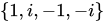


 Comment: So far all the sources I've read are backing the contents properly. I think this will be a quick GA pass review. MathKeduor7 (talk) 08:45, 17 July 2025 (UTC)

 This nomination still needs an actual review, none of which is provided by the above discussion. —David Eppstein (talk) 01:03, 20 August 2025 (UTC)

 Approve Alt1a Graywhales (talk) 03:27, 21 August 2025 (UTC)


