NGC 3756
From Wikipedia, the free encyclopedia
| NGC 3756 | |
|---|---|
 NGC 3756 imaged by SDSS | |
| Observation data (J2000 epoch) | |
| Constellation | Ursa Major |
| Right ascension | 11h 36m 48.0146s[1] |
| Declination | +54° 17′ 36.930″[1] |
| Redshift | 0.004300±0.00000500[1] |
| Heliocentric radial velocity | 1,289±1 km/s[1] |
| Distance | 63.45 ± 2.22 Mly (19.454 ± 0.682 Mpc)[1] |
| Group or cluster | NGC 3898 group (LGG 250) |
| Apparent magnitude (V) | 12.11[1] |
| Characteristics | |
| Type | SAB(rs)bc[1] |
| Size | ~92,300 ly (28.29 kpc) (estimated)[1] |
| Apparent size (V) | 4.2′ × 2.1′[1] |
| Other designations | |
| IRAS 11340+5434, 2MASX J11364797+5417372, UGC 6579, MCG +09-19-134, PGC 35931, CGCG 268-063[1] | |
NGC 3756 is a intermediate spiral galaxy in the constellation of Ursa Major. Its velocity with respect to the cosmic microwave background is 1,466±12 km/s, which corresponds to a Hubble distance of 70.5 ± 5.0 Mly (21.62 ± 1.53 Mpc).[1] Additionally, 28 non-redshift measurements give a similar mean distance of 63.45 ± 2.22 Mly (19.454 ± 0.682 Mpc).[2] It was discovered by German-British astronomer William Herschel on 14 April 1789.[3]
NGC 3756 has a possible active galactic nucleus, i.e. it has a compact region at the center of a galaxy that emits a significant amount of energy across the electromagnetic spectrum, with characteristics indicating that this luminosity is not produced by the stars.[4][5]
Supernova
One supernova has been observed in NGC 3756:
- SN 1975T (type unknown, mag. 17.5) was discovered by Swiss astronomer Paul Wild on 28 December 1975.[8][9] It reached maximum brightness (mag. 15.7) around 11 January 1976, and although never officially classfied, its light curve suggested that it was a Type II supernova.[10]
Image gallery
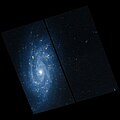 NGC 3756 imaged by the Hubble Space Telescope


