Portal:Western Australia
Wikipedia portal for content related to Western Australia
From Wikipedia, the free encyclopedia

Introduction
 Western Australia (WA) is the westernmost state of Australia. It is bounded by the Indian Ocean to the north and west, the Southern Ocean to the south, the Northern Territory to the north-east, and South Australia to the south-east. Western Australia is Australia's largest state, with a land area of 2,527,013 square kilometres (975,685 sq mi), and is also the second-largest subdivision of any country on Earth. Western Australia has a diverse range of climates, including tropical conditions in the Kimberley, deserts in the interior (including the Great Sandy Desert, Little Sandy Desert, Gibson Desert, and Great Victoria Desert) and a Mediterranean climate on the south-west and southern coastal areas. As of June 2024,[update] the state has 2.965 million inhabitants—10.9 percent of the national total. Over 90 percent of the state's population live in the south-west corner and around 80 percent live in the state capital Perth, leaving the remainder of the state sparsely populated. The Trans-Australian Railway and the Eyre Highway traverse the Nullarbor Plain in the state's south-east, providing the principal connection between Western Australia and the population centres in the eastern states. (Full article...)
|


.JPG)


.jpg)


(Northern
Territory) |
 Good articles -


Lakelands railway station is on the Mandurah line on the Transperth network in Western Australia. The station is in the Mandurah suburb of Lakelands, 6.5 kilometres (4.0 mi) north of Mandurah station and 64.5 kilometres (40.1 mi) south of Perth Underground station. Construction started in 2021 and it opened on 11 June 2023.
Provision for the station was made when the Mandurah line was built during the 2000s. There were several proposals to build the station during the 2010s but, when the state Labor Party came to power in 2017, it had committed to build the nearby Karnup station, not Lakelands. However, the federal Coalition government wanted Lakelands station to be built, and committed to funding 80% of the A$80 million required. The federal government refused requests for the funding to be transferred to the Karnup station project, and that project was put on hold so that the state could provide its share of funding for Lakelands. That resulted in accusations that the federal government was pork barrelling, because Lakelands station was in Liberal MP Andrew Hastie's seat, whereas Karnup station was in a safe Labor seat, held by Madeleine King. (Full article...)- Linda Yunkata Syddick Napaltjarri (born c. 1937) is a Pintupi- and Pitjantjatjara- speaking Indigenous artist from Australia's Western Desert region. Her father was killed when she was young; her mother later married Shorty Lungkarta Tjungarrayi, an artist whose work was a significant influence on Syddick's painting.
Syddick was one of many Western Desert women who took up painting in the early 1990s, as part of a broader contemporary Indigenous Australian art movement. She began painting some time prior to 1991, when her work was first exhibited in Alice Springs. Her work includes a distinctive fusion of Christian and Aboriginal traditional themes and motifs. She has been a finalist in the National Aboriginal & Torres Strait Islander Art Awards on at least four occasions, and in the Blake Prize (a religious art competition) at least three times. Her works are held by numerous galleries including the National Gallery of Australia, the Art Gallery of New South Wales and the Art Gallery of South Australia. Syddick was the subject of a portrait painted by Robert Hannaford, which was a 1992 finalist in Australia's premiere portrait competition, the Archibald Prize. (Full article...)
Leederville railway station is a suburban railway station on the boundary of Leederville and West Leederville, suburbs of Perth, Western Australia. The station is on the Yanchep line and is part of the Transperth network. Located within the median strip of the Mitchell Freeway, Leederville station consists of an island platform connected to either side of the freeway by a footbridge.
The initial master plan for the Yanchep line (then known as the Joondalup line or Northern Suburbs Railway) gave provisions for Leederville station but stated it would not be constructed at first. The station was later added to the construction program to offset complaints from local residents about a widening of the Mitchell Freeway. The station opened to limited service on 20 December 1992 as one of three initial stations on the line. The remaining stations opened the following year and on 21 March 1993, full service on the Joondalup line commenced. The station has had minor upgrades since, with the platforms being extended in 2004 and a bus interchange opening in 2013. (Full article...)
Collier Road is a 4.7-kilometre (2.9 mi) main road in the north-eastern suburbs of Perth, Western Australia, linking Morley in the north-west to Bassendean in the south-east. It services an industrial area in Bayswater and Bassendean, the Morley business district, and connects to Tonkin Highway. Collier Road first existed as a gravel track in the 1910s. The 1950s and 1960s saw the land around Collier Road change from rural to urban. It has undergone a major realignment twice, first in the mid-1980s to make room for a larger shopping centre in Morley, and between 2016 and 2018, for the construction of an interchange with Tonkin Highway. (Full article...)
The 11th Battalion was an Australian Army battalion that was among the first infantry units raised during World War I for the First Australian Imperial Force. It was the first battalion recruited in Western Australia, and following a brief training period in Perth, the battalion sailed to Egypt where it undertook four months of intensive training. In April 1915 it took part in the invasion of the Gallipoli Peninsula, landing at Anzac Cove. In August 1915 the battalion was in action in the Battle of Lone Pine. Following the withdrawal from Gallipoli, the battalion returned to Egypt where it was split to help form the 51st Battalion. In March 1916, the battalion was deployed to the Western Front in France and Belgium where it took part in trench warfare until the end of the war in November 1918.
The battalion was disbanded in 1919, but since 1921 has been re-activated and merged several times as a reserve unit, initially as the 11th Battalion (City of Perth Regiment), which fought a brief campaign against the Japanese on New Britain during World War II. Other units that have maintained the traditions of the original 11th Battalion include the 11th/44th Battalion (City of Perth Regiment), 'A' (City of Perth) Company, 1st Battalion, Royal Western Australia Regiment and the current 11th/28th Battalion, Royal Western Australia Regiment. (Full article...)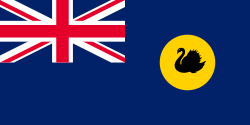
The state flag of Western Australia consists of a Blue Ensign defaced with the badge of the state. Adopted in 1953 to replace a similar design used from the time when the state was still a British colony, it has been the flag of Western Australia since 3 November of that year. The design of the present flag entailed reversing the direction of the black swan so that it faced towards the hoist. This was done in order to adhere to vexillological convention. Western Australia's flag is similar to the flags of the other five Australian states, which are also Blue Ensigns with their respective state badges. When flown with those state flags and the national flag, it is sixth in the order of precedence. This is indicative of its position on the Commonwealth Coat of Arms. (Full article...)
Tonkin Highway is an 81-kilometre-long (50 mi) north–south highway and partial freeway in Perth, Western Australia, linking Perth Airport and Kewdale with the city's north-eastern and south-eastern suburbs. As of April 2020, the northern terminus is at the interchange with Brand Highway and Great Northern Highway in Muchea, and the southern terminus is at Thomas Road in Oakford. It forms the entire length of State Route 4, and connects to several major roads. Besides Brand Highway and Great Northern Highway, it also connects to Reid Highway, Great Eastern Highway, Leach Highway, Roe Highway, and Albany Highway.
Planning for the route began in the 1950s, but the first segment between Wattle Grove and Cloverdale was not opened until 1980. Over the next five years, the highway was extended north to Great Eastern Highway and south to Albany Highway, and a discontinuous section was constructed north of the Swan River. In 1988 the Redcliffe Bridge linked these sections, and three years later, Reid Highway became the northern terminus. The next major works on the highway, between 2003 and 2005, extended the highway south to Thomas Road. (Full article...)
Cullacabardee is a northeastern rural suburb of Perth, the capital city of Western Australia, located 21 km (13 mi) from Perth's central business district via Alexander Drive or Beechboro Road. It is in the City of Swan local government area. Most of the suburb is covered in native sheoak and banksia forest. A small Noongar community is based on Baal Street, a drug rehabilitation retreat is located off Gnangara Road in the suburb's northeast, and the Perth International Telecommunications Centre facility is based in the suburb's northwest. (Full article...)
Victoria Park railway station is a suburban railway station on the Transperth network in Western Australia. The station is in the Perth suburbs of Lathlain and Victoria Park. Between November 2023 and June 2025, the station was the terminus of the Armadale and Thornlie lines due to the Victoria Park-Canning Level Crossing Removal Project.
The first Victoria Park station opened in 1898 after lobbying by the Municipality of Victoria Park. It gained a station master in 1922, which lasted until 1969. The Victoria Park section of the Armadale line underwent several improvements in the 2000s. Lathlain station closed in 2003, and a nearby level crossing was removed and replaced with a bridge. The Thornlie line commenced services on 7 August 2005, enabling most Armadale services to skip the station. In 2007, construction started on a new Victoria Park station, 230 metres (750 ft) south of the original station and closer to the demolished Lathlain station. The new station had greater accessibility and was no longer on a curve, which allowed for a smaller platform gap. The new Victoria Park station opened on 2 August 2008, and the old one was demolished soon afterwards. (Full article...)
Albany Highway links Western Australia's capital city Perth with its oldest settlement, Albany, on the state's south coast. The 405-kilometre-long (252 mi) highway travels through the southern Wheatbelt and Great Southern regions, and is designated State Route 30 for most of its length. Outside of Perth the highway is predominately a sealed, single carriageway with regular overtaking lanes in some undulating areas. Albany Highway commences at The Causeway, a river crossing that connects to Perth's central business district. The highway heads south-east through Perth's metropolitan region, bypassed in part by Shepperton Road and Kenwick Link, and continues south-eastwards through to Albany. It intersects several major roads in Perth, including the Leach, Tonkin, Brookton, and South Western highways. The rural section of Albany Highway connects to important regional roads at the few towns and roadhouses along the route, including Coalfields Highway at Arthur River, Great Southern Highway at Cranbrook, and Muir Highway at Mount Barker.
Prior to European settlement, the indigenous Noongar people had a considerable network of tracks, including a trade route between the areas now known as Perth and Albany. Construction of a road between Perth and Albany began soon after the naming of Albany in 1832, but progress was slow, with only 16 miles (26 km) completed by 1833. A monthly mail route which operated in the 1840s had such trouble with the journey that a new contractor was required each year, and from 1847 the mail route detoured via Bunbury. The introduction of convicts in 1850, and thus convict labour, allowed a road along the direct route to be fully constructed by 1863. (Full article...)
Eyre Highway is a 1,664-kilometre (1,034 mi) highway linking Western Australia and South Australia via the Nullarbor Plain. Signed as National Highways 1 and A1, it forms part of Highway 1 and the Australian National Highway network linking Perth and Adelaide. It was named after explorer Edward John Eyre, who was the first European to cross the Nullarbor by land, in 1840–1841. Eyre Highway runs from Norseman in Western Australia, past Eucla, to the state border. Continuing to the South Australian town of Ceduna, it crosses the top of the Eyre Peninsula before reaching Port Augusta.
The construction of the East–West Telegraph line in the 1870s, along Eyre's route, resulted in a hazardous trail that could be followed for interstate travel. A national highway was called for, with the federal government seeing the route's importance in 1941, when a war in the Pacific seemed imminent. The highway was constructed between July 1941 and June 1942, and was trafficable by January 1942. It was originally named Forrest Highway, after John Forrest, by the war cabinet. It was officially named Eyre Highway, a name agreed upon by the states' nomenclature committees. (Full article...)
The 2010 Gascoyne River flood was regarded as the most severe flood to take place along the Gascoyne River in Western Australia on record. Triggered by record-breaking rainfall, amounting to over 6,000 percent of the monthly mean, 313.6 mm (12.35 in) and 5 mm (0.20 in) respectively, in just four days, the floods caused widespread damage in the region. By 17 December, the river began to rise in response to the heavy rains, eventually exceeding its banks within two days. Water levels reached record values at three stations along the river, cresting at 15.53 m (51.0 ft) near Fishy Pool. Evacuation orders were issued for several towns affected by rising waters. The most substantial impact was felt in Carnarvon where entire homes were washed away. Following the disaster, emergency supplies and funds were distributed to affected residents to aid them in restoring their livelihoods. Though no people died in the event, an estimated two thousand head of cattle perished and damage was estimated at A$100 million. (Full article...)
Glencora McGhie (née Ralph; born 8 August 1988) is an Australian water polo centre back/driver. She attended the Curtin University of Technology and is a dental therapist. She competes for the Fremantle Marlins in the Australian National Water Polo League, and was on sides that won the league championship in 2003, 2004, 2006 and 2007. She has been a member of the Australia women's national water polo team on the junior and senior level. She has won gold medals at the 2011 Canada Cup and at the 2007 FINA Junior World Championships. She won silver medals at the 2010 FINA World League Super Finals and at the 2010 FINA Women's Water Polo World Cup. She won a bronze medal at the 2009 FINA World League Super Finals. She was part of the Australian water polo team that won bronze at the 2012 Summer Olympics and competed in the 2016 Summer Olympics. (Full article...)
Charles Christian Porter (born 11 July 1970) is an Australian former politician and lawyer who served as the 37th Attorney-General of Australia from 2017 to 2021 in the Turnbull government and the subsequent Morrison government. He was a Member of Parliament (MP) for the Division of Pearce from 2013 to 2022 and a member of the Liberal Party of Australia. Porter also served as Leader of the House and Minister for Industrial Relations from 2019 to 2021, and Minister for Industry, Science and Technology in 2021 following his resignation as attorney-general.
From Perth, Porter attended Hale School, the University of Western Australia and later the London School of Economics, and practised law at Clayton Utz and taught law at the University of Western Australia before his election to parliament. He is the son of the 1956 Olympic silver medallist, Charles "Chilla" Porter and the grandson of Queensland Liberal politician, Charles Porter, who was a member of the Queensland Legislative Assembly from 1966 to 1980. (Full article...)
Eglinton railway station is a suburban rail station in Eglinton, a suburb of Perth, Western Australia. Situated on Transperth's Yanchep line, the station consists of two side platforms within a cutting below a ground-level concourse, with a bus interchange.
Since planning for the Yanchep line, originally known as the Joondalup line, began in the 1980s, it has been planned to eventually be extended to Yanchep. After an extension to Butler opened in 2014, detailed planning began for a 14.5-kilometre (9.0 mi), three-station extension to Yanchep, which included Eglinton station. Construction began in mid-2020. Originally planned to be completed by the end of 2021, the extension opened on 14 July 2024. (Full article...)


.jpg)


.jpg)


Did you know (auto-generated)

- ... that Bill Dunn, an Indigenous Australian pastoralist approaching retirement, sold his station at half-price to the Jigalong community despite receiving full-price offers from non-Indigenous people?
- ... that Dan Bull was a keyboardist for Eskimo Joe before he was elected to the Western Australian Legislative Assembly?
Categories

More portals


More did you know...

- ...that when the 1987 America's Cup was raced off Fremantle, Western Australia it was the first time for 132 years that the regatta had not been hosted by the New York Yacht Club?
- ...that the original Victoria Dam, constructed in 1891, was the first dam in Western Australia, and it stood for almost 100 years before being replaced with the current dam?
- ...that Anglican bishop Kay Goldsworthy was consecrated as the first woman bishop of any Australian church on 22 May 2008?
Related WikiProjects


Things you can do
Here are some tasks you can do to help with WikiProject Western Australia:
| Vital articles: | 100 Most Influential Western Australians is a possible starting point | |
| Requested articles: | Nicholson, Western Australia • Robin Sarah Greenburg (see Crimenet page) • Indiana Teahouse | |
| Missing topics: | Peter M. Olde • Neil R. Marriott • Christopher J. French • 1962 British Empire and Commonwealth Games Parade of Nations • See missing topics report for more | |
| Draft articles: | Search for Western Australia drafts • Search for Perth drafts • See draft articles listing for more | |
| Split topic articles: | See Split topic listing for more | |
| Seeking sources: | William Harris (Australian civil rights leader) • Michael Kailis | |
| Expansion needed: | David Parker • Economy of Western Australia • Bill Hassell • May Holman • Barry MacKinnon • PGA • Pilbara historical timeline • List of WA waterfalls • tourism sections needed in Western Australia • Thomas Hughes (Australian politician) - needs expansion from cultural sources | |
| Requested images: | Requested photographs in Western Australia • Requested photographs in Perth | |
| Article cleanup: | See Cleanup listing | |
| Popular pages: | See Popular pages listing (related changes) – improvements to (or vandalism of) these articles will impact a larger number of readers | |
| Assessment: | See Unassessed WA articles and Unknown-importance WA articles | |
| Outreach projects: |
Associated Wikimedia
The following Wikimedia Foundation sister projects provide more on this subject:
-
 Commons
Free media repository -
 Wikidata
Free knowledge base -
 Wikiquote
Collection of quotations -
 Wikisource
Free-content library -
 Wikispecies
Directory of species -
 Wikiversity
Free learning tools -
 Wikivoyage
Free travel guide -
 Wiktionary
Dictionary and thesaurus


