Portal:South East England
Wikipedia portal for content related to South East England
From Wikipedia, the free encyclopedia

The South East England Portal

South East England is one of the nine official regions of England that are in the top level category for statistical purposes. It consists of the nine counties of Berkshire, Buckinghamshire, East Sussex, Hampshire, the Isle of Wight, Kent, Oxfordshire, Surrey and West Sussex. South East England is the third-largest region of England, with a land area of 19,072 square kilometres (7,364 sq mi), and is also the most populous with a total population of 9,642,942 in 2024.
South East England contains eight legally chartered cities: Brighton and Hove, Canterbury, Chichester, Milton Keynes, Oxford, Portsmouth, Southampton and Winchester. Officially it does not include London, which is a separate region. The geographical term for "South East England" may differ from the official definition of the region; for example, London, Bedfordshire, Hertfordshire and Essex are sometimes colloquially referred to as being in the south east of England. This article only considers the South East as being the official statistical region.
In medieval times, South East England included much of the Kingdom of Wessex, which was the precursor to the modern state of England. Winchester was the capital of England after unification of the various states, including the kingdoms of Kent, Sussex and Mercia. Winchester stopped being the administrative capital of England some time in the 13th century as its influence waned while the City of London dominated commerce. The last monarch to be crowned at Winchester was Richard II in 1377, although the last monarch to be crowned by the Bishop of Winchester was Queen Mary I in 1553.
Today, the region's close proximity to London has led to South East England becoming a prosperous economic hub with the largest economy of any region in the UK, after London. The region is home to Gatwick Airport (the UK's second busiest airport). The coastline along the English Channel provides numerous ferry crossings to mainland Europe. South East England is also known for its countryside, which includes two national parks: the New Forest and the South Downs, as well as the North Downs, the Chiltern Hills and part of the Cotswolds. The River Thames flows through the region and its basin is known as the Thames Valley.
It is also the location of a number of internationally known places of interest, such as HMS Victory in Portsmouth, Cliveden in Buckinghamshire, Thorpe Park and RHS Wisley in Surrey, Blenheim Palace in Oxfordshire, Windsor Castle in Berkshire, Leeds Castle, the White Cliffs of Dover and Canterbury Cathedral in Kent, Brighton Palace Pier, and Hammerwood Park in East Sussex, and Wakehurst Place in West Sussex. The region has many universities; the University of Oxford is the oldest in the English-speaking world, and ranked among the best in the world.
South East England is host to various sporting events, including the annual Henley Royal Regatta, Royal Ascot and The Derby, and sporting venues include Wentworth Golf Club and Brands Hatch. Some of the events of the 2012 Summer Olympics were held in the south east, including the rowing at Eton Dorney and part of the cycling road race in the Surrey Hills. (Full article...)
Selected article

The Battle of Bonchurch took place in late July 1545 at Bonchurch on the Isle of Wight. No source gives the precise date, although 21 July is possible from the sequence of events. The battle was a part of the wider Italian War of 1542–1546, and took place during the French invasion of the Isle of Wight. Several landings were made, including at Bonchurch. Most accounts suggest that England won the battle, and the French advance across the island was halted.
The battle was between French regular soldiers, and local English militiamen. Although the French force that landed was considerably larger than the English force, it is thought that the number of French soldiers involved in this battle to be about 500, with the number of militiamen uncertain, with one source stating 300 and another 2,800. The English forces are believed to have been commanded by Captain Robert Fyssher, and the French by Le Seigneur de Tais.
The battle was one of several fought between English and French on the Isle of Wight. The majority of sources state that the English won this battle, although one suggests that the French were victorious. The battle was fought as part of the French attempt to cause enough damage to force English ships to leave their defensive positions and attack in less favourable conditions, which was something they failed to achieve and thus had to withdraw from the island Other French landings were made at Sandown, Bembridge, and St Helens. (Full article...)
Selected pictures
 Breamore House in the west of the county, north of the New Forest (from Portal:Hampshire/Selected pictures)
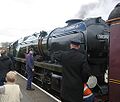 A train on the Watercress Line (from Portal:Hampshire/Selected pictures)
 Heathland in the New Forest (from Portal:Hampshire/Selected pictures)
 Panoramic view of Blenheim Palace (from Portal:Oxfordshire/Selected pictures)
 Credit: Michael RoweDover Castle is situated at Dover, Kent and has been described as the "Key to England" due to its defensive significance throughout history. (from Portal:Kent/Selected pictures)
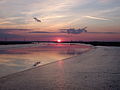 Credit: Adam MillerThe Swale refers to the strip of water separating North Kent from the Isle of Sheppey. (from Portal:Kent/Selected pictures)
 Credit: C HoyleBrockhill Country Park is dominated by a large grassy valley, bisected by the Brockhill Stream as it makes its way to the Royal Military Canal at Hythe. (from Portal:Kent/Selected pictures)

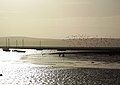 Winter sunshine at Keyhaven (from Portal:Hampshire/Selected pictures)
 Pineferous forest of the sandy Bagshot Formation spanning parts of four boroughs towards the north-west and in the far west of the county, with defensive positions for historic army training near Deepcut and Pirbright (from Portal:Surrey/Selected pictures)
 Credit: XtrememachineukThe Channel Tunnel is a 31 mile long rail tunnel beneath the English Channel connecting England to France. (from Portal:Kent/Selected pictures)
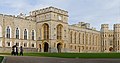 Windsor Castle Upper Ward Quadrangle (from Portal:Berkshire/Selected pictures)
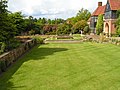 Lawns at RHS Garden, Wisley, north-east of Guildford (from Portal:Surrey/Selected pictures)
 Typical interior of old pub-restaurant, semi-rural example near Reigate in the east of the county (from Portal:Surrey/Selected pictures)
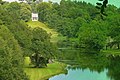 Painshill Park in Cobham has follies on natural, but landscaped slopes by part of the Mole disguised as ornamental lakes and the Great Cedar thought to be the largest Cedar of Lebanon in Europe. In the mid-north of the county. (from Portal:Surrey/Selected pictures)
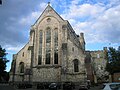 The West window of Romsey Abbey (from Portal:Hampshire/Selected pictures)
 Credit: Dave Bushell.A Eurostar on High Speed 1 going through the Medway Towns (from Portal:Kent/Selected pictures)
 Credit: StephenDawsonThe Channel Tunnel terminal at Cheriton near Folkestone in Kent, from the Pilgrims' Way on the escarpment on the southern edge of Cheriton Hill, part of the North Downs. (from Portal:Kent/Selected pictures)
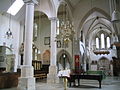 The interior of Portsmouth Cathedral (from Portal:Hampshire/Selected pictures)
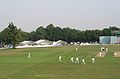 Credit: Paddy BriggsSt Lawrence Ground is the home of Kent County Cricket Club and is notable as a first-class cricket ground that has a tree within the boundary. (from Portal:Kent/Selected pictures)
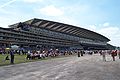 The grandstand at Ascot Racecourse (from Portal:Berkshire/Selected pictures)
 The seafront and beach at Lee-on-the-Solent (from Portal:Hampshire/Selected pictures)
 Credit: Tony HobbsScotney Castle is a country house with gardens in the valley of the River Bewl in Kent, England. (from Portal:Kent/Selected pictures)
 Credit: Hans MusilCanterbury Cathedral is one of the oldest and most famous Christian structures in England and forms part of a World Heritage Site. (from Portal:Kent/Selected pictures)
 Donnington Castle in Berkshire (from Portal:Berkshire/Selected pictures)
 Credit: O1iveBrockhill Country Park is dominated by a large grassy valley, bisected by the Brockhill Stream as it makes its way to the Royal Military Canal at Hythe. (from Portal:Kent/Selected pictures)
 One of the several golf courses in Woking's borough in the mid/north-west of the county (from Portal:Surrey/Selected pictures)
 Georgian hotel/restaurant typical of many larger Surrey villages and its oldest towns. (from Portal:Surrey/Selected pictures)
 Great Fosters restaurant/hotel, Runnymede (from Portal:Surrey/Selected pictures)
 Nemesis Inferno at Thorpe Park in the north-west of the county (from Portal:Surrey/Selected pictures)
 Reading Festival in 2007 (from Portal:Berkshire/Selected pictures)
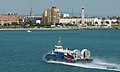 Hovercraft passing the mixed architecture, public gardens and shingle beach at Southsea, Portsmouth (from Portal:Hampshire/Selected pictures)
 Twyford Post Office and stores, between Winchester and Southampton (from Portal:Hampshire/Selected pictures)
 Credit: O1iveSt Mary in Castro (or St Mary de Castro) is the church at Dover Castle.(from Portal:Kent/Selected pictures)
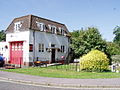 West End Fire Station, near Southampton, designed by Herbert Collins (from Portal:Hampshire/Selected pictures)
 A boat on the Basingstoke Canal (from Portal:Hampshire/Selected pictures)
 Mermaid Street in Rye showing typically steep slope and cobbled surface (from Portal:East Sussex/Selected pictures)
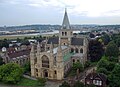 Credit: Sdwelch1031Rochester is a large town in Kent, England, at the lowest bridging point of the River Medway about 30 miles (50 km) from London. Construction of Rochester Cathedral, shown, began in about 1080. (from Portal:Kent/Selected pictures)
 Remains of the undercroft of the lay brothers' refectory at Waverley Abbey, near Farnham, main town of the Borough of Waverley (from Portal:Surrey/Selected pictures)


.jpg)


Selected biography

Plegmund (or Plegemund; died 2 August either 914 or 923) was a medieval English Archbishop of Canterbury. He may have been a hermit before he became archbishop in 890. As archbishop, he reorganised the Diocese of Winchester, creating four new sees, and worked with other scholars in translating religious works. He was canonised after his death. (Full article...)
On This Day in South East England
13 July:
- 1811: Architect Sir George Gilbert Scott was born in Gawcott, Buckinghamshire.
- 1908: Round the world yachtsman Sir Alec Rose was born in Canterbury.
Categories

Related portals


WikiProjects

Topics
Associated Wikimedia
The following Wikimedia Foundation sister projects provide more on this subject:
-
 Commons
Free media repository -
 Wikidata
Free knowledge base -
 Wikiquote
Collection of quotations -
 Wikisource
Free-content library -
 Wikiversity
Free learning tools -
 Wikivoyage
Free travel guide -
 Wiktionary
Dictionary and thesaurus


