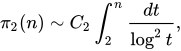
第一ハーディ・リトルウッド予想 From Wikipedia, the free encyclopedia 分野 数論提出者 G. H. HardyJohn Edensor Littlewood提出時期 1923公開問題 未解決第一ハーディ・リトルウッド予想 Plot showing the number of twin primes less than a given n. The first Hardy–Littlewood conjecture predicts there are infinitely many of these.分野 数論提出者 G. H. HardyJohn Edensor Littlewood提出時期 1923公開問題 未解決 数論において、第一ハーディ・リトルウッド予想[1]とは、素数定理を一般化することにより、与えられた大きさ未満の素数 k-組の個数に関する漸近公式を定式化したものである。これは1923年にG・H・ハーディとJ・E・リトルウッドによって初めて提唱された。[2] 正の偶数 m 1 , m 2 , … , m k {\displaystyle m_{1},m_{2},\ldots ,m_{k}} について、数列 P = ( p , p + m 1 , p + m 2 , … , p + m k ) {\displaystyle P=(p,p+m_{1},p+m_{2},\ldots ,p+m_{k})} の各数は、いかなる素数に対しても完全剰余類をなさないものとする。また、 π P ( n ) {\displaystyle \pi _{P}(n)} を p + m 1 , p + m 2 , … , p + m k {\displaystyle p+m_{1},p+m_{2},\ldots ,p+m_{k}} がすべて素数となるような、 n {\displaystyle n} 未満の素数 p {\displaystyle p} の個数とする。すると以下の漸化式が成り立つという予想である。[1][3] π P ( n ) ∼ C P ∫ 2 n d t log k + 1 t , {\displaystyle \pi _{P}(n)\sim C_{P}\int _{2}^{n}{\frac {dt}{\log ^{k+1}t}},} ここで C P = 2 k ∏ q prime, q ≥ 3 1 − w ( q ; m 1 , m 2 , … , m k ) q ( 1 − 1 q ) k + 1 {\displaystyle C_{P}=2^{k}\prod _{q{\text{ prime,}} \atop q\geq 3}{\frac {1-{\frac {w(q;m_{1},m_{2},\ldots ,m_{k})}{q}}}{\left(1-{\frac {1}{q}}\right)^{k+1}}}} は奇素数全体をわたる積であり、 w ( q ; m 1 , m 2 , … , m k ) {\displaystyle w(q;m_{1},m_{2},\ldots ,m_{k})} は 0 , m 1 , m 2 , … , m k {\displaystyle 0,m_{1},m_{2},\ldots ,m_{k}} をmod q {\displaystyle q} で見たときの異なる剰余の個数とする。 特に k = 1 {\displaystyle k=1} 、 m 1 = 2 {\displaystyle m_{1}=2} の場合は双子素数予想に関連する。このとき π 2 ( n ) {\displaystyle \pi _{2}(n)} は n より小さい双子素数の数を表す。このとき、 π 2 ( n ) ∼ C 2 ∫ 2 n d t log 2 t , {\displaystyle \pi _{2}(n)\sim C_{2}\int _{2}^{n}{\frac {dt}{\log ^{2}t}},} ここで C 2 = 2 ∏ q prime, q ≥ 3 ( 1 − 1 ( q − 1 ) 2 ) ≈ 1.320323632 … {\displaystyle C_{2}=2\prod _{\textstyle {q{\text{ prime,}} \atop q\geq 3}}\left(1-{\frac {1}{(q-1)^{2}}}\right)\approx 1.320323632\ldots } は双子素数定数。[3] スキューズ数 →詳細は「Prime k-tuple § Skewes numbers」を参照 素数 k-組に対するスキューズ数は第一ハーディ・リトルウッド予想に基づいて、スキューズ数の定義を素数 k-組に拡張したものである。k-組 P についてハーディ・リトルウッド不等式を満たさない最初の素数 p 、すなわち、 π P ( p ) > C P li P ( p ) , {\displaystyle \pi _{P}(p)>C_{P}\operatorname {li} _{P}(p),} を満たす(p がもし存在すれば) 最小の素数が素数 k-組に対するスキューズ数である。[3] 結果 この予想は、第二ハーディ・リトルウッド予想と矛盾することが示されている。[4] 一般化 ベイトマン・ホーン予想は第一ハーディ・リトルウッド予想を次数1以上の多項式に一般化した予想である。[1] 注釈 1 2 3 Aletheia-Zomlefer, Fukshansky & Garcia 2020. ↑ Hardy, G. H.; Littlewood, J. E. (1923). “Some Problems of 'Partitio Numerorum.' III. On the Expression of a Number as a Sum of Primes.”. Acta Math. 44 (44): 1–70. doi:10.1007/BF02403921. . 1 2 3 Tóth 2019. ↑ Richards, Ian (1974). “On the Incompatibility of Two Conjectures Concerning Primes”. Bull. Amer. Math. Soc. 80: 419–438. doi:10.1090/S0002-9904-1974-13434-8. 参考文献 Aletheia-Zomlefer, Soren Laing; Fukshansky, Lenny; Garcia, Stephan Ramon (2020). “The Bateman–Horn conjecture: Heuristic, history, and applications”. Expositiones Mathematicae 38 (4): 430–479. doi:10.1016/j.exmath.2019.04.005. ISSN 0723-0869. Tóth, László (January 2019). “On the Asymptotic Density of Prime k-tuples and a Conjecture of Hardy and Littlewood”. Computational Methods in Science and Technology 25 (3): 143–138. arXiv:1910.02636. doi:10.12921/cmst.2019.0000033. 表話編歴素数に関する予想 ハーディ・リトルウッド予想 1st 2nd Agoh–Giuga アンドリカ Artin's Bateman–Horn ブロカール ブニャコフスキー en:Chinese hypothesis Cramér's Dickson's Elliott–Halberstam Firoozbakht's Gilbreath's Grimm's ランダウの4の問題 ゴールドバッハ 弱 ルジャンドル 双子素数 ルジャンドル予想 Lemoine's メルセンヌ Oppermann's Polignac's ポリア en:Schinzel's hypothesis H Waring's prime number Related Articles~TimelinesTop QsFact Checks
 について、数列
  の各数は、いかなる素数に対しても完全剰余類をなさないものとする。また、
  を
を  がすべて素数となるような、
  未満の素数
未満の素数  の個数とする。すると以下の漸化式が成り立つという予想である。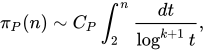
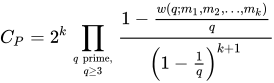
 は
は  をmod
をmod  で見たときの異なる剰余の個数とする。
 、
、  の場合は双子素数予想に関連する。このとき
  は n より小さい双子素数の数を表す。このとき、