Portal:Visual arts
From Wikipedia, the free encyclopedia

Introduction

The visual arts are art forms such as painting, drawing, printmaking, sculpture, ceramics, photography, video, image, filmmaking, design, crafts, and architecture. Many artistic disciplines such as performing arts, conceptual art, and textile arts, also involve aspects of the visual arts, as well as arts of other types. Within the visual arts, the applied arts, such as industrial design, graphic design, fashion design, interior design, and decorative art are also included.
Current usage of the term "visual arts" includes fine art as well as applied or decorative arts and crafts, but this was not always the case. Before the Arts and Crafts Movement in Britain and elsewhere at the turn of the 20th century, the term 'artist' had for some centuries often been restricted to a person working in the fine arts (such as painting, sculpture, or printmaking) and not the decorative arts, crafts, or applied visual arts media. The distinction was emphasized by artists of the Arts and Crafts Movement, who valued vernacular art forms as much as high forms. Art schools made a distinction between the fine arts and the crafts, maintaining that a craftsperson could not be considered a practitioner of the arts.
The increasing tendency to privilege painting, and to a lesser degree sculpture, above other arts has been a feature of Western art as well as East Asian art. In both regions, painting has been seen as relying on the imagination of the artist to the highest degree and being the furthest removed from manual labour – in Chinese painting, valued styles were "scholar-painting", at least in theory practiced by gentleman amateurs. The Western hierarchy of genres reflected similar attitudes. (Full article...)
Selected article
.jpg)
The Raft of the Medusa (French: Le Radeau de la Méduse [lə ʁado d(ə) la medyz]) – originally titled Scène de Naufrage (Shipwreck Scene) – is an oil painting of 1818–1819 by the French Romantic painter and lithographer Théodore Géricault (1791–1824). Completed when the artist was 27, the work has become an icon of French Romanticism. At 491 by 716 cm (16 ft 1 in by 23 ft 6 in), it is an over-life-size painting that depicts a moment from the aftermath of the wreck of the French naval frigate Méduse, which ran aground off the coast of today's Mauritania on 2 July 1816. On 5 July 1816, at least 150 people were set adrift on a hurriedly constructed raft; all but 15 died in the 13 days before their rescue, and those who survived endured starvation and dehydration and practiced cannibalism. The event became an international scandal, in part because its cause was widely attributed to the incompetence of the French captain. Géricault chose this large-scale uncommissioned work to launch his career, using a subject that had already generated widespread public interest. The event fascinated him.
Théodore Géricault's social circles had close family connections with the French navy and were directly involved in France's colonies and France's slave trade. Indeed, one of these relations, a naval officer and a slave owner, died defending France's colonial interests on the coast of west Africa in 1779 not far from the site of the Méduse shipwreck decades later. (Full article...)
Selected picture

Selected quote
| “ | The creative act is not performed by the artist alone; the spectator brings the work in contact with the external world by deciphering and interpreting its inner qualifications and thus adds his contribution to the creative act. | ” |
| — Marcel Duchamp, The Creative Act (1957) |
Related portals


Selected biography

El Lissitzky (Russian: Эль Лиси́цкий, born Lazar Markovich Lissitzky Russian: Ла́зарь Ма́ркович Лиси́цкий, listen; 23 November [O.S. 11 November] 1890 – 30 December 1941) was a Russian and Soviet artist, active as a painter, illustrator, designer, printmaker, photographer, and architect. He was an important figure of the avant-garde, helping develop suprematism with his mentor, Kazimir Malevich, and designing numerous exhibition displays and propaganda works for the Soviet Union.
Lissitzky began his career illustrating Yiddish children's books in an effort to promote Jewish culture. He started teaching at the age of 15, maintaining his teaching career for most of his life. Over the years, he taught in a variety of positions, schools, and artistic media, spreading and exchanging ideas. He took this ethic with him when he worked with Malevich in heading the suprematist art group UNOVIS, when he developed a variant suprematist series of his own, Proun, and further still in 1921, when he moved to Weimar Republic. In his remaining years he brought significant innovation and change to typography, exhibition design, photomontage, and book design, producing critically respected works and winning international acclaim for his exhibition design. This continued until his deathbed, where in 1941 he produced one of his last works – a Soviet propaganda poster rallying the people to construct more tanks for the fight against Nazi Germany. (Full article...)
Did you know (auto generated) -

- ... that to encourage the development of Bissau-Guinean cinema, one foreign filmmaker provided the country's film institute with cameras, lights, and a Steinbeck guitar?
- ... that the author of Sugar Dog Life ended up buying and raising a cactus after drawing one in the manga?
- ... that the filmmakers of Cyborgs wrote dialogue in both Russian and Ukrainian to show the diversity of the eponymous soldiers who defended Donetsk Airport in late 2014?
- ... that Sarah Pickstone based her John Moores Prize–winning painting on an illustration that accompanied the poem "Not Waving but Drowning"?
- ... that an Iowa nun's drawing of Eve and a pregnant Mary was described as "simple yet theologically dazzling"?
- ... that Dutch filmmaker Richard Raaphorst claimed that a boss character in Resident Evil Village copied the design of a monster he created for his 2013 film Frankenstein's Army?
- ... that Diane Orr and C. Larry Roberts were once said to "epitomize the regional, independent filmmaker"?
- ... that Io Kaziwara developed tendonitis while drawing the first volume of the manga series Reincarnated into Demon King Evelogia's World?
General images
 A fresco showing Hades and Persephone riding in a chariot, from the tomb of Queen Eurydice I of Macedon at Vergina, Greece, 4th century BC (from History of painting)
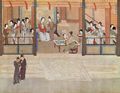 Spring Morning in the Han Palace, by Ming-era artist Qiu Ying (1494–1552 AD) (from History of painting)
 Bharat Mata by Abanindranath Tagore (1871–1951), a nephew of the poet Rabindranath Tagore, and a pioneer of the movement (from History of painting)
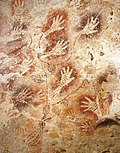 Hand stencils in the "Tree of Life" cave painting in Gua Tewet, Kalimantan, Indonesia (from History of painting)
 Max Beckmann, The Night (Die Nacht), 1918–1919, Kunstsammlung Nordrhein-Westfalen, Düsseldorf (from History of painting)
 In 2021, researchers discovered ancient cave art in Leang Tedongnge, Sulawesi, Indonesia, estimated to be at least 45,500 years old. Depicting a warty pig, this artwork is recognized as the world's oldest known example of figurative or representational art. (from History of painting)
 Francis Picabia, (Left) Le saint des saints c'est de moi qu'il s'agit dans ce portrait, 1 July 1915; (center) Portrait d'une jeune fille americaine dans l'état de nudité, 5 July 1915: (right) J'ai vu et c'est de toi qu'il s'agit, De Zayas! De Zayas! Je suis venu sur les rivages du Pont-Euxin, New York, 1915 (from History of painting)
 An Ethiopian illuminated Evangelist portrait of Mark the Evangelist, from the Ethiopian Garima Gospels, 6th century AD, Kingdom of Aksum (from History of painting)
 Poster to promote the Centennial of Argentina (1910) (from Graphic design)
 Graphic symbols are often functionalist and anonymous, as these pictographs from the US National Park Service illustrate. (from Graphic design)
 The Eternal Father Painting the Virgin of Guadalupe. Attributed to Joaquín Villegas (1713 – active in 1753) (Mexican) (painter, Museo Nacional de Arte. (from History of painting)
 The Sakyamuni Buddha, by Zhang Shengwen, 1173–1176 AD, Song dynasty period. (from History of painting)

 Joan Miró, Horse, Pipe and Red Flower, 1920, abstract Surrealism, Philadelphia Museum of Art (from History of painting)
 Loquats and Mountain Bird, anonymous artist of the Southern Song dynasty; paintings in leaf album style such as this were popular in the Southern Song (1127–1279). (from History of painting)
 Due to its interdisciplinary nature, graphic design can be performed in different areas of application: branding, technical and artistic drawing, signage, photography, image and video editing, 3D modeling, animation, programming, among other fields. (from Graphic design)
 Muromachi period, Shingei (1431–1485), Viewing a Waterfall, Nezu Museum, Tokyo. (from History of painting)

 Silk painting depicting a man riding a dragon, painting on silk, dated to 5th–3rd century BC, Warring States period, from Zidanku Tomb no. 1 in Changsha, Hunan Province (from History of painting)
 Spanish cave painting of Bulls (from History of painting)
 Golden section in book design (from Graphic design)
 Pictographs from the Great Gallery, Canyonlands National Park, Horseshoe Canyon, Utah, c. 1500 BCE (from History of painting)
 A Boeing 747 aircraft with livery designating it as Air Force One. The cyan forms, the US flag, presidential seal and the Caslon lettering, were all designed at different times, by different designers, for different purposes, and combined by designer Raymond Loewy in this one single aircraft exterior design. (from Graphic design)


 Two Scribes Seated with Books and a Writing Table Fragment of a decorative margin Northern India (Mughal school), ca. 1640–1650 (from History of painting)
 Colour (from Graphic design)
 Cover of the Thanksgiving 1895 issue of The Chap-Book, designed by Will H. Bradley (from Graphic design)
 Wayang beber, 17th century (from History of painting)
 Gwion Gwion rock paintings found in the north-west Kimberley region of Western Australia c. 15,000 BC (from History of painting)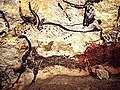
 Cueva de las Manos (Spanish for Cave of the Hands) in the Santa Cruz province in Argentina, c. 7300 BC (from History of painting)
 Diego Rivera, Recreation of Man at the Crossroads (renamed Man, Controller of the Universe), originally created in 1934, Mexican muralism movement (from History of painting)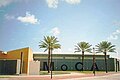
 Book of Hours (from History of painting)
 Mother Goddess A miniature painting of the Pahari style, dating to the eighteenth century. Pahari and Rajput miniatures share many common features. (from History of painting)
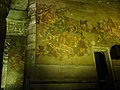 A fresco from Cave 1 of Ajanta. (from History of painting)
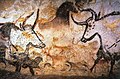 Lascaux, Bulls and Horses (from History of painting)
 Lascaux, Horse (from History of painting)
 Young Mother Sewing, Mary Cassatt (from History of painting)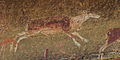




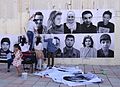 Irbid, Jordan, "We are Arabs. We are Humans". Inside Out is a global participatory art project, initiated by the French photographer JR, an example of Street art. (from Contemporary art)
 A Chinese painted jar from the Western Han Era (202 BCE – 9 CE) (from History of painting)


,_oil_on_canvas,_133_x_154_cm,_Kunstsammlung_Nordrhein-Westfalen,_Düsseldorf.jpg)


,_1922_-_Paul_Klee.jpg)


.jpg)


'_by_Barnett_Newman,_1968.jpg)


.JPG)


.jpg)

Major topics
- Types of visual art – Architecture • Art intervention • Ceramic art • Computer art • Drawing • Fashion • Film • Installation art • Land art • Mixed media • Painting • Performance art • Photography • Printmaking • Sculpture • Stained glass; • Artists' Books
- Art history – Pre-historic art • Ancient art • Art of Ancient Egypt • Art in Ancient Greece • Minoan pottery • Scythian art • Roman art • Women artists
- Western art periods and movements – Medieval art • Gothic art • Renaissance • Mannerism • Baroque • Rococo • Neoclassicism • Romanticism • Realism • Modern Art • Impressionism • Symbolism • Fauvism • Proto-Cubism • Cubism • Futurism • Dada • Art Deco • Surrealism • Abstract Expressionism • Lyrical abstraction • Conceptual Art • Contemporary Art • Postmodern art visual arts.
- Eastern and Middle Eastern art – Buddhist art • Chinese art • Islamic art • Japanese art • Laotian art • Thai art • Tibetan art
- Lists – Architects • Art movements • Art periods • Painters • Printmakers • Sculptors • Statues
- Lists of basic topics – Visual arts • Architecture • Film • Painting • Photography • Sculpture
Subcategories

Architecture | Ceramic art | Comics | Crafts | Design | Drawing | Illustration | Film | Glass | Graphic design | Industrial design | Landscape architecture | Multimedia | Painting | Photography | Pottery | Printmaking | Public art | Sculpture | Typography | Mosaic
Artists | Visual arts awards | Artist collectives | Art collectors | Art critics | Art curators | Visual arts exhibitions | Art forgery | Art history | Visual arts materials | Art schools | Artistic techniques |
WikiProjects
Things you can do

Associated Wikimedia
The following Wikimedia Foundation sister projects provide more on this subject:
-
 Commons
Free media repository -
 Wikidata
Free knowledge base -
 Wikiquote
Collection of quotations -
 Wikisource
Free-content library -
 Wikiversity
Free learning tools -
 Wiktionary
Dictionary and thesaurus


