Alkyne zipper reaction
From Wikipedia, the free encyclopedia
The alkyne zipper reaction is an organic reaction of unsaturated hydrocarbons. In the presence of an extremely strong base, a non-terminal alkyne isomerizes to a terminal alkynylide anion:

The reaction is an equilibrium reaction, and is driven by formation (and possibly precipitation) of the terminal anion.[1] The conversion proceeds for straight-chain alkynes and acetylinic ethers, and provides remote functionalization in long chains.[2]
Zipper isomerization was first reported by Alexey Favorsky in 1887.[3]
The alkyne zipper occurs through repeated isomerizations between an alkyne and an allene. First, the base deprotonates the less-substituted methylene adjacent to the alkyne group, to form an allene anion. The anion reprotonates, but at the other end. Then the base attacks the same lesser-substituted carbon on the allene, catalyzing a similar process to form an alkyne:[4][1]
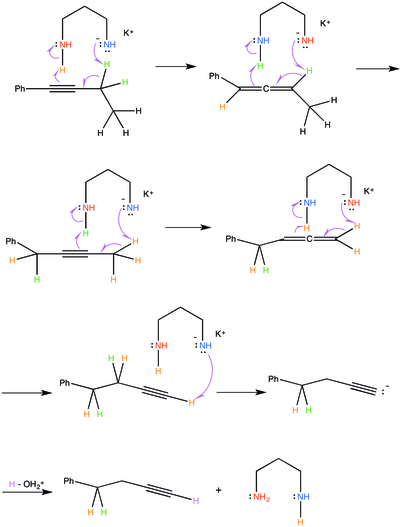
Through repetition, the alkyne/allene pseudoparticle can move arbitrarily along an unsubstituted alkane chain. When a terminal alkyne is achieved, the base instead attacks and removes the terminal proton.[1][4]
A mild acid workup quenches the equilibrium before reprotonating the acetylide anion.[1][4]
Choice of base
The alkyne zipper reaction requires a base strong enough to deprotonate the final alkyne to form a terminal alkynylide anion salt. Otherwise, the base sets up an isomerization equilibrium, but internal alkynes are thermodynamically favored over terminal alkynes.[1]
Potash amides, from the reaction of potassium hydride and a diamine, are sufficient, and the state of the art in 1975 was potassium 1,3-diaminopropanide, generated in situ from potassium hydride in 1,3-diaminopropane solvent.[1] Ethylenediamine cannot replace 1,3-diaminopropane.[citation needed]
Potassium hydride is expensive and hazardous, and a LiCKOR base is an acceptable substitute.[4] In the synthesis of 9-decyn-1-ol from 2-decyn-1-ol, a mixture of lithium 1,3-diaminopropanide and potassium tert-butoxide affords yields of approximately 85%:[2]
- HO–CH2C≡C–(CH2)6CH3 → HO(CH2)8–C≡CH
References
- 1 2 3 4 5 6 C. A. Brown and A. Yamashita (1975). "Saline hydrides and superbases in organic reactions. IX. Acetylene zipper. Exceptionally facile contrathermodynamic multipositional isomeriazation of alkynes with potassium 3-aminopropylamide". J. Am. Chem. Soc. 97 (4): 891–892. doi:10.1021/ja00837a034.
- 1 2 Suzanne R. Abrams and Angela C. Shaw (1988). "Triple Bond Isomerizations: 2- to 9-decyn-1-ol". Organic Syntheses. 66: 127; Collected Volumes, vol. 8, p. 146.
- ↑ Favorsky (1887), in J. Russ. Phys.-Chem. Soc., vol. 19, pp. 414–.
- 1 2 3 4 "Alkyne Zipper Reaction". SynArchive. 2017. Archived from the original on December 22, 2017. Retrieved December 19, 2017.
{{cite web}}: CS1 maint: bot: original URL status unknown (link)