Geography (from Ancient Greekγεωγραφίαgeōgraphía; combining gê 'Earth' and gráphō 'write', literally 'Earth writing') is the study of the lands, features, inhabitants, and phenomena of Earth. Geography is an all-encompassing discipline that seeks an understanding of Earth and its human and natural complexities—not merely where objects are, but also how they have changed and come to be. While geography is specific to Earth, many concepts can be applied more broadly to other celestial bodies in the field of planetary science. Geography has been called "a bridge between natural science and social science disciplines."
The history of geography as a discipline spans cultures and millennia, being independently developed by multiple groups, and cross-pollinated by trade between these groups. Geography as a discipline dates back to the earliest attempts to understand the world spatially, with the earliest example of an attempted world map dating to the 9th century BC in ancient Babylon. Origins of many of the concepts in geography can be traced to Greek Eratosthenes of Cyrene, who may have coined the term "geographia" (c.276 BC– c.195/194 BC). The first recorded use of the word γεωγραφία was as the title of a book by Greek scholar Claudius Ptolemy (100 – 170 AD). During the Middle Ages, geography was influenced by Islamic scholars, such as Muhammad al-Idrisi, producing detailed maps of the world. The Age of Discovery was influential in the development of geography, as European explorers mapped the New World. Modern developments include the development of geomatics and geographic information science.
The core concepts of geography consistent across all approaches are a focus on space, place, time, and scale. Today, geography is an extremely broad discipline with multiple approaches and modalities. The main branches of geography are physical geography, human geography, and technical geography. Physical geography focuses on the natural environment, human geography focuses on how humans interact with the Earth, and technical geography focuses on the development of tools for understanding geography. Techniques employed can generally be broken down into quantitative and qualitative approaches, with many studies taking mixed-methods approaches. Common techniques include cartography, remote sensing, interviews, and surveying. (Full article...)
A large eruption took place approximately 2,600 years ago. Guallatiri has been active in historical times with a number of eruptions, the latest in 1960. Fumarolic and seismic activity is ongoing and has resulted in the deposition of sulfur and other minerals on the volcano. The volcano is covered by an ice cap above 5,500 to 5,800m (18,000 to 19,000ft) that has shrunk and fragmented during the course of the 20th and 21st centuries. Guallatiri, along with several other volcanoes, is part of Lauca National Park and is monitored by the Chilean National Geology and Mining Service (SERNAGEOMIN). (Full article...)
The Riegelmann Boardwalk is primarily made of wooden planks arranged in a chevron pattern. It ranges from 50 to 80 feet (15 to 24m) wide and is raised slightly above sea level. The boardwalk connects several amusement areas and attractions on Coney Island, including the New York Aquarium, Luna Park, Deno's Wonder Wheel Amusement Park, and Maimonides Park. It has become an icon of Coney Island, with numerous appearances in the visual arts, music, and film. After its completion, the boardwalk was considered the most important public works project in Brooklyn since the Brooklyn Bridge, with a comparable impact to the Catskill Watershed and Central Park. (Full article...)
Image 4
T8's sister ship, T3, the only significant external difference was that T8 had two funnels
Following Austria-Hungary's defeat in 1918, 97 was allocated to the Navy of the Kingdom of Serbs, Croats and Slovenes, which later became the Royal Yugoslav Navy, and renamed T8. At the time, she and the seven other 250t-class boats were the only modern sea-going vessels of the fledgling maritime force. During the interwar period, T8 and the rest of the navy were involved in training exercises and cruises to friendly ports, but activity was limited by constrained naval budgets. The boat was captured by the Italians during the German-led Axisinvasion of Yugoslavia in April 1941. After her main armament was modernised, she served with the Royal Italian Navy under her Yugoslav designation, conducting coastal and second-line escort duties in the Adriatic Sea. Following the Italian capitulation in September 1943, T8 was sunk by German aircraft while attempting to escape to Allied-held southern Italy. (Full article...)
Image 5
Trafford is a metropolitan borough of Greater Manchester, England, with an estimated population of 241,025 in 2024. It covers 106 square kilometres (41sqmi) and includes the towns of Altrincham, Stretford, Urmston, Partington and Sale. The borough was formed in 1974 as a merger of six former districts and part of a seventh. The River Mersey flows through the borough, separating North Trafford from South Trafford, and the historic counties of Lancashire and Cheshire. Trafford is the seventh-most populous district in Greater Manchester.
Averaging about 5,400 feet (1,600m) in elevation, the park has a dry windy climate with temperatures that vary from summer highs of about 100°F (38°C) to winter lows well below freezing. More than 400 species of plants, dominated by grasses such as bunchgrass, blue grama, and sacaton, are found in the park. Fauna include larger animals such as pronghorns, coyotes, and bobcats; many smaller animals, such as deer mice, snakes, lizards, and seven kinds of amphibians; and more than 200 species of birds, some of which are permanent residents and many of which are migratory. About one third of the park is designated wilderness—50,260 acres (79sqmi; 203km2). (Full article...)
Image 7
Mayan city-states that have existed in Mesoamerica
Extent of Ali Bey and Daher's territory between 1768 and 1774 and Russian naval movements in the Levant, based on the accounts of Sauveur Lusignan, a contemporary historian Beirut was twice occupied during the Russo-Turkish War of 1768–1774 by squadrons of the Imperial Russian Navy's Mediterranean Fleet, first in June 1772 and second from October 1773 to early 1774, as part of its Levant campaign. Russia's main objective in this campaign was to assist local forces led by Egypt's autonomous ruler, Ali Bey al-Kabir, who was in open rebellion against the Ottoman Empire.
Russia, led by Catherine the Great, was pressing the Ottomans in Europe. Ali took advantage of the Empire's preoccupation with Russia to declare Egypt's independence; in 1771 he sent an army led by Muhammad Bey Abu al-Dhahab to occupy Ottoman territory in the Levant. Abu al-Dhahab unexpectedly returned to challenge Ali for control of Egypt. Ali requested Russian military assistance against both his rival and the Ottomans. When this aid, in the form of a small Russian squadron, arrived in the region, Ali had already fled Egypt and taken refuge in Acre, the power base of his ally, Daher al-Umar. After helping repel an Ottoman offensive on Sidon, the Russian squadron sailed for Beirut. They bombarded the town in June 1772 and occupied it from 23 to 28 June. (Full article...)
Image 9
A B-52G, similar to the one that crashed at Thule Air Base
The United States and Denmark launched an intensive clean-up and recovery operation, but the secondary stage of one of the nuclear weapons could not be accounted for after the operation was completed. USAF Strategic Air Command "Chrome Dome" operations were discontinued immediately after the accident, which highlighted the safety and political risks of the missions. Safety procedures were reviewed, and more stable explosives were developed for use in nuclear weapons. (Full article...)
Archduke Charles carried out major reforms to the Imperial Austrian Army, but the quality of it was diminished to some extent by the incompleteness of training and the Army's multinational nature. The French military relied on their talented emperor, veterans, whose numbers had dwindled over the course of recent wars, as well as the effective Napoleonic la maraude tactics. Napoleon, like the Austrians, had to cope with a multinational army, which included many foreign allies. On 10 April 1809, Austrian forces under Archduke Charles crossed the border of Bavaria, a French client state. The French response, under Louis-Alexandre Berthier, was disorganised but order was imposed with the arrival of Napoleon on 17 April. Napoleon led an advance to Landshut, hoping to cut off the Austrian line of retreat and sweep into their rear. Charles crossed the Danube at Regensburg, which allowed him to retreat eastwards, although he failed to reach the Austrian capital, Vienna, before the French. A French assault across the Danube was repulsed on 21–22 May at the Battle of Aspern-Essling but a repeat attack was successful in July. Napoleon won a major victory at the 5–6 July Battle of Wagram, which forced the Austrians to sign the Armistice of Znaim on 12 July. Austrian invasions of the Duchy of Warsaw and Saxony (where they fought alongside the Black Brunswickers) were repulsed and they were driven out of their territories in Italy. British forces landed in Walcheren, in the French client state of Holland, but were unable to seize their objective of capturing Antwerp and later withdrew. (Full article...)
Image 11
Amundsen, Hanssen, Hassel, and Wisting at Polheim at the South Pole
The first expedition to reach the Geographic South Pole was led by the Norwegian explorer Roald Amundsen. He and four other crew members made it to the geographical South Pole on 14December 1911, which was to be five weeks ahead of the British party led by Robert Falcon Scott as part of the Terra Nova Expedition. Amundsen and his team returned safely to their base, and about a year later heard that Scott and his four companions had perished on their return journey.
Amundsen's initial plans had focused on the Arctic and the conquest of the North Pole by means of an extended drift in an icebound ship. He obtained the use of Fridtjof Nansen's polar exploration ship Fram, and undertook extensive fundraising in a country that had gained its independence only some six years earlier. Preparations for this expedition were disrupted when, in 1909, the rival American explorers Frederick Cook and Robert Peary each claimed to have reached the North Pole - both claims are highly disputed. Amundsen then changed his plan and began to prepare for a conquest of the South Pole; uncertain of the extent to which the public and his backers would support him, he kept this revised objective secret. When he set out in June1910, he led even his crew to believe they were embarking on an Arctic drift, and revealed their true Antarctic destination only when Fram was leaving their last port of call, Madeira, on 9 September 1910. (Full article...)
Image 12
Mount Sylvania in Portland, Oregon, one of the major volcanoes in the field
The Boring Lava Field (also known as the Boring Volcanic Field) is a Plio-Pleistocenevolcanic field of cinder cones, small shield volcanoes, and lava flows in the northern Willamette Valley of the U.S. state of Oregon and adjacent southwest Washington. The volcanic field is named for the town of Boring, Oregon, located 12 miles (20km) southeast of downtown Portland and on the edge of the densest cluster of volcanic vents. The zone became volcanically active about 2.7million years ago, with long periods of eruptive activity interspersed with quiescence. Its last eruptions took place about 57,000 years ago at the Beacon Rock cinder cone volcano. The individual volcanic vents of the field are considered extinct, but the field itself is not.
The Boring Lava Field covers an area of about 1,500 square miles (3,900km2) and has a total volume of 2.4 cubic miles (10km3). This region sustains diverse flora and fauna within its habitat areas, which are subject to Portland's moderate climate. The highest point of the field is at Larch Mountain, which reaches an elevation of 4,055 feet (1,236m). (Full article...)
Image 13
Jeannette at Le Havre in 1878, prior to her departure for San Francisco in a trip that would see her round Cape Horn The Jeannetteexpedition of 1879–1881, officially called the U.S. Arctic Expedition, was an attempt led by George W. De Long to reach the North Pole by pioneering a route from the Pacific Ocean through the Bering Strait. The premise was that a temperate current, the Kuro Siwo, flowed northwards into the strait, providing a gateway to the hypothesized Open Polar Sea and thus to the pole.
This theory proved illusory; the expedition's ship, USSJeannette and its crew of thirty-three men, was trapped by ice and drifted for nearly two years before she was crushed and sunk north of the Siberian coast. De Long then led his men on a perilous journey by sled, dragging the Jeannette'swhaleboat and two cutters, eventually switching to these small boats to sail for the Lena Delta in Siberia. During this journey, and in the subsequent weeks of wandering in Siberia before rescue, twenty of the ship's complement died, including De Long. (Full article...)
Image 14
Disaster Peak and spring wildflowers in 2013
The Trout Creek Mountains are a remote, semi-arid Great Basin mountain range mostly in southeastern Oregon and partially in northern Nevada in the United States. The range's highest point is Orevada View Benchmark, 8,506 feet (2,593m) above sea level, in Nevada. Disaster Peak, elevation 7,781 feet (2,372m), is another prominent summit in the Nevada portion of the mountains.
The mountains are characteristic of the Great Basin's topography of mostly parallel mountain ranges alternating with flat valleys. Oriented generally north to south, the Trout Creek Mountains consist primarily of fault blocks of basalt, which came from an ancient volcano and other vents, on top of older metamorphic rocks. The southern end of the range, however, features many graniticoutcrops. As a whole, the faulted terrain is dominated by rolling hills and ridges cut by escarpments and canyons. (Full article...)
The eruption was preceded by a series of earthquakes and steam-venting episodes caused by an injection of magma at shallow depth below the volcano that created a large bulge and a fracture system on the mountain's north slope. An earthquake at 8:32:11am PDT (UTC−7) on May 18, 1980, caused the entire weakened north face to slide away, a sector collapse which was the largest subaerial landslide in recorded history. This allowed the partly molten rock, rich in high-pressure gas and steam, to suddenly explode northward toward Spirit Lake in a hot mix of lava and pulverized older rock, overtaking the landslide. An eruption column rose 80,000 feet (24km; 15mi) into the atmosphere and deposited ash in eleven U.S. states and various Canadian provinces. At the same time, snow, ice, and several entire glaciers on the volcano melted, forming a series of large lahars (volcanic mudslides) that reached as far as the Columbia River, nearly 50 miles (80km; 260,000ft) to the southwest. Less severe outbursts continued into the next day, only to be followed by other large, but not as destructive, eruptions later that year. The thermal energy released during the eruption was equal to 26 megatons of TNT. (Full article...)
Asia (/ˈeɪʒə/ⓘAY-zhə, UK also /ˈeɪʃə/AY-shə) is the largest continent in the world by both land area and population. It covers an area of more than 44 million square kilometres, about 30% of Earth's total land area and 8% of Earth's total surface area. The continent, which has long been home to the majority of the human population, was the site of many of the first civilisations. Its 4.7billion people constitute roughly 60% of the world's population. (Full article...)
An animation showing the unfolding of a Dymaxion map, a projection of a world map onto the surface of a polyhedron (in this case, an icosahedron) and then flattened to form a two-dimensional map which retains most of the relative proportional integrity of the globe map. This type of map was invented by Buckminster Fuller and is one of several of his inventions to use the name Dymaxion.
The van der Grinten projection is a compromise map projection that is neither equal-area nor conformal. It projects the entire Earth into a circle, though the polar regions are subject to extreme distortion. The projection was the first of four proposed by Alphons J. van der Grinten in 1904, and, unlike perspective projections, is an arbitrary geometric construction on the plane. It was adopted as the National Geographic Society's reference map of the world from 1922 until 1988.
Typhoon Noru was the second-longest lasting tropical cyclone of the northwest Pacific Ocean on record. The fifth named storm of the 2017 Pacific typhoon season, it formed on July19 and reached peak intensity on July31 with 175km/h (110mph) 10-minute sustained winds. By this time, as shown in this satellite image, the typhoon was located south of Iwo Jima, and had taken on annular characteristics, with a symmetric ring of deep convection surrounding a 30km (19mi) well defined eye and fairly uniform cloud top temperatures. Traveling northwestward over an area of low ocean heat content, the eye became enlarged and ragged as the system weakened. By the time Noru made landfall over Wakayama Prefecture, Japan, on August7, it had been downgraded to a severe tropical storm. It then dissipated over the Sea of Japan on August9 as an extratropical cyclone.
Illustration of the Ptolemaicgeocentric model of the Universe (the theory that the Earth is the center of the universe) by Portuguese cosmographer and cartographer Bartolomeu Velho. Taken from his treatise Cosmographia, made in Paris, 1568. Notice the distances of the bodies to the centre of the Earth (left) and the times of revolution, in years (right).
The Aitoff projection is a modified azimuthal map projection first proposed by David A. Aitoff in 1889. Based on the equatorial form of the azimuthal equidistant projection, Aitoff halved longitudes from the central meridian, projected by the azimuthal equidistant, and then stretched the result horizontally into a 2:1 ellipse.
A c. 1650 map showing the Island of California, a long-held European misconception, dating from the 16th century, that California was not part of mainland North America but rather a large island separated from the continent by a strait now known instead as the Gulf of California. The belief persisted until the expeditions of Juan Bautista de Anza in 1774–76.
The Catalan Atlas is a medieval map in the Catalan language, created in 1375. Described as "the zenith of medieval map-work", it is the earliest known chart to use a compass rose. It was produced by the Majorcan cartographic school and is attributed to Abraham Cresques, a Jewish book illuminator described by a contemporary as a master of mappae mundi. It has been in the royal library of France (now the Bibliothèque nationale de France) since the time of King CharlesV. The atlas originally consisted of six vellum leaves, each about 64.5 by 50cm (25.4 by 19.7in), folded vertically and painted in various colours including gold and silver. This picture is a montage of eight pages (four leaves) of the atlas, depicting Europe, northern Africa and Asia.
Map: Strebe, using the Geocart map projection software
A two-point equidistant projection of Eurasia. All distances of other points from the two points marked in red (45°N 40°E and 30°N 110°E) are correct. This map is a derivative of NASA's Blue Marble summer month composite, with oceans lightened to enhance legibility and contrast.
The Lambert conformal conic projection is a conic map projection used for aeronautical charts, portions of the State Plane Coordinate System, and many national and regional mapping systems. It is one of seven projections introduced by Johann Heinrich Lambert in 1772. Conceptually, the projection seats a cone over the sphere of the Earth and projects the surface conformally onto the cone. The cone is unrolled, and the parallel that was touching the sphere is assigned unit scale. By scaling the resulting map, two parallels can be assigned unit scale, with scale decreasing between them and increasing outside them. Unlike other conic projections, no true secant form of this projection exists.
Zhang Heng began his career as a minor civil servant in Nanyang. Eventually, he became Chief Astronomer, Prefect of the Majors for Official Carriages, and then Palace Attendant at the imperial court. His uncompromising stance on historical and calendrical issues led to his becoming a controversial figure, preventing him from rising to the status of Grand Historian. His political rivalry with the palace eunuchs during the reign of Emperor Shun (r.125–144) led to his decision to retire from the central court to serve as an administrator of Hejian Kingdom in present-day Hebei. Zhang returned home to Nanyang for a short time, before being recalled to serve in the capital once more in 138. He died there a year later, in 139. (Full article...)
Generation Z, often shortened to Gen Z and informally known as Zoomers, is the demographic cohort succeeding Millennials and preceding Generation Alpha. Researchers and popular media use the mid-to-late 1990s as starting birth years and the early 2010s as ending birth years, with the generation typically being defined as people born from 1997 to 2012. Most members of Generation Z are the children of members of Generation X, and it is predicted that many will be the parents of Generation Beta. (Full article...)


 Featured article -




 Vital article
_without_New_Guinea.svg)


 Image: Chris RywaltAn animation showing the unfolding of a Dymaxion map, a projection of a world map onto the surface of a polyhedron (in this case, an icosahedron) and then flattened to form a two-dimensional map which retains most of the relative proportional integrity of the globe map. This type of map was invented by Buckminster Fuller and is one of several of his inventions to use the name Dymaxion.
 The geography of Australia, the world's smallest continent, encompasses a wide variety of biogeographic regions. By surface area, it is the sixth-largest country in the world, but as can be seen in this composite satellite image, much of the interior is arid desert. The vast majority of the human population is concentrated along the eastern and southeastern coasts, and it is the fiftieth most populous nation.
 Map: Strebe, using GeocartThe van der Grinten projection is a compromise map projection that is neither equal-area nor conformal. It projects the entire Earth into a circle, though the polar regions are subject to extreme distortion. The projection was the first of four proposed by Alphons J. van der Grinten in 1904, and, unlike perspective projections, is an arbitrary geometric construction on the plane. It was adopted as the National Geographic Society's reference map of the world from 1922 until 1988.
 Map: Strebe, using GeocartA gnomonic projection of a portion of the Northern Hemisphere, centered on the geographic North Pole. Such projections display all great circles as straight lines, resulting in any line segment on a gnomonic map showing the shortest route between the segment's two endpoints.
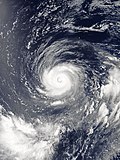 Typhoon Noru was the second-longest lasting tropical cyclone of the northwest Pacific Ocean on record. The fifth named storm of the 2017 Pacific typhoon season, it formed on July 19 and reached peak intensity on July 31 with 175 km/h (110 mph) 10-minute sustained winds. By this time, as shown in this satellite image, the typhoon was located south of Iwo Jima, and had taken on annular characteristics, with a symmetric ring of deep convection surrounding a 30 km (19 mi) well defined eye and fairly uniform cloud top temperatures. Traveling northwestward over an area of low ocean heat content, the eye became enlarged and ragged as the system weakened. By the time Noru made landfall over Wakayama Prefecture, Japan, on August 7, it had been downgraded to a severe tropical storm. It then dissipated over the Sea of Japan on August 9 as an extratropical cyclone.
 Photo credit: Joaquim Alves GasparIllustration of the Ptolemaic geocentric model of the Universe (the theory that the Earth is the center of the universe) by Portuguese cosmographer and cartographer Bartolomeu Velho. Taken from his treatise Cosmographia, made in Paris, 1568. Notice the distances of the bodies to the centre of the Earth (left) and the times of revolution, in years (right).
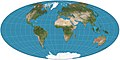 Map: Strebe, using GeocartThe Aitoff projection is a modified azimuthal map projection first proposed by David A. Aitoff in 1889. Based on the equatorial form of the azimuthal equidistant projection, Aitoff halved longitudes from the central meridian, projected by the azimuthal equidistant, and then stretched the result horizontally into a 2:1 ellipse.
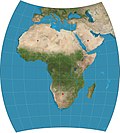 Map: Strebe, using GeocartThe Chamberlin trimetric projection is a map projection where three points are fixed on the globe and the points on the sphere are mapped onto a plane by triangulation. It was developed in 1946 by Wellman Chamberlin for the National Geographic Society. It is neither conformal nor equal-area, but rather attempts to minimize distortion of distances everywhere with the side-effect of balancing between areal equivalence and conformality.
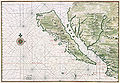 Map: Johannes Vingboons; Restoration: Lise BroerA c. 1650 map showing the Island of California, a long-held European misconception, dating from the 16th century, that California was not part of mainland North America but rather a large island separated from the continent by a strait now known instead as the Gulf of California. The belief persisted until the expeditions of Juan Bautista de Anza in 1774–76.
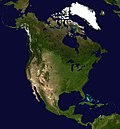 Photo: NASAA composite satellite image of the continent of North America in orthographic projection. North America occupies the northern portion of the landmass generally known as the Americas, with its southern border at the Darién watershed along the Colombia–Panama border. The vast majority of North America rests on the North American Plate, while small parts of California and western Mexico rest on the Pacific Plate; Central America and the Caribbean islands rest on the Caribbean Plate.
 Map: Strebe, using GeocartThe Eckert II projection is an equal-area pseudocylindrical map projection presented by Max Eckert-Greifendorff in 1906. In the equatorial aspect (where the equator is shown as the horizontal axis) the network of longitude and latitude lines consists solely of straight lines, and the outer boundary has the distinctive shape of an elongated hexagon.
 Earth at nightPhoto credit: NASA and NOAAEarth at night.
 Map credit: Abraham CresquesThe Catalan Atlas is a medieval map in the Catalan language, created in 1375. Described as "the zenith of medieval map-work", it is the earliest known chart to use a compass rose. It was produced by the Majorcan cartographic school and is attributed to Abraham Cresques, a Jewish book illuminator described by a contemporary as a master of mappae mundi. It has been in the royal library of France (now the Bibliothèque nationale de France) since the time of King Charles V. The atlas originally consisted of six vellum leaves, each about 64.5 by 50 cm (25.4 by 19.7 in), folded vertically and painted in various colours including gold and silver. This picture is a montage of eight pages (four leaves) of the atlas, depicting Europe, northern Africa and Asia.
 Map: Strebe, using the Geocart map projection softwareA two-point equidistant projection of Eurasia. All distances of other points from the two points marked in red (45°N 40°E and 30°N 110°E) are correct. This map is a derivative of NASA's Blue Marble summer month composite, with oceans lightened to enhance legibility and contrast.
 Map: Strebe, using GeocartThe Lambert conformal conic projection is a conic map projection used for aeronautical charts, portions of the State Plane Coordinate System, and many national and regional mapping systems. It is one of seven projections introduced by Johann Heinrich Lambert in 1772. Conceptually, the projection seats a cone over the sphere of the Earth and projects the surface conformally onto the cone. The cone is unrolled, and the parallel that was touching the sphere is assigned unit scale. By scaling the resulting map, two parallels can be assigned unit scale, with scale decreasing between them and increasing outside them. Unlike other conic projections, no true secant form of this projection exists.





.svg)
.svg)

.jpeg)


 Categories
 Commons
 Wikibooks
 Wikidata
 Wikinews
 Wikiquote
 Wikisource
 Wikiversity
 Wikivoyage
 Wiktionary


