Portal:Modern history
Wikipedia portal for content related to Modern history
From Wikipedia, the free encyclopedia

The Modern History Portal
Modern history encompasses the following topics:
- Early modern period – 1450–1750
- Modern era – 1750–1945
- Contemporary history – 1945–present (Full article...)
Selected articles -

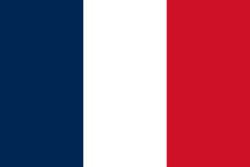
Free France (French: France libre) was a resistance government
claiming to be the legitimate government of France following the dissolution of the Third Republic during World War II. Led by General Charles de Gaulle, Free France was established as a government-in-exile in London in June 1940 after the Fall of France to Nazi Germany. It joined the Allied nations in fighting Axis forces with the Free French Forces (Forces françaises libres), supported the resistance in Nazi-occupied France, known as the French Forces of the Interior, and gained strategic footholds in several French colonies in Africa.
Following the defeat of the Third Republic by Nazi Germany, Marshal Philippe Pétain led efforts to negotiate an armistice and established a German client state known as Vichy France. Opposed to the idea of an armistice, de Gaulle fled to Britain and from there broadcast the Appeal of 18 June (Appel du 18 juin) exhorting the French people to resist the Nazis and join the Free French Forces. On 27 October 1940, the Empire Defense Council (Conseil de défense de l'Empire)—later the French National Committee (Comité national français or CNF)—formed to govern French territories in central Africa, Asia, and Oceania that had heeded the 18 June call.
Initially, with the exception of French possessions in the Pacific, India, and Equatorial Africa, all the territories of the French colonial empire rejected de Gaulle's appeal and reaffirmed their loyalty to Marshall Pétain and the Vichy government. It was only progressively, often with the decisive military intervention of the Allies, that Free France took over more Vichy possessions, securing the majority of colonies by November 1942. (Full article...)- The modern history of Los Angeles began in 1781 when 44 settlers from central New Spain (modern Mexico) established a permanent settlement in what is now Downtown Los Angeles, as instructed by Spanish Governor of Las Californias, Felipe de Neve, and authorized by Viceroy Antonio María de Bucareli. After sovereignty changed from Mexico to the United States in 1849, great changes came from the completion of the Santa Fe railroad line from Chicago to Los Angeles in 1885. "Overlanders" flooded in, mostly White Protestants from the Midwest and Upland South.
Los Angeles had a strong economic base in farming, oil, tourism, real estate and movies. It grew rapidly with many suburban areas inside and outside the city limits. Its motion picture industry made the city world-famous, and World War II brought new industry, especially high-tech aircraft construction. Politically the city was moderately conservative, with a weak labor union sector.
Since the 1960s, growth has slowed—and traffic delays have become infamous. Los Angeles was a pioneer in freeway development as the public transit system deteriorated. New arrivals, especially from Mexico and Asia, have transformed the demographic base since the 1960s. Old industries have declined, including farming, oil, military and aircraft, but tourism, entertainment and high-tech remain strong. Over time, droughts and wildfires have increased in frequency and become less seasonal and more year-round, further straining the city's water security. (Full article...)
The modern political history of the United Kingdom (1979–present) began when Margaret Thatcher gained power in 1979, giving rise to 18 years of Conservative government. Victory in the Falklands War (1982) and the government's strong opposition to trade unions helped lead the Conservative Party to another three terms in government. Thatcher initially pursued monetarist policies and went on to privatise many of Britain's nationalised companies such as British Telecom, British Gas Corporation, British Airways and British Steel Corporation. She kept the National Health Service. The controversial "poll tax" to fund local government was unpopular, and the Conservatives removed Thatcher as prime minister in 1990, although Michael Heseltine, the minister who did much to undermine her, did not personally benefit from her being ousted.
Thatcher's successor, John Major, replaced the "poll tax" with Council Tax and oversaw successful British involvement in the Gulf War. Despite a recession, Major led the Conservatives to a surprise victory in 1992. The events of Black Wednesday in 1992, party disunity over the European Union and several scandals involving Conservative politicians all led to the Labour Party winning a landslide election victory under Tony Blair in 1997. Labour had shifted its policies from the political left closer to the centre, under the slogan of 'New Labour'. The Bank of England was given independence over monetary policy and Scotland and Wales were given a devolved Scottish Parliament and Welsh Assembly respectively, whilst London wide local government was also re-established in the form of an Assembly and Mayor. The Good Friday Agreement was negotiated in 1997 in an effort to end The Troubles in Northern Ireland, with a devolved, power-sharing Northern Ireland Assembly being established in 1998.
Blair led Britain into the Afghanistan and Iraq Wars before leaving office in 2007, when he was succeeded by his chancellor, Gordon Brown. The 2008 financial crisis led to Labour's defeat in the 2010 election. It was replaced by a Conservative-Liberal Democrat coalition government, headed by David Cameron, that pursued a series of public spending cuts with the intention of reducing the budget deficit. In 2016, the UK voted in an advisory referendum to leave the European Union, which led to Cameron's resignation. Cameron was succeeded by his home secretary, Theresa May. (Full article...)- The history of Ireland from 1691–1800 was marked by the dominance of the Protestant Ascendancy. These were Anglo-Irish families of the Anglican Church of Ireland, whose English and Scottish ancestors had settled Ireland in the wake of its conquest by England and colonisation in the Plantations of Ireland, and had taken control of most of the land. Many were absentee landlords based in England, but others lived full-time in Ireland and increasingly identified as Irish. (See Early Modern Ireland 1536-1691). During this time, Ireland was nominally an autonomous Kingdom with its own Parliament; in actuality it was a client state controlled by the King of Great Britain and supervised by his cabinet in London. The great majority of its population, Roman Catholics, were excluded from power and land ownership under the penal laws. The second-largest group, the Presbyterians in Ulster, owned land and businesses but could not vote and had no political power. The period begins with the defeat of the Catholic Jacobites in the Williamite War in Ireland in 1691 and ends with the Acts of Union 1800, which formally annexed Ireland in a United Kingdom from 1 January 1801 and dissolved the Irish Parliament. (Full article...)
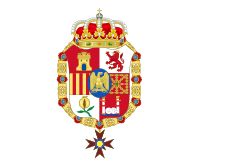
Spain in the 19th century was a country in turmoil. Under Napoleonic Spain from 1808 to 1814, the massively destructive "Peninsular War" ensued. Following the Spanish Constitution of 1812, Spain was divided between the constitution's liberal principles and the absolutism personified by the rule of Ferdinand VII, who repealed the 1812 Constitution for the first time in 1814, only to be forced to swear over the constitution again in 1820 after a liberal pronunciamiento, giving way to the brief Trienio Liberal (1820–1823). This brief period came to an abrupt end with Ferdinand again abolishing the 1812 constitution and the start of the Ominous Decade (1823–1833) of absolutist rule for the last ten years of his reign.
Economic transformations throughout the century included the privatisation of communal municipal lands—not interrupted but actually intensified and legitimised during the Fernandine absolutist restorations —as well as the confiscation of Church properties. The early century saw the loss of the bulk of the Spanish colonies in the New World in the 1810s and 1820s, except for Cuba and Puerto Rico.
The regency of Maria Christina and the reign of Isabella II brought reforms repealing the extremes of the absolutist Ominous Decade. Civil wars broke out in the country—the so-called Carlist Wars—pitting the government forces against the reactionary Carlists, a legitimist movement in favour of the ancien régime. Disaffection with Isabella's government and high disapproval from many people led to repeated military intervention in political affairs and to several revolutionary attempts against the government, including the 1854 revolution. The 1868 Glorious revolution deposed Isabella and installed a provisional government, leading up to the election of a constituent assembly under universal manhood suffrage that elaborated the 1869 constitution of the Kingdom of Spain. The brief spell of Amadeo of Savoy as constitutional monarch was followed after his abdication by the proclamation of the First Spanish Republic, which was replaced after a 1874 coup by the reign of Alfonso XII, bringing the Bourbon dynasty back to power. (Full article...)
The Cold War was a period of international geopolitical rivalry between the United States (US) and the Soviet Union (USSR) and their respective allies, the capitalist Western Bloc and communist Eastern Bloc. It began in the aftermath of the Second World War and ended with the dissolution of the Soviet Union in 1991. The term cold war is used because there was no direct fighting between the two superpowers, though each supported opposing sides in regional conflicts known as proxy wars. In addition to the struggle for ideological and economic influence and an arms race in both conventional and nuclear weapons, the Cold War was expressed through technological rivalries such as the Space Race, espionage, propaganda campaigns, embargoes, and sports diplomacy.
After the end of the Second World War in 1945, during which the US and USSR had been allies, the USSR installed satellite governments in its occupied territories in Eastern Europe and North Korea by 1949, resulting in the political division of Europe (and Germany) by an "Iron Curtain". The USSR tested its first nuclear weapon in 1949, four years after their use by the US on Hiroshima and Nagasaki, and allied with the People's Republic of China, founded in 1949. The US declared the Truman Doctrine of "containment" of communism in 1947, launched the Marshall Plan in 1948 to assist Western Europe's economic recovery, and founded the NATO military alliance in 1949 (matched by the Soviet-led Warsaw Pact in 1955). The Berlin Blockade of 1948 to 1949 was an early confrontation, as was the Korean War of 1950 to 1953, which ended in a stalemate.
US involvement in regime change during the Cold War included support for First World anti-communist and right-wing dictatorships and uprisings, while Soviet involvement included the funding of Second World left-wing parties, wars of independence, and dictatorships. As nearly all the colonial states underwent decolonization, many became Third World battlefields of the Cold War. Both powers used economic aid in an attempt to win the loyalty of non-aligned countries. The Cuban Revolution of 1959 installed the first communist regime in the Western Hemisphere, and in 1962, the Cuban Missile Crisis began after deployments of US missiles in Europe and Soviet missiles in Cuba; it is widely considered the closest the Cold War came to escalating into nuclear war. Another major proxy conflict was the Vietnam War of 1955 to 1975, which ended in defeat for the US. (Full article...)- The war on terror, officially the Global War on Terrorism (GWOT), is a global military campaign initiated by the United States in response to the September 11 attacks in 2001. A global conflict spanning multiple wars, some researchers and political scientists have argued that it replaced the Cold War.
The main targets of the campaign were militant Islamist movements such as al-Qaeda, the Taliban, and their allies. Other major targets included the Ba'athist regime in Iraq, which was deposed in an invasion in 2003, and various militant factions that fought during the ensuing insurgency. Following its territorial expansion in 2014, the Islamic State also emerged as a key adversary of the United States. In 2026, the United States and Israel launched a war on Iran, identifying it as the largest state sponsor of terrorism.
The term "war on terror" uses war as a metaphor to describe a variety of actions which fall outside the traditional definition of war. US president George W. Bush first used the term "war on terrorism" on 16 September 2001, and then "war on terror" a few days later in a formal speech to Congress. Bush indicated the enemy of the war on terror as "a radical network of terrorists and every government that supports them". The initial conflict was aimed at al-Qaeda, with the main theater in Afghanistan and Pakistan, a region that would later be referred to as "AfPak". The term "war on terror" was immediately criticized by individuals including Richard Myers, then chairman of the Joint Chiefs of Staff, and eventually more nuanced terms came to be used by the Bush administration to define the campaign. While "war on terror" was never used as a formal designation of US operations, a Global War on Terrorism Service Medal was and is issued by the US Armed Forces. (Full article...) - Cyprus was part of the British Empire, under military occupation from 1914 to 1925, and a Crown colony from 1925 to 1960. Cyprus became an independent nation in 1960. Cyprus became a republic in the Commonwealth of Nations during the 1961 Commonwealth Prime Ministers' Conference in March 1961. (Full article...)

An early nuclear power plant that used atomic energy to generate electricity
The Atomic Age, also known as the Atomic Era, is the period of history following the detonation of the first nuclear weapon, The Gadget at the Trinity test in New Mexico on 16 July 1945 during World War II. Although nuclear chain reactions had been hypothesized in 1933 and the first artificial self-sustaining nuclear chain reaction (Chicago Pile-1) had taken place in December 1942, the Trinity test and the ensuing bombings of Hiroshima and Nagasaki represented the first large-scale use of nuclear technology and ushered in profound changes in sociopolitical thinking and the course of technological development.
While atomic power was promoted for a time as the epitome of progress and modernity, entering into the nuclear power era also entailed frightful implications of nuclear warfare, the Cold War, mutual assured destruction, nuclear proliferation, the risk of nuclear disaster (potentially as extreme as anthropogenic global nuclear winter), as well as beneficial civilian applications in nuclear medicine. It is no easy matter to fully segregate peaceful uses of nuclear technology from military or terrorist uses (such as the fabrication of dirty bombs from radioactive waste), which complicated the development of a global nuclear-power export industry right from the outset.
In 1973, concerning a flourishing nuclear power industry, the United States Atomic Energy Commission predicted that by the turn of the 21st century, 1,000 reactors would be producing electricity for homes and businesses across the U.S. However, the "nuclear dream" fell far short of what was promised, because nuclear technology produced a range of social problems, from the nuclear arms race to nuclear meltdowns, and the unresolved difficulties of bomb plant cleanup and civilian plant waste disposal and decommissioning. After 1973, reactor orders declined sharply as electricity demand fell and construction costs rose. Many orders and partially completed plants were cancelled. (Full article...)- The history of Ireland between 1536 and 1691 saw the conquest and colonisation of the island by the English state and the settlement of tens of thousands of Protestant settlers from England, Wales and Scotland. Ireland had been partially conquered by England in the late twelfth and thirteenth centuries, yet had never been fully brought under English rule. The Tudor conquest of the sixteenth century largely reduced the Gaelic lords of Leinster, Munster, Connacht and Ulster to English rule, while colonial projects like the Munster Plantation and Ulster Plantation of the sixteenth and seventeenth centuries transformed landholding in the country. In the process the Irish were subordinated to the rule of London-based governments and a British Protestant minority became the dominant political and economic class ruling over an Irish Roman Catholic majority. The period is bounded by the dates 1536, when King Henry VIII deposed the FitzGerald dynasty as Lords Deputies of Ireland (the new Kingdom of Ireland was declared by Henry VIII in 1542), and 1691, when the Catholic Jacobites surrendered at Limerick, thus confirming Protestant dominance in Ireland. This is sometimes called the early modern period.
The English Reformation, by which Henry VIII broke with Papal authority in 1536, was to change Ireland totally. While Henry VIII broke English Catholicism from Rome, his son Edward VI moved further, breaking with Papal doctrine completely. While the English, the Welsh and, later, the Scots accepted Protestantism, the Irish remained Catholic. Queen Mary I then reverted the state to Catholicism in 1553–58, and Queen Elizabeth I broke again with Rome in 1559. These confusing changes determined their relationship with the British state for the next four hundred years, as the Reformation coincided with a determined effort on behalf of the English state to re-conquer and colonise Ireland thereafter. The religious schism meant that the native Irish and the (Roman Catholic) Old English were to be excluded from power in the new settlement unless they converted to Protestantism. (Full article...) - A History of the Modern World is a work initially published by the distinguished American historian at Princeton and Yale universities Robert Roswell Palmer in 1950. The work has since been extended by Joel Colton (from its second edition, 1956) and Lloyd S. Kramer (from its ninth edition, 2001), and currently counts 12 editions. First published in 1950, and translated into six languages, the book is used in more than 1,000 colleges and universities, as well as many high school advanced placement courses.
The second edition (1956), comprises two volumes, 20 main chapters and 110 sub-chapters. The author focuses on World History from a European perspective, and the newer editions also exists under the title "A History of Europe in the Modern World". (Full article...) - The terms Second Cold War, Cold War II, and New Cold War have been used by scholars and journalists to describe heightened geopolitical tensions in the 21st century post–Cold War era, usually between the United States on one side and Russia and/or China on the other. Russia is regarded as the successor state to the Soviet Union, which led the Eastern Bloc during the original Cold War. The terms are sometimes used to describe tensions in multilateral relations, including China–Russia relations, or in the context of international conflicts. Some commentators have used the terms as a comparison to the original Cold War, while others have discouraged their use to refer to any ongoing tensions. (Full article...)

The mission at 312 Azusa Street in 1907, Los Angeles, California, the United States, considered to be the birthplace of Pentecostalism.
The history of modern Christianity concerns the Christian religion from the beginning of the 15th century to the end of World War II. It can be divided into the early modern period and the late modern period. The history of Christianity in the early modern period coincides with the Age of Exploration, and is usually taken to begin with the Protestant Reformation c. 1517–1525 (usually rounded down to 1500) and ending in the late 18th century with the onset of the Industrial Revolution and the events leading up to the French Revolution of 1789. It includes the Protestant Reformation, the Counter-Reformation and the Catholic Church and the Age of Discovery. Christianity expanded throughout the world during the Age of Exploration. Christianity has thus become the world's largest religion. (Full article...)
From 1945 to 1990, the divided Germany began with the Berlin Declaration, marking the abolition of the German Reich and Allied-occupied period in Germany on 5 June 1945, and ended with the German reunification on 3 October 1990.
Following the collapse of the Third Reich in 1945 and its defeat in World War II, Germany was stripped of its territorial gains. Beyond that, more than a quarter of its old pre-war territory was annexed by communist Poland and the Soviet Union. The German populations of these areas were expelled to the west. Saarland was a French protectorate from 1947 to 1956 without the recognition of the "Four Powers", because the Soviet Union opposed it, making it a disputed territory.
At the end of World War II, there were some eight million foreign displaced people in Germany, mainly forced laborers and prisoners. This included around 400,000 survivors of the Nazi concentration camp system, where many times more had died from starvation, harsh conditions, murder, or being worked to death. Between 1944 and 1950, some 12 to 14 million German-speaking refugees and expellees arrived in Western and central Germany from the former eastern territories and other countries in Eastern Europe; an estimated two million of them died on the way there. Some nine million Germans were prisoners of war. (Full article...)- This is a timeline of modern Greek history. (Full article...)


.svg)


Need help?
Do you have a question about Modern history that you can't find the answer to?
Consider asking it at the Wikipedia reference desk.
General images -
The following are images from various modern history-related articles on Wikipedia.
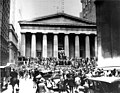 The Wall Street Crash of 1929 was a major factor contributing to the Great Depression (from 20th century)
 Hong Kong, under British administration from 1842 to 1997, is one of the original Four Asian Tigers. (from 20th century)
 The international community grew in the second half of the century significantly due to a new wave of decolonization, particularly in Africa. Most of the newly independent states, were grouped together with many other so called developing countries. Developing countries gained attention, particularly due to rapid population growth, leading to a record world population of nearly 7 billion people by the end of the century. (from 20th century)
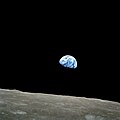 Earthrise, taken on 24 December 1968 by the American astronaut William Anders during the Apollo 8 space mission. It is the first photograph taken of Earth from lunar orbit. (from 20th century)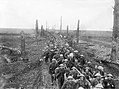
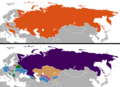 Changes in national boundaries after the end of the Cold War and the dissolution of the Soviet Union in 1991 (from 20th century)
 Map of territorial changes in Europe after World War I (as of 1923). (from 20th century)
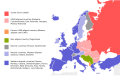 The division of Europe during the Cold War (from Contemporary history)
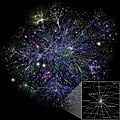 A visualization of the various routes through a portion of the Internet. Partial map of the Internet based in 2005 (from Contemporary history)
 The Siege of Leningrad during World War II is widely considered one of the most lethal sieges in history (from 20th century)
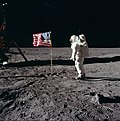 Photograph of the American astronaut Buzz Aldrin during the first moonwalk in 1969, taken by Neil Armstrong. The relatively young aerospace engineering industries rapidly grew in the 66 years after the Wright brothers' first flight. (from 20th century)

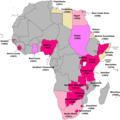 Decolonization of the British Empire in Africa. (from Contemporary history)
 Countries by real GDP growth rate in 2014. (Countries in brown were in recession.) (from Contemporary history)
 In 1924, Edwin Hubble announced that the Andromeda Nebula is actually a galaxy and that the Milky Way is just one of many galaxies in the universe. (from 20th century)
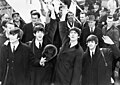 The Beatles in 1964, widely regarded as one of the most influential bands in Western popular music. (from 20th century)
 Ayatollah Ruhollah Khomeini was the Shia cleric who led the 1979 Iranian Revolution, overthrowing the Shah and establishing Iran as an Islamic Republic. (from 20th century)
 The mushroom cloud of the detonation of Little Boy, the first nuclear attack in history, on 6 August 1945 over Hiroshima, igniting the nuclear age with the international security dominating thread of mutual assured destruction in the latter half of the 20th century. (from 20th century)
 The Empire State Building is an iconic building of the 1930s. (from 20th century)
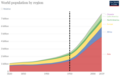 The 20th century saw an explosive increase in human population, rising from about 1.6 billion in 1900 to over 6 billion by 2000, with the Green Revolution (mid-20th century) being a key factor (from 20th century)
 The Blue Marble, Earth as seen from Apollo 17 in December 1972. The photograph is taken by LMP Harrison Schmitt. The second half of the 20th century saw humanity's first space exploration. (from 20th century)
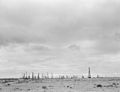 Oil field in California, US, in 1938. The first modern oil well is drilled in 1848 by the Russian engineer F.N. Semyonov, on the Apsheron Peninsula north-east of Baku. (from 20th century)
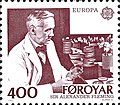 A stamp commemorating Alexander Fleming. His discovery of penicillin changed the world of medicine by introducing the age of antibiotics. (from 20th century)
 World powers and empires in 1914, just before the First World War.(from 20th century)
 Dutch colonial officer with Papuans in the Baliem Valley, Dutch New Guinea, 1958 (from 20th century)
 Martin Luther King Jr., an African American civil rights movement leader (Washington, August 1963) (from 20th century)
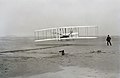 First flight of the Wright brothers' Wright Flyer on 7 December 1903 in Kitty Hawk, North Carolina, US; Orville piloting with Wilbur running at wingtip. (from 20th century)
.jpg)


.svg)


.jpg)


.jpg)


.jpg)

Related portals


.svg)
Related WikiProjects

Associated Wikimedia
The following Wikimedia Foundation sister projects provide more on this subject:
-
 Commons
Free media repository -
 Wikidata
Free knowledge base -
 Wikiquote
Collection of quotations -
 Wikisource
Free-content library -
 Wikiversity
Free learning tools -
 Wiktionary
Dictionary and thesaurus


Discover Wikipedia using portals


