Georgia is a country in the Caucasus region on the coast of the Black Sea. It is located at the intersection of Eastern Europe and West Asia, and is today generally regarded as part of Europe. It is bordered to the north and northeast by Russia; to the west by the Black Sea, to the south by Turkey and Armenia, and to the southeast by Azerbaijan. It has a population of 3.9 million, of which over a third live in Tbilisi, the capital and largest city. Georgians, who are native to the region and constitute the majority of the population, are ethno-linguistically distinct from all of their neighboring nations and primarily speak Georgian, a Kartvelian language that has no relation to any other language family in the world.
Kingdom of Georgia emerged in the early 11th century out of unification of various Georgian kingdoms, most notably the Kingdom of the Iberians and the Kingdom of Abkhazia. Lasting for nearly five centuries, the kingdom fell to the Mongol invasions in the 13th century, but managed to re-assert sovereignty by the 1340s. The following decades were marked by the Black Death, as well as numerous invasions under the leadership of Timur, who devastated the country's economy, population, and urban centers. The Kingdom's geopolitical situation further worsened after the conquest of the Byzantine Empire and the Empire of Trebizond by the Ottoman Turks. As a result of these processes, by the end of the 15th century Georgia turned into a fractured entity. This whole series of events also led to the final collapse of the kingdom into anarchy by 1466. (Full article...)
Born in Racha, in western Georgia, Svanidze eventually moved to Tiflis with her two sisters and brother, and worked as a seamstress. Her brother Alexander was a confidant of Stalin, then still known by his birth name of Ioseb Jughashvili, and introduced him to Svanidze in 1905. They were married in 1906 and she gave birth to son Yakov a few months later. The family moved to Baku to avoid arrest, though Svanidze got quite ill there and returned to Tiflis in 1907, dying shortly after her return, likely from typhoid or tuberculosis. Her death had a profound effect on Stalin, who deeply cared for Svanidze. He abandoned Yakov to be raised by the Svanidze family, and rarely saw them again, fully immersing himself in his revolutionary activities. (Full article...)
Energy: Poti port - Kulevi - Supsa - Baku-Supsa oil pipeline - Baku-Tbilisi-Ceikhan pipeline - ბაქო-თბილისი-ერზერუმის ნავთობსადენი - ბაქო-ბათუმის ნავთობსადენი - Oléoduc Géorgie-Ukraine-UE - GOGC - Wissol Petroleum - Telasi - Enguri HES - Centrale éléctrique de Khrami - ხუდონჰესი - ლაჯანურჰესი - Centrale hydroéléctrique de Namakhiani - Centrale hydroéléctrique de Samtskhè-Javakhétie - Centrale hydroéléctrique de Tskhinvali - Centrale hydroéléctrique de Tvichi - ვარდნილჰესი - Centrale hydroéléctrique de Jonétie.
Transport: Tbilisi Metro - Limitations de vitesse en Géorgie - Plaque d'immatriculation géorgienne
This list was generated from these rules. Questions and feedback are always welcome! The search is being run daily with the most recent ~14 days of results. Note: Some articles may not be relevant to this project.




 Chakapuli (from Georgian cuisine)
 A Fisherman, 1900s, Art Museum of Georgia (from Niko Pirosmani)
 Dambalkhacho cheese. (from Georgian cuisine)
 Self-portrait, 1900, Private collection (from Niko Pirosmani)
 Lobio (from Georgian cuisine)
 A miniature from the 1824 manuscript of Amiran-Darejaniani copied by David Tumanov (H-384, National Center of Manuscripts). (from Culture of Georgia (country))
 Nino Ananiashvili (from Culture of Georgia (country))
 The Baku–Tbilisi–Ceyhan pipeline project (from History of Georgia (country))
 Wall Painting in Georgia's ancient monastery, Shio-Mghvime (from Culture of Georgia (country))
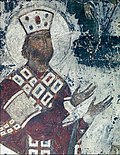 George III as depicted on a medieval fresco from Vardzia (from History of Georgia (country))
 White Cow on a Black Background, 1915, Private collection (from Niko Pirosmani)
 Details from Pirosmani's paintings Threshing and Fisherman in a Red Shirt on the 5 lari banknote of the 2017 series. (from Niko Pirosmani)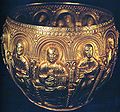
 A Peasant Woman with Children Going to Fetch Water, 1900s, Art Museum of Georgia (from Niko Pirosmani)
 Ceremonial crown of the Georgian high nobility, an example of metalwork from the early modern period (from Culture of Georgia (country))
 Georgian parade armour with golden plates (from Culture of Georgia (country))
 King Mirian III established Christianity in Georgia as the official state religion in 324. (from History of Georgia (country))
 Churchkhela (from Georgian cuisine)
 Queen Tamar and her father King George III, fresco from Vardzia. (from History of Georgia (country))
 Location of Georgia (including Abkhazia and South Ossetia) and the Russian part of North Caucasus. (from History of Georgia (country))
 Janitor (from Niko Pirosmani)
 Titsian Tabidze, a Georgian poet persecuted by the Soviet authorities (from Culture of Georgia (country))
 Sandro Akhmeteli, a leading Georgian theater director. (from Culture of Georgia (country))
 Eduard Shevardnadze, second President of Georgia (1995–2003) (from History of Georgia (country))
 British troops marching in Batumi, Georgia in 1920. Following World War I, Britain replaced German troops in Georgia (from History of Georgia (country))
 Giraffe, 1900s, Art Museum of Georgia (from Niko Pirosmani)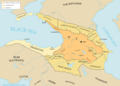
 Mikheil Saakashvili with George W. Bush. (from History of Georgia (country))
 Photos of the 9 April 1989 Massacre victims (mostly young women) on billboard in Tbilisi (from History of Georgia (country))
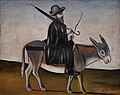 Healer on a Donkey, 1900s, Sighnaghi Museum (from Niko Pirosmani)
 Leaders of Georgian independence movement in late 1980s, Zviad Gamsakhurdia (left) and Merab Kostava (right) (from History of Georgia (country))
 Tatar camel driver (from Niko Pirosmani)
 Georgian cuisine collage (from Culture of Georgia (country))
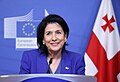 President Zourabichvili (from History of Georgia (country))
 King David the Builder, one of Georgia's greatest kings. (from History of Georgia (country))
 Patera depicting Marcus Aurelius uncovered in central Georgia, 2nd century AD. (from History of Georgia (country))
 Akaki Tsereteli, prominent Georgian poet and national liberation movement figure. (from History of Georgia (country))
 Ambrosius of Georgia opposed the Soviet regime, for which he faced repressions during the Red Terror (from History of Georgia (country))
 Leek with walnut paste (from Georgian cuisine)
 The construction of Svetitskhoveli Cathedral in Mtskheta, now a UNESCO World Heritage Site, was initiated in the 1020s by George I. (from History of Georgia (country))
 Adjarian khachapuri. (from Georgian cuisine)
 Pirosmani in c. 1880 (from Niko Pirosmani)
 A Bear on a Moonlit night (from Niko Pirosmani)
 Still Life (from Niko Pirosmani)
 Batumi port, 1900s, Art Museum of Georgia (from Niko Pirosmani)


.JPG)


.jpg)


.jpg)


.jpg)


_3.jpg)


.jpg)


.svg)


