Sonate K. 171
From Wikipedia, the free encyclopedia


La sonate K. 171 (F.121/L.77) en sol majeur est une œuvre pour clavier du compositeur italien Domenico Scarlatti.
La sonate K. 171, en sol majeur, est notée Allegro. Elle pourrait former une paire avec la sonate K. 169, mais les sources les séparent[1]. Carlo Grante propose pour sa part de faire un triptyque, avec celle en ut majeur, K. 170.
![\version "2.18.2"
\header {
tagline = ##f
% composer = "Domenico Scarlatti"
% opus = "K. 171"
% meter = "Allegro"
}
%% les petites notes
trillC = { \tag #'print { c4\prall } \tag #'midi { d32 c d c~ c8 } }
trillE = { \tag #'print { e4\prall } \tag #'midi { fis32 e fis e~ e8 } }
trillD = { \tag #'print { d4\prall } \tag #'midi { e32 d e d~ d8 } }
trillGDown = { \tag #'print { g,4\prall } \tag #'midi { a32 g a g~ g8 } }
trillEqqpUp = { \tag #'print { e'16.\prall } \tag #'midi { \times 2/3 { e32 fis e~ } e32 } }
trillEq = { \tag #'print { e8\prall } \tag #'midi { fis32 e fis \tempo 4. = 20 e \tempo 4. = 66 } }
trillA = { \tag #'print { a4\prall~ } \tag #'midi { b32 a b a~ a8~ } }
trillADown = { \tag #'print { a,4\prall~ } \tag #'midi { b32 a b a~ a8~ } }
upper = \relative c'' {
\clef treble
\key g \major
\time 3/8
\tempo 4. = 66
\repeat volta 2 {
s8*0^\markup{Allegro}
g'8 d16 b e c | d8 b16 g c a | \repeat unfold 3 { b c32 d \trillC } | b16 a g fis \tempo 4. = 36 g8 \tempo 4. = 66 |
% ms. 7
r16 b32 e \repeat unfold 2 { d4~ | d16 b32 e } d8.[ c16] | b a g fis \tempo 4. = 36 g8 \tempo 4. = 66 | r16 b32 a' g16[ fis e d] | cis b a g fis e |
% ms. 13
r16 a32 g' fis16[ e d cis] | b a g fis e d | \repeat unfold 2 { r16 cis'32 d e16[ fis fis g] } | r16 gis16 a gis fis e | d cis b a a gis |
% ms. 19
a'16 g32 fis e4~ | e16 fis32 g \trillE | d16 e32 fis \trillD | cis16 d32 e \trillGDown | r16 d'32 b a4~ | a16 fis'32 d a4~ |
% ms. 25
a16 a'32 fis a,4 | r16 fis'32 e d16[ cis gis a] | ais b cis d \trillEq | r16 d32 b \trillA | a16 fis'32 d \trillA | a16 a'32 fis \trillADown
% ms. 31
r16 d'16 d a a fis | fis[ d d a] \trillEqqpUp d64 e | fis16 d'16 d a a fis | fis[ d d a] \trillEqqpUp \tempo 4. = 36 d64 cis | d4. \tempo 4. = 66 }%repet
% ms. 38
% ms. 44
}
lower = \relative c' {
\clef bass
\key g \major
\time 3/8
\repeat volta 2 {
% ************************************** \appoggiatura a16 \repeat unfold 2 { } \times 2/3 { } \omit TupletNumber
R4.*2 | \repeat unfold 3 { g'8 a d, } | g,4.
% ms. 7
\repeat unfold 3 { g8. g'16 fis d } | g,4. | g'8 g g | g r8 r8 |
% ms. 13
fis8 fis fis |fis r8 r8 | e8 e d | < cis e >8 q < b d > | < a e' > r8 r8 | R4.
% ms. 19
a8. a'16 g fis | g,8. g'16 fis e | fis,8. fis'16 e d | e,8. e'16 d cis | \repeat unfold 3 { d,8. d'16 cis a } |
% ms. 26
d,8 e fis | g a a, | \repeat unfold 3 { d,8. d'16 cis a } |
% ms. 31
d8 e fis | g a a, | d, e fis | g a a | d,4. }%repet
% ms. 38
% ms. 44
}
thePianoStaff = \new PianoStaff <<
\set PianoStaff.instrumentName = #"Clav."
\new Staff = "upper" \upper
\new Staff = "lower" \lower
>>
\score {
\keepWithTag #'print \thePianoStaff
\layout {
#(layout-set-staff-size 17)
\context {
\Score
\override TupletBracket.bracket-visibility = ##f
\override SpacingSpanner.common-shortest-duration = #(ly:make-moment 1/2)
\remove "Metronome_mark_engraver"
}
}
}
\score {
\unfoldRepeats
\keepWithTag #'midi \thePianoStaff
\midi { \set Staff.midiInstrument = #"harpsichord" }
}](http://upload.wikimedia.org/score/5/z/5zrp20u6izqk39r1mi5jpt6ybzghc02/5zrp20u6.png)
Manuscrits
Le manuscrit principal est le numéro 24 du volume I (Ms. 9772) de Venise (1752), copié pour Maria Barbara ; l'autre est Parme I 24 (Ms. A. G. 31406)[2].
 Parme I 24.
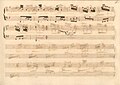 Parme I 24 (fin de la première section).
 Venise I 24.
 Venise I 24 (fin de la première section).
 Venise I 24 (début de la seconde section).
 Venise I 24 (fin de la sonate).

.jpg)

.jpg)
.jpg)
.jpg)
Interprètes
La sonate K. 171 est défendue au piano, notamment par Carlo Grante (2009, Music & Arts, vol. 1), Duanduan Hao (2011, Naxos, vol. 14) et Andrea Bacchetti (2013, RCA) ; au clavecin, elle est jouée par Scott Ross (1985, Erato)[3], Richard Lester (2001, Nimbus, vol. 1) et Pieter-Jan Belder (Brilliant Classics, vol. 4).


