Sonate K. 485
From Wikipedia, the free encyclopedia

La sonate K. 485 (F.429/L.153) en ut majeur est une œuvre pour clavier du compositeur italien Domenico Scarlatti.
La sonate K. 485, notée Andante è cantabile, est la première d'un triptyque en ut majeur, avec les sonates suivantes, K. 486 et 487. Il s'agit de l’avant-dernier du corpus. La sonate contient des fusées en gammes rapides, sixtes et octaves dans la partie mineure. La sonate réclame un clavecin le plus large de tout le corpus : du fa grave (fa1) au sol aigu (sol3)[1].
Même si l'on peut ressentir l'influence directe ou indirecte du style de la pastorale de Couperin, à la fois dans l'humeur et dans la mesure, notamment les triolets que porte une battue alla breve[2], l'ouverture ne laisse pas deviner dans son style galant — généralement à l'ambitus étroit — que Scarlatti prépare une œuvre à la texture et au sens de l’espacement inégalés par toute autre sonate[3].
![\version "2.18.2"
\header {
tagline = ##f
% composer = "Domenico Scarlatti"
% opus = "K. 485"
% meter = "Andante è cantabile"
}
%% les petites notes
trillCq = { \tag #'print { c8\prall } \tag #'midi { d32 c d c } }
trillEq = { \tag #'print { e8\prall } \tag #'midi { f32 e f e } }
trillFq = { \tag #'print { f8\prall } \tag #'midi { g32 f g f } }
trillGq = { \tag #'print { g8\prall } \tag #'midi { a32 g a g } }
trillD = { \tag #'print { d4\prall } \tag #'midi { e32 d e d~ d8 } }
trillDb = { \tag #'print { d2\prall } \tag #'midi { e32 d e d~ d4. } }
trillAb = { \tag #'print { a2\prall } \tag #'midi { b32 a b a~ a4. } }
trillA = { \tag #'print { a4\prall } \tag #'midi { b32 a b a~ a8 } }
upper = \relative c'' {
\clef treble
\key c \major
\time 2/2
\tempo 4 = 86
s8*0^\markup{Andante è cantabile}
r4 \times 2/3 { \trillCq b8 c } \omit TupletNumber \times 2/3 { \trillEq d8 e \trillGq f8 g } |
\times 2/3 { gis8 a g f e d d[ e f] \trillFq e8 f } |
\times 2/3 { fis8 g f e[ d c] c d e e[f g] }
% ms. 4
\times 2/3 { gis8 a f a,[ f' d] } c4 \trillD | c2 \repeat unfold 2 { r4 \times 2/3 { e8 f g } |
\times 2/3 { gis8 f d a' f d f e c g' e c }
% ms. 7
\trillDb }%repet
\repeat unfold 2 { r4 \times 2/3 { b8 c d }
% ms. 10
\times 2/3 { d8 c a e' c a c b g d' b g }
% ms. 13
\trillAb }%repet
\repeat unfold 2 { \times 2/3 { r8 \repeat unfold 2 { d'8 d, } d' } |
\times 2/3 { r8 \repeat unfold 2 { c8 c, } c' } |
\times 2/3 { r8 \repeat unfold 2 { b8 b, } b' } |
\times 2/3 { r8 a c } \trillA } |
% ms. 17 suite…
\times 2/3 { g8 < d bes' > < c a' > < ees c' > < d bes' > < c a' > } |
< bes g' >4 r4 \times 2/3 { r8 < d bes' > < c a' > < ees c' > < d bes' > < c a' > } |
% ms. 19
< bes g' >2 r8
}
lower = \relative c' {
\clef bass
\key c \major
\time 2/2
% ************************************** \appoggiatura a16 \repeat unfold 2 { } \times 2/3 { } \omit TupletNumber
c,2 r4 e'4 | f f, r4 d' | e e, r4 c' |
% ms. 4
f4 f, g g, | \omit TupletNumber \times 2/3 { c'8[ g e] c g e } \tempo 4 = 58 c4 \tempo 4 = 86 c'' | d b c c, |
% ms. 7
\times 2/3 { g''8[ d b] g d b } g4 c' | d b c c, | \times 2/3 { g'8[ d b] g d b } g4 g'' |
% ms. 10
a4 fis g g, | \times 2/3 { d''8[ a fis] d a fis } d4 g' | a fis g g, |
% ms. 13
\times 2/3 { d''8[ a fis] d a fis } d4 \repeat unfold 2 { \clef treble b''' a fis g \clef bass g, |
% ms. 17
c, d g, } r4 | \times 2/3 { r8 < g' g' >8 < f f' > < ees ees' >[ < d d' > < c c' >] } < bes bes' >2 |
% ms. 19
\times 2/3 { r8 < ees ees' >8 < d d' > < c c' >[ < bes bes' > < a a' >] } < g g' >2*1/4 |
}
thePianoStaff = \new PianoStaff <<
\set PianoStaff.instrumentName = #"Clav."
\new Staff = "upper" \upper
\new Staff = "lower" \lower
>>
\score {
\keepWithTag #'print \thePianoStaff
\layout {
#(layout-set-staff-size 17)
\context {
\Score
\override TupletBracket.bracket-visibility = ##f
\override SpacingSpanner.common-shortest-duration = #(ly:make-moment 1/2)
\remove "Metronome_mark_engraver"
}
}
}
\score {
\keepWithTag #'midi \thePianoStaff
\midi { \set Staff.midiInstrument = #"harpsichord" }
}](http://upload.wikimedia.org/score/n/h/nha6nw04i2jro3b6rswnp9r54nti58t/nha6nw04.png)
Manuscrits
Le manuscrit principal est le numéro 2 du volume XII (Ms. 9783) de Venise (1756), copié pour Maria Barbara ; les autres sont Parme XIV 2 (Ms. A. G. 31419), Münster (D-MÜp) I 20 (Sant Hs 3964) et Vienne C 16 (VII 28011 C)[4]. Une copie figure à la Morgan Library, manuscrit Cary 703 no 99[5],[6].
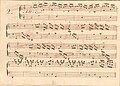 Parme XIV 2.
 Parme XIV 2 (fin de la première section).
 Venise XII 2.
 Venise XII 2 (fin de la première section).
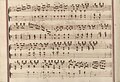 Venise XII 2 (début de la seconde section).
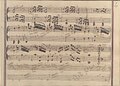 Venise XII 2 (fin de la sonate).

.jpg)

.jpg)
.jpg)
.jpg)
Interprètes
La sonate K. 485 est défendue au piano, notamment par Soyeon Lee (2006, Naxos, vol. 8) et Carlo Grante (2016, Music & Arts, vol. 5) ; au clavecin, elle est jouée par Luciano Sgrizzi (1979, Erato), Scott Ross (1985, Erato)[7], Eiji Hashimoto (1996, Klavier), Richard Lester (2004, Nimbus, vol. 5) et Pieter-Jan Belder (Brilliant Classics, vol. 11). Fábio Zanon (2000, Musical Heritage) l'interprète à la guitare.


