Sonate K. 21
From Wikipedia, the free encyclopedia


La sonate K. 21 (F.537/L.363) en ré majeur est une œuvre pour clavier du compositeur italien Domenico Scarlatti. C'est la vingt-et-unième sonate du seul recueil publié du vivant de l'auteur, les Essercizi per gravicembalo (1738), qui contient trente numéros.
La sonate K. 21, en ré majeur, est notée Allegro.
Dernières mesures de la sonate :
![\version "2.18.2"
\header {
tagline = ##f
% composer = "Domenico Scarlatti"
% opus = "K. 21"
% meter = "Allegro"
}
%% les petites notes
trillEqp = { \tag #'print { e8.\trill } \tag #'midi { fis32 e fis e~ e16 } }
upper = \relative c'' {
\clef treble
\key d \major
\time 3/8
\tempo 4 = 86
\set Staff.midiInstrument = #"harpsichord"
\override TupletBracket.bracket-visibility = ##f
\set Score.currentBarNumber = #119
\omit Staff.TimeSignature
\omit TupletNumber
\bar ""
s8*0^\markup{[Allegro]}
a'16 fis d a fis d | b'8 b a' | g16 e cis g e cis | a'8 a g' | fis16 d a fis d b | g'8 g fis' | e16 cis a e cis a | fis'8 d' fis | b, g' b |
% ms. 128
cis,8 a g' | fis32 e d16 \trillEqp d16 | d4 \times 2/3 { \stemDown fis,16[ d \stemUp \change Staff = "lower" a] } |
\repeat unfold 2 {
\stemDown \change Staff = "upper" \times 2/3 { g'16 e \stemUp \change Staff = "lower" a, }
\repeat unfold 2 { \stemDown \change Staff = "upper" \times 2/3 { fis'16[ d \stemUp \change Staff = "lower" a] } \stemDown \change Staff = "upper" \times 2/3 { e'16[ \stemUp \change Staff = "lower" cis a] }
}
\stemDown \change Staff = "upper" \times 2/3 { fis'16 d \stemUp \change Staff = "lower" a }
} \stemDown \change Staff = "upper" |
\times 2/3 { g'16[ e \stemUp \change Staff = "lower" a,] } \stemDown \change Staff = "upper" \times 2/3 { fis'16 d \stemUp \change Staff = "lower" a } \stemDown \change Staff = "upper" \times 2/3 { g'16[ e \stemUp \change Staff = "lower" a,] } |
\stemDown \change Staff = "upper" \times 2/3 { fis'16 d \stemUp \change Staff = "lower" a } \stemDown \change Staff = "upper" \times 2/3 { g'16[ e \stemUp \change Staff = "lower" a,] } \stemUp \change Staff = "upper" \times 2/3 { a'16 fis \change Staff = "lower" a, } \stemUp \change Staff = "upper" \times 2/3 { g'16[ e \change Staff = "lower" a,] } \stemUp \change Staff = "upper" \times 2/3 { fis'16[ d \change Staff = "lower" a] } \stemUp \change Staff = "upper" \times 2/3 { e'16[ \change Staff = "lower" cis a] } | \change Staff = "upper" \appoggiatura e'32 fis4
% ms. 138 fin
\times 2/3 { \stemDown fis16[ d \stemUp \change Staff = "lower" a] } |
\repeat unfold 2 {
\stemDown \change Staff = "upper" \times 2/3 { g'16 e \stemUp \change Staff = "lower" a, }
\repeat unfold 2 { \stemDown \change Staff = "upper" \times 2/3 { fis'16[ d \stemUp \change Staff = "lower" a] } \stemDown \change Staff = "upper" \times 2/3 { e'16[ \stemUp \change Staff = "lower" cis a] }
}
\stemDown \change Staff = "upper" \times 2/3 { fis'16 d \stemUp \stemUp \change Staff = "lower" a }
} \stemDown \change Staff = "upper" \times 2/3 { g'16[ e \stemUp \change Staff = "lower" a,] } \stemDown \change Staff = "upper" \times 2/3 { fis'16[ d \stemUp \change Staff = "lower" a] } \stemDown \change Staff = "upper" \times 2/3 { e'16[ \stemUp \change Staff = "lower" cis a] } |
\stemDown \change Staff = "upper" \times 2/3 { fis'16 d \stemUp \stemUp \change Staff = "lower" a } \stemDown \change Staff = "upper" \times 2/3 { g'16 e \stemUp \change Staff = "lower" a, } \stemDown \change Staff = "upper" \times 2/3 { a'16[ fis \stemUp \change Staff = "lower" a,] } |
% ms. 145
\stemDown \change Staff = "upper" \times 2/3 { g'16[ e \stemUp \change Staff = "lower" a,] } \stemDown \change Staff = "upper" \times 2/3 { fis'16[ d \stemUp \change Staff = "lower" a] } \stemDown \change Staff = "upper" \times 2/3 { e'16[ \stemUp \change Staff = "lower" cis a] } | \stemNeutral \change Staff = "upper"
\times 2/3 { fis''16[ d a] } \times 2/3 { g'16[ e a,] } \times 2/3 { a'16[ fis a,] } \times 2/3 { g'16[ e a,] } \repeat unfold 2 { \times 2/3 { fis'16[ d a] } \times 2/3 { e'16[ cis a] } } | \times 2/3 { d16[ a fis] } | \times 2/3 { e'16[ b g] } \times 2/3 { d'16[ a fis] } \times 2/3 { cis'16[ g e] } | < e fis g cis >8 < fis a d >4
}
lower = \relative c' {
\clef bass
\key d \major
\time 3/8
\set Staff.midiInstrument = #"harpsichord"
\override TupletBracket.bracket-visibility = ##f
\omit Staff.TimeSignature
% ************************************** \appoggiatura a8 \repeat unfold 2 { } \times 2/3 { } \omit TupletNumber
d,8 d d | g,16 b d g b d |e,,8 e e | fis16 a d fis a cis | d,,8 d d | e16 g b e g b | a,8 a a | d,16 fis a d fis a | g, b d g b d |
% ms. 128
a,16 cis e a cis e | d,8 a' a, | d,4 \stemUp \change Staff = "upper" a'''8 | b b cis | \repeat unfold 2 { d d a | b b cis } |
% ms. 136
d8[ d] \stemNeutral \change Staff = "lower" fis,,8 | g e a | d,4 \stemUp \change Staff = "upper" a''8 | b b cis | \repeat unfold 2 { d d a | b b cis } | d8[ d] \stemNeutral \change Staff = "lower" fis,,8 |
% ms. 145
g8 e a | \repeat unfold 2 { d, e fis | g a a, } | d4. \bar ":|."
}
thePianoStaff = \new PianoStaff <<
\set PianoStaff.instrumentName = #"Clav."
\new Staff = "upper" \upper
\new Staff = "lower" \lower
>>
\score {
\keepWithTag #'print \thePianoStaff
\layout {
#(layout-set-staff-size 17)
\context {
\Score
\override SpacingSpanner.common-shortest-duration = #(ly:make-moment 1/3)
\remove "Metronome_mark_engraver"
}
}
}
\score {
\keepWithTag #'midi \thePianoStaff
\midi { }
}](http://upload.wikimedia.org/score/4/y/4y6dn5olfygzk608e6sc5odni2p5y1k/4y6dn5ol.png)
Édition et manuscrits
L'œuvre est imprimée dans le recueil des Essercizi per gravicembalo publié sans doute à Londres en 1738[1]. Des copies manuscrites apparaissent dans Münster V 49, Vienne A 35[2] et Orfeó Catalá (E-OC) no 28[3].
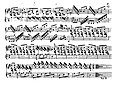 Édition Londres, 1739 (dernière page).
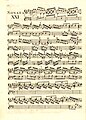 Édition Amsterdam, 1742.
 Édition Haslinger/Czerny, 1838.
.jpg)


Interprètes
La sonate K. 21 est défendue au piano, notamment par Carlo Grante (2009, Music & Arts, vol. 1) et Duanduan Hao (2011, Naxos, vol. 14) ; au clavecin par Scott Ross (1976, Still et 1985, Erato)[4], Colin Tilney (1987, Dorian), Joseph Payne (1990, BIS), Laura Alvini (Frame et Nuova Era), Ottavio Dantone (2002, Stradivarius, vol. 8), Richard Lester (2003, Nimbus, vol. 3), Pieter-Jan Belder (Brilliant Classics), Kenneth Weiss (2007, Satirino) et Hank Knox (2021, Leaf Music).


