Solar eclipse of December 14, 2020
From Wikipedia, the free encyclopedia
| Total eclipse | |
 Totality as viewed from Gorbea, Chile | |
 Map | |
| Gamma | −0.2939 |
|---|---|
| Magnitude | 1.0254 |
| Maximum eclipse | |
| Duration | 130 s (2 min 10 s) |
| Coordinates | 40°18′S 67°54′W / 40.3°S 67.9°W |
| Max. width of band | 90 km (56 mi) |
| Times (UTC) | |
| Greatest eclipse | 16:14:39 |
| References | |
| Saros | 142 (23 of 72) |
| Catalog # (SE5000) | 9554 |
A total solar eclipse occurred at the Moon's descending node of orbit on Monday, December 14, 2020,[1][2][3][4][5][6] with a magnitude of 1.0254. A total solar eclipse occurs when the Moon's apparent diameter is larger than the Sun's and the apparent path of the Sun and Moon intersect, blocking all direct sunlight and turning daylight into darkness; the Sun appears to be black with a halo around it. Totality occurs in a narrow path across Earth's surface, with the partial solar eclipse visible over a surrounding region thousands of kilometres wide. Occurring about 1.8 days after perigee (on December 12, 2020, at 20:40 UTC), the Moon's apparent diameter was larger.[7]
Totality was visible from parts of southern Chile and Argentina. A partial eclipse was visible for parts of central and southern South America, Southern Africa, and Antarctica. A total solar eclipse crossed a similar region of the Earth about a year and a half earlier on July 2, 2019.
Chile

Totality made landfall in Puerto Saavedra, before traversing through portions of Araucanía Region, Los Ríos Region, and a very small part of Bío Bío Region.[8] Cities in the path included Temuco, Villarrica, and Pucón. Totality was also visible on Mocha Island. The eclipse's path was similar to the solar eclipse of February 26, 2017. It occurred just 17 months after the solar eclipse of July 2, 2019 and, like the 2019 eclipse, was also visible from Chile and Argentina. It was also a partial solar eclipse in Bolivia, Brazil, Ecuador, Paraguay, Peru and Uruguay.
Argentina
Totality was visible across the Northern Patagonia (specifically the provinces of Neuquén and Río Negro), passing through cities including Piedra del Águila, Sierra Colorada, Ministro Ramos Mexía, Junín de los Andes, and partially in San Martín de los Andes and San Carlos de Bariloche.
Eclipse timing
Places experiencing total eclipse
| Country or territory | City or place | Start of partial eclipse | Start of total eclipse | Maximum eclipse | End of total eclipse | End of partial eclipse | Duration of totality (min:s) | Duration of eclipse (hr:min) | Maximum magnitude |
|---|---|---|---|---|---|---|---|---|---|
 Chile Chile | Temuco | 11:39:54 | 13:02:40 | 13:02:47 | 13:02:53 | 14:30:16 | 0:13 | 2:50 | 1.0006 |
| Chile | Villarrica | 11:41:15 | 13:02:59 | 13:04:03 | 13:05:08 | 14:31:12 | 2:09 | 2:50 | 1.0127 |
| References: [1] | |||||||||
Places experiencing partial eclipse
| Country or territory | City or place | Start of partial eclipse | Maximum eclipse | End of partial eclipse | Duration of eclipse (hr:min) | Maximum coverage | |||
|---|---|---|---|---|---|---|---|---|---|
 Clipperton Island Clipperton Island | Clipperton Island | 05:46:35 | 06:21:49 | 06:59:40 | 1:13 | 9.90% | |||
 Ecuador Ecuador | Galápagos Islands | 07:58:26 | 08:40:45 | 09:27:23 | 1:29 | 9.41% | |||
 Pitcairn Islands Pitcairn Islands | Adamstown | 05:58:30 | 06:48:49 | 07:43:39 | 1:45 | 53.34% | |||
 French Polynesia French Polynesia | Taioha'e | 05:23:37 (sunrise) | 05:25:59 | 05:59:58 | 0:36 | 52.11% | |||
 Peru Peru | Lima | 09:16:41 | 10:16:19 | 11:23:19 | 2:07 | 17.19% | |||
| French Polynesia | Papeete | 05:18:06 (sunrise) | 05:20:35 | 05:34:28 | 0:16 | 13.03% | |||
 Bolivia Bolivia | La Paz | 10:40:55 | 11:48:07 | 13:00:35 | 2:20 | 17.69% | |||
| Bolivia | Sucre | 10:47:59 | 12:00:55 | 13:17:40 | 2:30 | 22.08% | |||
| Chile | Santiago | 11:36:27 | 13:01:27 | 14:31:35 | 2:55 | 78.66% | |||
 Paraguay Paraguay | Asunción | 12:07:34 | 13:31:38 | 14:53:31 | 2:46 | 37.56% | |||
 Argentina Argentina | Buenos Aires | 12:03:59 | 13:32:38 | 14:59:17 | 2:55 | 73.66% | |||
 Falkland Islands Falkland Islands | Stanley | 12:20:26 | 13:35:16 | 14:48:54 | 2:28 | 64.64% | |||
 Uruguay Uruguay | Montevideo | 12:09:21 | 13:38:06 | 15:03:38 | 2:54 | 74.14% | |||
 Antarctica Antarctica | Orcadas Base | 12:47:09 | 13:47:17 | 14:45:46 | 1:59 | 35.51% | |||
 Brazil Brazil | Pelotas | 12:19:26 | 13:47:47 | 15:10:37 | 2:51 | 61.08% | |||
| Brazil | Rio Grande | 12:20:00 | 13:48:22 | 15:11:08 | 2:51 | 62.12% | |||
 South Georgia and the South Sandwich Islands South Georgia and the South Sandwich Islands | King Edward Point | 13:52:43 | 15:00:35 | 16:04:50 | 2:12 | 53.20% | |||
 Lesotho Lesotho | Maseru | 18:54:09 | 19:02:22 | 19:05:11 (sunset) | 0:11 | 6.57% | |||
| Brazil | Brasília | 13:05:54 | 14:03:17 | 14:56:03 | 1:50 | 8.50% | |||
| Brazil | São Paulo | 12:45:42 | 14:05:05 | 15:16:34 | 2:31 | 31.57% | |||
 Botswana Botswana | Ghanzi | 18:58:37 | 19:09:08 | 19:11:45 (sunset) | 0:13 | 9.99% | |||
| Botswana | Tsabong | 18:56:13 | 19:11:09 | 19:17:57 (sunset) | 0:22 | 16.22% | |||
| Brazil | Rio de Janeiro | 12:57:10 | 14:14:19 | 15:22:51 | 2:26 | 31.17% | |||
 Bouvet Island Bouvet Island | Bouvet Island | 17:34:22 | 18:21:50 | 19:06:55 | 1:33 | 26.80% | |||
 Angola Angola | Lubango | 18:04:48 | 18:28:36 | 18:31:05 (sunset) | 0:26 | 29.69% | |||
 Namibia Namibia | Windhoek | 18:58:41 | 19:29:12 | 19:31:50 (sunset) | 0:33 | 45.47% | |||
 Saint Helena, Ascension and Tristan da Cunha Saint Helena, Ascension and Tristan da Cunha | Edinburgh of the Seven Seas | 16:32:29 | 17:40:07 | 18:40:58 | 2:08 | 89.74% | |||
| Namibia | Walvis Bay | 18:58:33 | 19:40:18 | 19:42:56 (sunset) | 0:44 | 69.27% | |||
 South Africa South Africa | Cape Town | 18:52:05 | 19:43:34 | 19:53:06 (sunset) | 1:01 | 59.36% | |||
| Saint Helena, Ascension and Tristan da Cunha | Jamestown | 17:03:11 | 18:01:03 | 18:49:51 (sunset) | 1:47 | 50.25% | |||
| References: [1] | |||||||||
Scientific observations
The ionospheric effects of the eclipse were expected to be monitored as part of the December 2020 Eclipse Festival of Frequency Measurement, a citizen science experiment organized through the Amateur Radio Science Citizen Investigation (HamSCI).[9] Also, a prediction was made for a group of ionospheric stations in South America, using a numerical model (SUPIM-INPE), of the ionospheric response to this event.[10]
Coincidentally, a comet belonging to the Kreutz sungrazer family called C/2020 X3 (SOHO) appeared during the eclipse, which later disintegrated shortly before reaching perihelion around the same day.[11][12][13]
Gallery
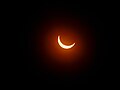 Partial from Rengo, Chile, 15:07 UTC
 Partial from Santiago de Chile, 16:02 UTC
 Partial from Puerto Varas, Chile, 16:09 UTC
 Totality from Ministro Ramos Mexía, Argentina, 16:14 UTC
 Partial from Manuel B. Gonnet, Argentina, 16:32 UTC
 Partial from Guarulhos, Brazil, 17:01 UTC
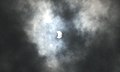 Partial from Taubaté, Brazil, 17:13 UTC
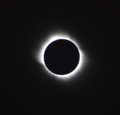 Totality from Valcheta, Argentina


.jpg)


Eclipse details
Shown below are two tables displaying details about this particular solar eclipse. The first table outlines times at which the Moon's penumbra or umbra attains the specific parameter, and the second table describes various other parameters pertaining to this eclipse.[14]
| Event | Time (UTC) |
|---|---|
| First Penumbral External Contact | 2020 December 14 at 13:35:04.2 UTC |
| First Umbral External Contact | 2020 December 14 at 14:33:44.2 UTC |
| First Central Line | 2020 December 14 at 14:34:00.3 UTC |
| First Umbral Internal Contact | 2020 December 14 at 14:34:16.4 UTC |
| First Penumbral Internal Contact | 2020 December 14 at 15:38:01.7 UTC |
| Greatest Eclipse | 2020 December 14 at 16:14:39.4 UTC |
| Greatest Duration | 2020 December 14 at 16:14:45.1 UTC |
| Ecliptic Conjunction | 2020 December 14 at 16:17:44.3 UTC |
| Equatorial Conjunction | 2020 December 14 at 16:19:21.9 UTC |
| Last Penumbral Internal Contact | 2020 December 14 at 16:51:09.2 UTC |
| Last Umbral Internal Contact | 2020 December 14 at 17:55:01.7 UTC |
| Last Central Line | 2020 December 14 at 17:55:15.8 UTC |
| Last Umbral External Contact | 2020 December 14 at 17:55:29.8 UTC |
| Last Penumbral External Contact | 2020 December 14 at 18:54:16.8 UTC |
| Parameter | Value |
|---|---|
| Eclipse Magnitude | 1.02536 |
| Eclipse Obscuration | 1.05136 |
| Gamma | −0.29394 |
| Sun Right Ascension | 17h30m05.9s |
| Sun Declination | -23°15'32.3" |
| Sun Semi-Diameter | 16'14.9" |
| Sun Equatorial Horizontal Parallax | 08.9" |
| Moon Right Ascension | 17h29m54.3s |
| Moon Declination | -23°32'58.8" |
| Moon Semi-Diameter | 16'23.7" |
| Moon Equatorial Horizontal Parallax | 1°00'10.4" |
| ΔT | 70.2 s |
Eclipse season
This eclipse is part of an eclipse season, a period, roughly every six months, when eclipses occur. Only two (or occasionally three) eclipse seasons occur each year, and each season lasts about 35 days and repeats just short of six months (173 days) later; thus two full eclipse seasons always occur each year. Either two or three eclipses happen each eclipse season. In the sequence below, each eclipse is separated by a fortnight.
| November 30 Ascending node (full moon) | December 14 Descending node (new moon) |
|---|---|
 | |
| Penumbral lunar eclipse Lunar Saros 116 | Total solar eclipse Solar Saros 142 |
.jpg)


.jpg)


_(cropped).jpg)

.jpg)


.jpg)


