Solar eclipse of September 1, 2016
From Wikipedia, the free encyclopedia
| Annular eclipse | |
 From L'Étang-Salé, Réunion | |
 Map | |
| Gamma | −0.333 |
|---|---|
| Magnitude | 0.9736 |
| Maximum eclipse | |
| Duration | 186 s (3 min 6 s) |
| Coordinates | 10°42′S 37°48′E / 10.7°S 37.8°E |
| Max. width of band | 100 km (62 mi) |
| Times (UTC) | |
| Greatest eclipse | 9:08:02 |
| References | |
| Saros | 135 (39 of 71) |
| Catalog # (SE5000) | 9544 |
An annular solar eclipse occurred at the Moon's ascending node of orbit on Thursday, September 1, 2016,[1][2][3][4] with a magnitude of 0.9736. A solar eclipse occurs when the Moon passes between Earth and the Sun, thereby totally or partly obscuring the image of the Sun for a viewer on Earth. An annular solar eclipse occurs when the Moon's apparent diameter is smaller than the Sun's, blocking most of the Sun's light and causing the Sun to look like an annulus (ring). An annular eclipse appears as a partial eclipse over a region of the Earth thousands of kilometres wide. Occurring about 5.4 days before apogee (on September 6, 2016, at 19:45 UTC), the Moon's apparent diameter was smaller.[5]
Annularity was visible from parts of Gabon, Congo, Democratic Republic of the Congo, Tanzania, Mozambique, Madagascar, and Réunion. A partial eclipse was visible for most of Africa and parts of Antarctica.

Animated Path
Eclipse timing
Places experiencing annular eclipse
| Country or territory | City or place | Start of partial eclipse | Start of annular eclipse | Maximum eclipse | End of annular eclipse | End of partial eclipse | Duration of annularity (min:s) | Duration of eclipse (hr:min) | Maximum coverage |
|---|---|---|---|---|---|---|---|---|---|
 Gabon Gabon | Franceville | 07:22:18 | 08:46:02 | 08:47:18 | 08:48:34 | 10:30:33 | 2:32 | 3:08 | 94.11% |
 Madagascar Madagascar | Mahajanga | 10:47:34 | 12:39:23 | 12:40:35 | 12:41:46 | 14:24:22 | 2:23 | 3:37 | 94.76% |
| Madagascar | Toamasina | 11:00:56 | 12:50:44 | 12:52:10 | 12:53:37 | 14:31:56 | 2:53 | 3:31 | 94.62% |
 Réunion Réunion | Saint-Paul | 12:22:32 | 14:08:10 | 14:09:14 | 14:10:19 | 15:42:15 | 2:09 | 3:20 | 94.34% |
| Réunion | Saint-Pierre | 12:23:36 | 14:08:34 | 14:09:59 | 14:11:24 | 15:42:40 | 2:50 | 3:19 | 94.32% |
| References: [1] | |||||||||
Places experiencing partial eclipse
| Country or territory | City or place | Start of partial eclipse | Maximum eclipse | End of partial eclipse | Duration of eclipse (hr:min) | Maximum coverage | |||
|---|---|---|---|---|---|---|---|---|---|
 Ivory Coast Ivory Coast | Abidjan | 06:13:11 | 07:20:50 | 08:40:30 | 2:31 | 71.55% | |||
 Ghana Ghana | Accra | 06:13:27 | 07:23:38 | 08:46:54 | 2:33 | 71.47% | |||
 Togo Togo | Lomé | 06:13:47 | 07:24:38 | 08:48:52 | 2:35 | 69.50% | |||
 Benin Benin | Porto-Novo | 07:14:09 | 08:25:49 | 09:51:08 | 2:37 | 68.29% | |||
 Nigeria Nigeria | Lagos | 07:14:20 | 08:26:35 | 09:52:40 | 2:38 | 68.45% | |||
 São Tomé and Príncipe São Tomé and Príncipe | São Tomé | 06:16:29 | 07:34:21 | 09:08:43 | 2:52 | 90.50% | |||
 Equatorial Guinea Equatorial Guinea | Malabo | 07:16:31 | 08:34:45 | 10:09:11 | 2:53 | 77.96% | |||
| Gabon | Libreville | 07:17:58 | 08:38:18 | 10:15:49 | 2:58 | 89.90% | |||
 Cameroon Cameroon | Yaoundé | 07:18:14 | 08:38:49 | 10:16:08 | 2:58 | 76.90% | |||
 Central African Republic Central African Republic | Bangui | 07:24:32 | 08:51:16 | 10:34:51 | 3:10 | 71.87% | |||
 Republic of the Congo Republic of the Congo | Brazzaville | 07:26:14 | 08:53:39 | 10:39:29 | 3:13 | 89.44% | |||
 Democratic Republic of the Congo Democratic Republic of the Congo | Kinshasa | 07:26:19 | 08:53:47 | 10:39:39 | 3:13 | 89.26% | |||
 Angola Angola | Luanda | 07:30:02 | 08:55:08 | 10:37:58 | 3:08 | 73.01% | |||
 Rwanda Rwanda | Kigali | 08:45:32 | 10:28:03 | 12:22:29 | 3:37 | 82.07% | |||
 Burundi Burundi | Gitega | 08:46:43 | 10:30:04 | 12:25:11 | 3:38 | 87.17% | |||
 Uganda Uganda | Kampala | 09:49:07 | 11:31:43 | 13:24:10 | 3:35 | 70.81% | |||
 Zambia Zambia | Mpulungu | 08:56:19 | 10:42:43 | 12:38:08 | 3:42 | 91.64% | |||
| Zambia | Kasama | 08:58:58 | 10:45:32 | 12:40:28 | 3:42 | 87.23% | |||
 Kenya Kenya | Nairobi | 10:00:27 | 11:46:58 | 13:38:41 | 3:38 | 69.11% | |||
 Tanzania Tanzania | Dodoma | 10:02:54 | 11:52:25 | 13:46:43 | 3:44 | 86.76% | |||
 Malawi Malawi | Lilongwe | 09:11:44 | 11:00:14 | 12:52:40 | 3:41 | 79.93% | |||
| Tanzania | Dar es Salaam | 10:12:57 | 12:04:34 | 13:56:37 | 3:44 | 82.28% | |||
 Mozambique Mozambique | Nampula | 09:27:08 | 11:19:08 | 13:08:35 | 3:41 | 86.39% | |||
| Mozambique | Pemba | 09:26:12 | 11:19:18 | 13:09:11 | 3:43 | 94.82% | |||
 Comoros Comoros | Moroni | 10:31:36 | 12:25:20 | 14:13:28 | 3:42 | 89.68% | |||
| Mayotte | Mamoudzou | 10:39:14 | 12:32:55 | 14:18:52 | 3:40 | 89.11% | |||
| Madagascar | Antananarivo | 10:57:00 | 12:48:16 | 14:29:14 | 3:32 | 90.52% | |||
| Réunion | Saint-Denis | 12:22:51 | 14:09:30 | 15:42:25 | 3:20 | 94.27% | |||
 Mauritius Mauritius | Port Louis | 12:27:46 | 14:13:13 | 15:44:25 | 3:17 | 88.89% | |||
 French Southern and Antarctic Lands French Southern and Antarctic Lands | Île Amsterdam | 14:23:24 | 15:43:42 | 16:54:48 | 2:31 | 71.84% | |||
| References: [1] | |||||||||
Gallery
 Composition images from L'Étang-Salé, Réunion
 Annularity progression from Les Avirons, Réunion
 Partial from Walvis Bay, Namibia, 7:15 UTC
 From Kalemie, DR Congo, 7:46 UTC
 Partial from Port Elizabeth, South Africa, 9:35 UTC
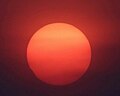 Partial from Jakarta, Indonesia, 10:33 UTC

.jpg)
.jpg)
.jpg)
.jpg)

Eclipse details
Shown below are two tables displaying details about this particular solar eclipse. The first table outlines times at which the Moon's penumbra or umbra attains the specific parameter, and the second table describes various other parameters pertaining to this eclipse.[6]
| Event | Time (UTC) |
|---|---|
| First Penumbral External Contact | 2016 September 1 at 06:14:16.4 UTC |
| First Umbral External Contact | 2016 September 1 at 07:18:57.7 UTC |
| First Central Line | 2016 September 1 at 07:20:21.3 UTC |
| First Umbral Internal Contact | 2016 September 1 at 07:21:45.1 UTC |
| First Penumbral Internal Contact | 2016 September 1 at 08:34:59.5 UTC |
| Ecliptic Conjunction | 2016 September 1 at 09:04:14.2 UTC |
| Greatest Duration | 2016 September 1 at 09:06:18.1 UTC |
| Greatest Eclipse | 2016 September 1 at 09:08:02.0 UTC |
| Equatorial Conjunction | 2016 September 1 at 09:19:12.7 UTC |
| Last Penumbral Internal Contact | 2016 September 1 at 09:40:44.7 UTC |
| Last Umbral Internal Contact | 2016 September 1 at 10:54:08.6 UTC |
| Last Central Line | 2016 September 1 at 10:55:35.3 UTC |
| Last Umbral External Contact | 2016 September 1 at 10:57:01.8 UTC |
| Last Penumbral External Contact | 2016 September 1 at 12:01:48.6 UTC |
| Parameter | Value |
|---|---|
| Eclipse Magnitude | 0.97362 |
| Eclipse Obscuration | 0.94794 |
| Gamma | −0.33301 |
| Sun Right Ascension | 10h43m43.3s |
| Sun Declination | +08°03'38.0" |
| Sun Semi-Diameter | 15'51.0" |
| Sun Equatorial Horizontal Parallax | 08.7" |
| Moon Right Ascension | 10h43m22.2s |
| Moon Declination | +07°45'51.0" |
| Moon Semi-Diameter | 15'12.4" |
| Moon Equatorial Horizontal Parallax | 0°55'48.6" |
| ΔT | 68.3 s |
Eclipse season
This eclipse is part of an eclipse season, a period, roughly every six months, when eclipses occur. Only two (or occasionally three) eclipse seasons occur each year, and each season lasts about 35 days and repeats just short of six months (173 days) later; thus two full eclipse seasons always occur each year. Either two or three eclipses happen each eclipse season. In the sequence below, each eclipse is separated by a fortnight. The first and last eclipse in this sequence is separated by one synodic month.
| August 18 Descending node (full moon) | September 1 Ascending node (new moon) | September 16 Descending node (full moon) |
|---|---|---|
 | |  |
| Penumbral lunar eclipse Lunar Saros 109 | Annular solar eclipse Solar Saros 135 | Penumbral lunar eclipse Lunar Saros 147 |
._(32844461616).jpg)

.jpg)


_-_square_crop.jpg)

.jpg)

.jpg)


.jpg)


