Wikipedia talk:Manual of Style/Infoboxes
From Wikipedia, the free encyclopedia
 | This project page does not require a rating on Wikipedia's content assessment scale. It is of interest to the following WikiProjects: | |||||||||||||||||||||||||||
| ||||||||||||||||||||||||||||


_-_The_Noun_Project.svg)

Modern images of early medieval rulers in infobox or article


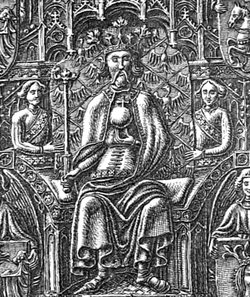
Hi, should be included in the infobox and article the 19th and first half of the 20th century depictions of sub-average quality of national romanticism (often anachronistically projecting late medieval/baroque attire), but not portraits/paintings nor sculptures of cultural value, about early medieval rulers, in this specific case, from Croatia, Serbia, Bosnia and Herzegovina and Montenegro? Recently a User:Cruz.croce uploaded on Wikimedia Commons a series of poorly known and poorly made depictions supposedly from 1940 edition of Danica calendar published by Croatian (Catholic) literary society of St. Geronimo without citing an author, and edited them into several English Wikipedia articles of Croatian early medieval rulers (including good article Tvrtko I of Bosnia from the 14th century, whose representation is obvious plagiarism of portraits of Croatian nobleman Petar Zrinski from the 17th century). In articles of some early Serbian rulers (Višeslav of Serbia, Zaharija of Serbia, Vlastimir) are included romanticized images by Kosta Mandrović (1885). As in the case of all of them, such poor depictions which are usually with attire not appropriate for the time period, don't bring any value for the article themselves and to the readers. They are mostly unknown to the general public as usually are not included in educational and scientific literature. They are products of bygone era. I don't think on Wikipedia should be promoted such outdated and poor depictions of old historical personalities. Does it exist some previous discussion or consensus about such topic? Miki Filigranski (talk) 13:30, 3 January 2025 (UTC) Note: WikiProject History, WikiProject Middle Ages, WikiProject Royalty and Nobility have been notified of this discussion. --Miki Filigranski (talk) 16:30, 3 January 2025 (UTC) Although the issue initially was about ex-Yugoslavian states, there's a need for a general consensus nevertheless a country, so the discussion expanded.--Miki Filigranski (talk) 22:52, 19 March 2025 (UTC)
- Nothing says we can’t replace a poor image with a better one. That should be our first goal. Blueboar (talk) 13:43, 3 January 2025 (UTC)
- Almost always there's no better image because there's no image in the first place. These are personalities who lived more than 1000 years ago. For some exist some archaeological iconography (coin, church mural etc.), a modern statue or painting which has cultural value because was created by a notable artist and has cultural-political context and can be found in reliable literature - but these images and authors are not such a case, their general value and notability is almost worthless. --Miki Filigranski (talk) 16:18, 3 January 2025 (UTC)
- Contemporaneous images are generally preferred. If romantic images are used they should be clearly labeled as later fictional depictions. DrKay (talk) 13:56, 3 January 2025 (UTC)
- Of course it is needed to have attribution and so on, but the question is, why they can/should be used at all? These images are poor fictional depictions of real historical personalities. These articles are part of scientific topics of historiography and other scientific disciplines. We are always citing reliable scientific sources (as per WP:SCIRS, as well Wikipedia:Scientific standards and Wikipedia:Editing scientific articles). Using images from some obscure, outdated, non-scientific and probably unreliable sources for visual representation of the subjects is basically violating the WP:RS. These depictions, not only worthless from artistic viewpoint, but from a scientific viewpoint are basically pseudoscientific. What's more, there's no pedagogical purpose and reasoning to include them in an encyclopedia.--Miki Filigranski (talk) 16:18, 3 January 2025 (UTC)
- Yes, they should be used, until 1. A better image is found; or 2. You can show on the article's Talk page, citing WP:Reliable sources, that the image is a misidentification of another person or there is some other reason why it is not at least intended to be a depiction of the person shown. As noted above, if it is a fictional/romanticized representation, that should be in the caption or footnote, which should also note the anachronisms.We are not saying that this is scientific, we are saying that this is how the person has been portrayed. -- Ssilvers (talk) 17:29, 3 January 2025 (UTC)
- I think "invented" images of historical people should only be used if RS do the same. We do not want someone inventing new faces for some 9th century bishops in 2025, but we can use invented faces from the 14th century that already have a long tradition in connection to their subject. —Kusma (talk) 17:56, 3 January 2025 (UTC)
- Agree, otherwise is opening of a pandora's box.--Miki Filigranski (talk) 18:07, 3 January 2025 (UTC)
- per MOS:IMAGEREL "Images must be significant and relevant in the topic's context, not primarily decorative" (these are primarily and only decorative, don't have any other purpose) and "However, not every article needs images" (of course), and per MOS:IMAGEQUALITY "Poor-quality images—dark or blurry; showing the subject too small, hidden in clutter, or ambiguous; and so on—should not be used unless absolutely necessary. Think carefully about which images best illustrate the subject matter" (these images are absolutely unnecessary).--Miki Filigranski (talk) 18:05, 3 January 2025 (UTC)
- The thing is, even fake images can become relevant, but usually only if there is some cultural context (say, NotableActor playing DeadKing in NotableFilm), not for any random image. Infobox and lead images should probably be held to a higher standard than general illustrations, though. —Kusma (talk) 19:07, 3 January 2025 (UTC)

This is not a "decorative" image, nor a "fake" one. 
...but is obviously fake and misleading, based on a notable late 11th century font of another Croatian king living ca. 150 years after "Kralj Tomislav". - "Decorative" images are things like Dingbats or putting butterflies and flowers in an article (that isn't about those insects or plants) just because you like the way they look. A drawing of the article's subject, especially when it is not user-generated, is perfectly fine.
- When the person lived a thousand years ago, then a drawing from a hundred years ago is okay, but you should address the age gap in the caption, e.g., "Drawing from early 20th century" or "Statue from early 20th century". WhatamIdoing (talk) 23:44, 18 March 2025 (UTC)
- Yes, but not every drawing of article's subject is "perfectly fine". The drawing of "Kralj Tomislav, Danica, 1940" is completely not notable and not recognizable in Croatia, created by an unknown author. It is completely without any historial and cultural relevancy and value (aside being a poor image). It is also a "fake" image as the drawing of the early 10th century Tomislav, King of Croatia is based on a notable late 11th century baptismal font, most probably, of a Croatian king Demetrius Zvonimir (who received regalia; crown, scepter, sword and flag), certainly not of Tomislav for whom is not even know whether received regalia by a Pope nor how his crown looked like (certainly not as Crown of Zvonimir), actually "when, where, or by whom" was crowned. Such a depiction is visually misleading and confusing the public.--Miki Filigranski (talk) 22:44, 19 March 2025 (UTC)
- Editors should address that kind of problem in the caption. The 11th-century artwork is not "fake". It's just an artist's representation of someone who died during the previous century. WhatamIdoing (talk) 00:44, 12 January 2026 (UTC)
- Yes, but not every drawing of article's subject is "perfectly fine". The drawing of "Kralj Tomislav, Danica, 1940" is completely not notable and not recognizable in Croatia, created by an unknown author. It is completely without any historial and cultural relevancy and value (aside being a poor image). It is also a "fake" image as the drawing of the early 10th century Tomislav, King of Croatia is based on a notable late 11th century baptismal font, most probably, of a Croatian king Demetrius Zvonimir (who received regalia; crown, scepter, sword and flag), certainly not of Tomislav for whom is not even know whether received regalia by a Pope nor how his crown looked like (certainly not as Crown of Zvonimir), actually "when, where, or by whom" was crowned. Such a depiction is visually misleading and confusing the public.--Miki Filigranski (talk) 22:44, 19 March 2025 (UTC)
- The thing is, even fake images can become relevant, but usually only if there is some cultural context (say, NotableActor playing DeadKing in NotableFilm), not for any random image. Infobox and lead images should probably be held to a higher standard than general illustrations, though. —Kusma (talk) 19:07, 3 January 2025 (UTC)
- I think "invented" images of historical people should only be used if RS do the same. We do not want someone inventing new faces for some 9th century bishops in 2025, but we can use invented faces from the 14th century that already have a long tradition in connection to their subject. —Kusma (talk) 17:56, 3 January 2025 (UTC)
- Yes, they should be used, until 1. A better image is found; or 2. You can show on the article's Talk page, citing WP:Reliable sources, that the image is a misidentification of another person or there is some other reason why it is not at least intended to be a depiction of the person shown. As noted above, if it is a fictional/romanticized representation, that should be in the caption or footnote, which should also note the anachronisms.We are not saying that this is scientific, we are saying that this is how the person has been portrayed. -- Ssilvers (talk) 17:29, 3 January 2025 (UTC)
- Of course it is needed to have attribution and so on, but the question is, why they can/should be used at all? These images are poor fictional depictions of real historical personalities. These articles are part of scientific topics of historiography and other scientific disciplines. We are always citing reliable scientific sources (as per WP:SCIRS, as well Wikipedia:Scientific standards and Wikipedia:Editing scientific articles). Using images from some obscure, outdated, non-scientific and probably unreliable sources for visual representation of the subjects is basically violating the WP:RS. These depictions, not only worthless from artistic viewpoint, but from a scientific viewpoint are basically pseudoscientific. What's more, there's no pedagogical purpose and reasoning to include them in an encyclopedia.--Miki Filigranski (talk) 16:18, 3 January 2025 (UTC)


@Shadow4ya: considering recent edits at Mutimir (where I removed 'own-work' of the original and replaced with the original whose author does have an article, but still don't see how is notable and relevant since the depiction is completely inappropriate for early medieval period), also your reverts at Constantine Bodin. Do you have any information whether these depictions of early Serbian and other rulers are publicly known outside Wikipedia, are used in school or academic literature? There's a need for clear consensus so your comment would be welcomed.--Miki Filigranski (talk) 20:42, 18 March 2025 (UTC)
@Borsoka, Gyalu22, OrionNimrod, and Ermenrich: as you are editors who extensively edited articles dealing with early medieval period (about the Huns and Hungarians), your commentary would be also welcomed (on the discussion at hand, and in general about the usage of romanticized images in infobox or body of the article as there's a need for a consensus with some specific criteria/statements of conclusion so as editors we can have a point of reference).--Miki Filigranski (talk) 20:58, 18 March 2025 (UTC)
- I would add @Norden1990 too OrionNimrod (talk) 22:51, 18 March 2025 (UTC)
- Sorry, forgot, thanks for pinging!--Miki Filigranski (talk) 22:03, 19 March 2025 (UTC)
- Of course we do not have photography from people who lived 500, 1000, 2000... years ago. (Today we have thousands of photos about famous people, it is also hard to choose what is a best shot to represent them.) Usually the artworks (paintings, sculptures...) also not a contemporary works. However there are famous artworks about famous old people, and we can see those artworks all the time everywhere to represent those people.
- If the work is contemporary, the quality can be very bad (like today also we have various quality of artworks for the same thing)
- I think the contemporary quality is bad regarding King Wladislaw:
 Contemporary work from 1438: King Wladislaw was 14 years old when he was depicted as old man with beard in his seal, this depiction is a bad quality
 Painting from 1488: King Wladislaw was 20 years old when he died, he was depicted as old man, this image is bad quality
 Better quality artwork 1876
 Better quality artwork 1891
- The contemporary representation of king Louis the Great looks ok:
 c 1360
 c 1360
 1420
1420 1488
1488
- John Hunyadi also has many famous representation, those are used everywhere all the time, but these one are not contemporary works:
 1488
1488 1600s
1600s 1903
1903 1906
1906
- All artworks are contemporary from king Matthias Corvinus, in this case we have more choose:
- Videos are very popular nowadays. I think it is always good to use many images in articles, like today academic history books also use a massive amount of images to help to visualise, represent, memorise things. I think the usage of images is depend on the situation, but we need choose good quality artworks, of course we do not need to put articles bad quality works just because the infobox is empty. OrionNimrod (talk) 10:56, 19 March 2025 (UTC)
.PNG)


_-_Louis_the_Great_of_Hungary.jpg)
.jpg)


.jpg)


- Thanks for pinging me. I think this problem is less apparent with the Hungarian medieval rulers. The illustrations in contemporary or near-contemporary chronicles – Chronicon Pictum and Chronica Hungarorum – are well known and widely used in other portfolios too. Sometime in the past, this discussion took place on the Hungarian Wikipedia regarding Josef Kriehuber's 19th-century lithographs, and the decision there was that these illustrations should be avoided if possible (perhaps these images are still used only for 10th-century princes). I also believe that these romanticized illustrations should be avoided in infoboxes, but the same applies to Baroque paintings from a few hundred years after the person's life, unless they are distinctive and widely known, say, as the work of a famous artist. I wouldn't rule out displaying the images in the Legacy section (if any). --Norden1990 (talk) 11:03, 19 March 2025 (UTC)
Flags and coats of arms
I come here following the closure of an RfC in Talk:Canada. It has been heavy dispute there whether or not to include the coats of arms of Canada on it.
I seek clear guidelines on whether the flags and coats of arms should appear on the infoboxes of articles about polities (countries, states of federal countries, regions, cities with defined local governance, etc.)
I invite you to read the aforementioned RfC, but the main points were
Support:
- There is clear precedent, with articles such as United Kingdom and United States. Not including it
would be an egregious case of inconsistency.
The coat of arms is an official symbol of the country and represents it. It is on par with a flag.
All blazon‐conformant interpretations are equally valid, and
the proposed coat of armsis of a high artistic quality
.
Oppose:
Infoboxes are already at full capacity
, it'sjust "infobox bloat"
,adding it (free or otherwise) does not provide an improvement to the infobox or article.
- The Canadian Government holds Crown Copyright to the official digital render (per an NFCC discussion, that render must only be used on Coat of arms of Canada), not using the official render would
misrepresent National official symbols
. - The coat of arms has prohibited mark status (“Designs, logos or marks that are similar to, or that could be easily mistaken for, the official symbols are pursued by the Government of Canada as unauthorized use”). It's worth noting that the flag of Canada also has prohibited mark status.
I am asking for consensus to be established here on:
- Whether the usage of flags and coats of arms is acceptable for infoboxes about the entities they represent, even if legal restrictions to the use of them apply (not copyright)
- If an “official” rendering of the symbols are unavailable, if “unofficial” renderings (such as those used for coat of arms in United States and United Kingdom) are acceptable
Coleisforeditor (talk) 15:21, 30 July 2025 (UTC)
- Canada is an odd ball because of the Canadian Heraldic Authority. While both symbols are subject to restrictions on commercial use, the flag is more broadly protected by trademark law, while the Coat of Arms' protection is linked to its status as a heraldic emblem that prohibits mistaken relations ...Secretariat, Treasury Board of Canada (February 4, 2025). "Legal protection of the official symbols of the Government of Canada". Canada.ca.
"The use of the Government of Canada's official symbols is restricted to the communications, operations and activities of the Government of Canada. The official symbols, shown below, including all of their design and colour variations, are protected against unauthorized use in Canada and abroad........Designs, logos or marks that are similar to, or that could be easily mistaken for, the official symbols are pursued by the Government of Canada as unauthorized use.
Moxy🍁 16:05, 30 July 2025 (UTC)- I have mentioned that argument here, and noted that the flag of Canada has the same protections. Many countries have similar protections for their national symbols which are not copyright, see WP:SOSUMI and
{{insignia}}Coleisforeditor (talk) 16:09, 30 July 2025 (UTC)- We have been dealing with this for over 20 years- Pls note flag of Canada is not listed under "Legal protection of the official symbols of the Government of Canada. I suggest reviewing our legal policies at Wikipedia:Non-free content criteria over an essay or template document page. Moxy🍁 16:28, 30 July 2025 (UTC)
- That site is listing some prohibited marks that represent the government specifically. You can verify that the flag of Canada has the exact same classification at the Canadian Trademarks Database: flag and coat of arms.Eligibility for and protections with prohibited mark status is laid out in paragraph 9(1) of the Trademarks Act, it only prevents you from using it “in connection with a business”, e.g. as a business logo or to otherwise identify said business.Again, prohibited mark ≠ copyright. Protections like this exist in many countries and it is consensus that it does not mean an image is unfree, as explained in WP:SOSUMI. Coleisforeditor (talk) 16:41, 30 July 2025 (UTC)
- As listed above the coat of arms is covered by two other copyrights. Respect for the rule of law is a Canadian value that us Canadians have been trying to uphold for two decades now. It's disheartening to say the least that other nations don't feel this way. Also very bad that we are misleading our readers about an official symbol.Moxy🍁 20:59, 30 July 2025 (UTC)
- Coat of arms 2
Coat of arms 3 - As you can see, all three registered “copyrights” are actually prohibited marks. Respect for rule of law is too a Fundamental British Value. I have explained to you the restrictions, explained that it is not copyright and explained to you the precedent and consensus around this issue. Coleisforeditor (talk) 22:07, 30 July 2025 (UTC)
- What you're showing us is that multiple parts of the arms are copyrighted individually..... not that we're are free to use them or mislead our readers with fake versions. Need experienced content editors involved here that understands Wikipedia's purpose. Moxy🍁 22:13, 30 July 2025 (UTC)
- Those are numerous representations of the same coat of arms.
- Additionally, how exactly is File:Royal Coat of arms of Canada.svg a fake? Coleisforeditor (talk) 22:16, 30 July 2025 (UTC)
- Because there's a real version...... thus the user rendition is fake...we are now misleading our readers about an official symbol. This is the opposite of what Wikipedia's purpose is - that is to present factual information..... Not decorate articles with misleading images. Moxy🍁 22:30, 30 July 2025 (UTC)
- How come File:Coat of arms of Canada.svg is the “real one”? One branch of the Government using one render doesn't mean all other renders are “fake”, that's not how coat of arms work.
- I find it important to note that the flag image used is also drawn by a user based on File:Flag of Canada (construction sheet - leaf geometry).svg which is self-admittedly
an unofficial (but highly accurate) mathematical representation of the maple leaf.
Should we remove that flag image too and replace it with a render from some random government website? Coleisforeditor (talk) 22:38, 30 July 2025 (UTC)- We should adhere to any copyright law for whatever country it applies to. And yes we've discussed the flag many times as well..... and came to the conclusion it's not misleading for our readers unlike the user generated version of the copyrighted arms symbol..... that if is so close to the copyrighted version should be deleted as a blatant copyright infringement. We have gotten many Canadian user renditions of the coat of arms deleted from Commons but they always come back - it's a pointless endeavor the most editors don't want to waste their time on anymore. As noted a few months ago we knew that an RFC would lead to this outcome.... that is Wikipedia being in the wrong and an FA article misrepresenting a national symbol. RFCs are not like they used to be.... now we just get votes saying it should be there - I like it - other pages have them. Well at the same time unable to address the copyright concerns raised by 50% of respondents. There's clearly no consensus here to use a misleading version.... or a version so close to the original that it's a copyright infringement.Moxy🍁 22:48, 30 July 2025 (UTC)
- Your accusation is inconsistent with copyright law.
- A blazon cannot be copyrighted, it is a mere description of a coat of arms and is not creative enough to be copyrightable.
- If I am to create a derivative work of a work in the public domain, it does not mean all other derivative works of that work are now infringing on my rights.
- I advise you to read Wikipedia:Copyright on emblems. Coleisforeditor (talk) 22:56, 30 July 2025 (UTC)
- You keep pointing us to essay and information pages as if they are policies. So let's be more clear here. Coats of arms drawn by users based solely on the definition (blazon) without any reference to the original drawing (representation) are usually safe for upload. There is simply no way the renditions we have are not simple distortions of the original Threshold of originality#Canada. The blazon description doesn't describe exact positionings or formations as seen in these renditions. this would be an accurate representation of a blazon guess Moxy🍁 23:07, 30 July 2025 (UTC)
- I am not talking of them like policies, I'm mentioning them because they explain the point concisely. They are not rules, they are explanations.
- Your example with the US flag is misguided. The exact positionings and formations for the US flag are described in Executive Order 10834, which is referenced by the United States Flag Code, an act of it's Congress.
- I use the term blazon here broadly for the specification of the arms/flag, I apologise for any confusion.
- The blazon is
Tierced in fesse the first and second divisions containing the quarterly coat following, namely, 1st, gules three lions passant guardant in pale Or, 2nd, Or a lion rampant within a double tressure flory-counter-flory gules, 3rd, azure a harp Or stringed argent, 4th, azure, three fleurs-de-lis Or, and the third division argent three maple leaves conjoined on one stem proper. And upon a royal helmet mantled argent doubled gules the crest, that is to say, on a wreath of the colours argent and gules a lion passant guardant Or imperially crowned proper and holding in the dexter paw a maple leaf gules. And for supporters on the dexter a lion rampant Or holding a lance argent, point Or, flying therefrom to the dexter the Union Flag, and on the sinister, a unicorn argent armed crined and unguled Or, gorged with a coronet composed of crosses-patée and fleurs-de-lis a chain affixed thereto reflexed of the last, and holding a like lance flying therefrom to the sinister a banner azure charged with three fleurs-de-lis Or; the whole ensigned with the Imperial Crown proper and below the shield upon a wreath composed of roses, thistles, shamrocks and lillies a scroll azure inscribed with the motto A mari usque ad mare.
- which is faithfully recorded in File:Royal Coat of arms of Canada.svg. Where there is no specification, it differs, this is noticeable in the helm. Coleisforeditor (talk) 23:25, 30 July 2025 (UTC)
- You keep pointing us to essay and information pages as if they are policies. So let's be more clear here. Coats of arms drawn by users based solely on the definition (blazon) without any reference to the original drawing (representation) are usually safe for upload. There is simply no way the renditions we have are not simple distortions of the original Threshold of originality#Canada. The blazon description doesn't describe exact positionings or formations as seen in these renditions. this would be an accurate representation of a blazon guess Moxy🍁 23:07, 30 July 2025 (UTC)
- We should adhere to any copyright law for whatever country it applies to. And yes we've discussed the flag many times as well..... and came to the conclusion it's not misleading for our readers unlike the user generated version of the copyrighted arms symbol..... that if is so close to the copyrighted version should be deleted as a blatant copyright infringement. We have gotten many Canadian user renditions of the coat of arms deleted from Commons but they always come back - it's a pointless endeavor the most editors don't want to waste their time on anymore. As noted a few months ago we knew that an RFC would lead to this outcome.... that is Wikipedia being in the wrong and an FA article misrepresenting a national symbol. RFCs are not like they used to be.... now we just get votes saying it should be there - I like it - other pages have them. Well at the same time unable to address the copyright concerns raised by 50% of respondents. There's clearly no consensus here to use a misleading version.... or a version so close to the original that it's a copyright infringement.Moxy🍁 22:48, 30 July 2025 (UTC)
- Because there's a real version...... thus the user rendition is fake...we are now misleading our readers about an official symbol. This is the opposite of what Wikipedia's purpose is - that is to present factual information..... Not decorate articles with misleading images. Moxy🍁 22:30, 30 July 2025 (UTC)
- What you're showing us is that multiple parts of the arms are copyrighted individually..... not that we're are free to use them or mislead our readers with fake versions. Need experienced content editors involved here that understands Wikipedia's purpose. Moxy🍁 22:13, 30 July 2025 (UTC)
- Coat of arms 2
- As listed above the coat of arms is covered by two other copyrights. Respect for the rule of law is a Canadian value that us Canadians have been trying to uphold for two decades now. It's disheartening to say the least that other nations don't feel this way. Also very bad that we are misleading our readers about an official symbol.Moxy🍁 20:59, 30 July 2025 (UTC)
- That site is listing some prohibited marks that represent the government specifically. You can verify that the flag of Canada has the exact same classification at the Canadian Trademarks Database: flag and coat of arms.Eligibility for and protections with prohibited mark status is laid out in paragraph 9(1) of the Trademarks Act, it only prevents you from using it “in connection with a business”, e.g. as a business logo or to otherwise identify said business.Again, prohibited mark ≠ copyright. Protections like this exist in many countries and it is consensus that it does not mean an image is unfree, as explained in WP:SOSUMI. Coleisforeditor (talk) 16:41, 30 July 2025 (UTC)
- We have been dealing with this for over 20 years- Pls note flag of Canada is not listed under "Legal protection of the official symbols of the Government of Canada. I suggest reviewing our legal policies at Wikipedia:Non-free content criteria over an essay or template document page. Moxy🍁 16:28, 30 July 2025 (UTC)
- I have mentioned that argument here, and noted that the flag of Canada has the same protections. Many countries have similar protections for their national symbols which are not copyright, see WP:SOSUMI and
- Support (fwiw) - per nom and Coleisforeditor here (and b/c oppose reasons here seem unconvincing imo; user-generated heraldic stuff is everywhere on WP, just has to be accurate/obey heraldic rules afaik), but honestly I thought there was already consensus on this sort of use in these sorts of human geographic articles?, as per MOS:FLAG? - Asdfjrjjj (talk) 00:27, 17 August 2025 (UTC)
- To editor Coleisforeditor: bit confused on prompt here, if you wouldn't mind clarifying? Prompt first says I seek clear guidelines on whether the flags and coats of arms should appear [added emphasis], but then says Whether the usage of flags and coats of arms is acceptable [added emphasis]. Should reads like encouragement to me (so closer to CREEP, contrary to consensus re micronations, both per Chipmunkdavis), in which case I vote oppose. Acceptable reads like licence to me (may or may not be used, MOS remains agnostic [ie no MOS change afaik]), in which case support vote remains :) - Asdfjrjjj (talk) 02:48, 17 August 2025 (UTC)
- Oppose, there is no need for a rule on this, that would be WP:CREEP. I wager nobody has actually analysed all countries, states of federal countries, regions, cities with defined local governance, etc. to see if this sweeping claim is applicable to all. We have an existing consensus not to show flags in infoboxes for micronations. Regarding "The coat of arms...is on par with a flag", that may be correct for some countries in some legal senses, but it is certainly not true in a WP:DUE sense. On the international level, flags are what are attached to the front of ambassadorial cars, hoisted outside the United Nations, and included to caption children's maps of the world. On the subnational level, some polities don't even have flags. CMD (talk) 02:23, 17 August 2025 (UTC)
- Use unofficial renders of the blazon if the official renders of coats of arms are copyrighted except in the page about the coats of arms themselves and the infobox about the places they represent.
- There is precedent for how to deal with copyrighted flags and copyrighted coats of arms: Only use them in the infobox about the places they represent and the specific article about the flag or coat of arms itself. For example, Seattle, Calgary, Edmonton, Fort Worth, etc... They're only used in the article infoboxes about those places and the articles about the flags and coats of arms themselves.
- We should reopen the discussion over whether we should use the official rendition of the coat of arms of Canada in the Canada infobox. I think we should. And use the unofficial render of the blazon elsewhere.
- I think it's rare for an official country, state, province, region, territory, city, et cetera, flag or coat of arms to be copyrighted. Most of them are explicitly in the public domain by law, but other restrictions apply. There's already a warning template about insignia.
- Also, speaking of the unofficial render for the coat of arms of the United States, works by the US government are public domain.
- For US works, Wikimedia projects only follow US law.
- By the way, is the official rendition of the coat of arms of the Netherlands copyrighted? Candidyeoman55 (talk) 08:54, 17 December 2025 (UTC)
- Don't remove flags and coats of arms from infoboxes, it's extremely informative and necessary so people can know they're in the right article. As I said, most countries put their state symbols explicitly in the public domain. However, there are other restrictions, but they should be common sense. Use of flags on Wikipedia is widespread and it should remain that way.
- There's already a placeholder flag for copyrighted flags. I guess they'll create a placeholder image for copyrighted coats of arms.
- As established in another consensus mentioned in photos of recent buildings in countries without freedom of panorama, English Wikipedia only follows US law.
- I don't usually mention users, but I think Moxy's positions on Canadian symbols are a bit strict. First, the current Canadian flag was created in 1965, and the coat of arms' current version was introduced in 1994. Is he afraid that Wikimedia could be sued in court or otherwise punished in Canada? I think the Wikimedia community in Canada should lobby the Canadian government to change the law to more common sense rules other countries adopt.
- I also think government works of any kind should automatically be public domain. We should lobby governments to pass laws like this.
- English Wikipedia only follows US law, but Wikimedia Commons also follows the copyright laws of the world's home countries when they're not US works. Candidyeoman55 (talk) 09:11, 17 December 2025 (UTC)
- By the way, the Wikimedia community should lobby the US Congress to pass a law stating that flags and coats of arms officially or unofficially in use or ever used by countries, states, provinces, regions, territories, cities, or any territorial subdivisions, as well as international organizations like the UN, EU, NATO, etc.. be explicitly in the public domain. Mexico has a law like this. Candidyeoman55 (talk) 09:23, 17 December 2025 (UTC)
Grand Duchy of Finland
Hi, to meet MOS:INFOBOXPURPOSE, should we simply write "|birth_place=..., Finland, Russian Empire" instead of "|birth_place=..., Grand Duchy of Finland, Russian Empire" in infoboxes of people born in Finland between 1809 and 1917 (e.g. Carl Gustaf Emil Mannerheim and Jean Sibelius)? Thedarkknightli (talk) 03:36, 9 September 2025 (UTC)
- What should be listed depends on the specifics of the case. Nikkimaria (talk) 04:12, 9 September 2025 (UTC)
- Finland at the time was the Grand Duchy of Finland. This was not just a regional name; it was the official designation for the autonomous state.
- The guideline you cited, MOS:INFOBOXPURPOSE, emphasizes summarizing "key facts" and the "
|birth_place=..., Finland, Russian Empire" is too misleading. Finland was not a province or region of Russian Empire. - I've noticed your repeated attempts to pursue this idea and insisting on adding "Russian Empire" as the birthplace for Finnish people born in the 19th century everywhere, and I must respectfully disagree with this idea.
- I see that you're trying to claim that Finland didn't have its own separate identity during that period, but this isn't accurate. It's important to recognize that the Grand Duchy of Finland had its own distinct legal and administrative systems. Although it was an autonomous state of the Russian Empire, it maintained its own constitution, currency, and military, and, importantly, its own citizenship. You're repeatedly claiming that people born in Finland at that time had Russian citizenship, that's simply not true.
- Adding the Russian Empire as a birthplace would be misleading and would shadow the fact that the Grand Duchy of Finland had its own separate identity, which is a crucial part of Finnish history.
- Also, I agree with @Nikkimaria's point that it may depend on the specifics of the case. Dresson354 (talk) 22:29, 16 September 2025 (UTC)
- Support the format "
|birth_place=..., Grand Duchy of Finland, Russian Empire". There is no reason to omit Russian Empire here and using the long name for the Grand Duchy improves clarity and makes the target of the link clear (in the sense of WP:EASTEREGG).
- The standard work discussing Finland's status within the Russian Empire is Jussila, Hentilä, Nevakivi (1999): From Grand Duchy to a Modern State: A Political History of Finland Since 1809. The concept of a "personal union" between Finland and the Russian state was an idea that was embraced by the Finnish elite starting from mid-19th century, and which caught wind in the late 19th century. It was never accepted by the Russian administration or the emperor. But even those promoting the idea of the personal union and a separate Finnish statehood did not dispute that Finland was a part of the Russian Empire, although they emphasized that it was not part of the Russian state. The inclusion of "Russian Empire" in the infobox is neutral with regard to that dispute, and does not take a side on whether Finland was a separate state of not. Jähmefyysikko (talk) 10:00, 17 September 2025 (UTC)
- Hello again guys, I've just started an RfC on how to format Mannerheim's place of birth. Could you please share your thoughts at Talk:Carl Gustaf Emil Mannerheim#RfC on how to format place of birth in infobox? Thanks in advance, Thedarkknightli (talk) 17:16, 27 January 2026 (UTC)
- "Grand Duchy of Finland, Russian Empire", would be correct. GoodDay (talk) 19:13, 27 January 2026 (UTC)
- Hey guys, there's an ongoing RfC on how to format Jean Sibelius's place of birth at Talk:Jean Sibelius#RfC on place of birth format in infobox. Your participation is welcome. Thedarkknightli (talk) 17:14, 28 March 2026 (UTC)
Length/size of infobox?
I just came across this infobox on Seán MacEntee and I have to say it seems to be very unwieldy in terms of length. It's longer than the article, and the article is already fairly well developed and not at all a stub. To me this is a problem, but I don't see exactly where in the MOS guideline size or length of the infobox is discussed. This seems like a fairly significant oversight in our MOS guidelines for infoboxes.4meter4 (talk) 17:28, 15 September 2025 (UTC)
- There shouldn't need to be a specific guideline on length as length is emergent from other properties. That box does not meet MOS:INFOBOXPURPOSE as it not only does not summarise the article, it has unique information. (Of course, it is possible that information should be in the infobox as it should be in the article, but at the moment it is not.) CMD (talk) 18:11, 15 September 2025 (UTC)
- That’s a good point but I do think at some point the info box size should be considered. I don’t know anyone who would find a box of that size useful as it has become essentially a wall of text. Even if the prose of the article were to significantly expand in a commiserate way, I would find this box too detailed to be useful. The most pertinent continent is pushed way down to the bottom as well.4meter4 (talk) 18:18, 15 September 2025 (UTC)
- Infobox officeholder is certainly not designed for such length. Why does "In office" need its own line for each entry, surely having the date under the title of the office is context enough? CMD (talk) 18:28, 15 September 2025 (UTC)
- I 100% agree.4meter4 (talk) 18:30, 15 September 2025 (UTC)
- That's a very good question. Why do we have
- In office23 June 1959 – 21 April 1965
- and not the ordinary, more compact
- In office 23 June 1959 – 21 April 1965
- line in this infobox? Unfortunately, Template talk:Infobox officeholder has a lot of archives, and "in office" is a common phrase in them. WhatamIdoing (talk) 04:00, 23 September 2025 (UTC)
- I 100% agree.4meter4 (talk) 18:30, 15 September 2025 (UTC)
- Infobox officeholder is certainly not designed for such length. Why does "In office" need its own line for each entry, surely having the date under the title of the office is context enough? CMD (talk) 18:28, 15 September 2025 (UTC)
- That’s a good point but I do think at some point the info box size should be considered. I don’t know anyone who would find a box of that size useful as it has become essentially a wall of text. Even if the prose of the article were to significantly expand in a commiserate way, I would find this box too detailed to be useful. The most pertinent continent is pushed way down to the bottom as well.4meter4 (talk) 18:18, 15 September 2025 (UTC)
- MOS:INFOBOXPURPOSE alludes to size:
—Bagumba (talk) 18:48, 15 September 2025 (UTC)The less information that an infobox contains, the more effectively it serves its purpose, allowing readers to identify key facts at a glance.
- Could we toughen up the language in the MOS? There are some ridiculously long infoboxes out there. In this particular case, could the less significant ministerial roles be omitted? Bondegezou (talk) 06:30, 16 September 2025 (UTC)
- The MOS already states that less is more. It seems a matter or enforcement, not needing WP:INSTRUCTIONCREEP. —Bagumba (talk) 15:32, 16 September 2025 (UTC)
- I don't think that "less is more" is always true. In particular, I think that {{chembox}} is fine, even though it is large and even though it usually contains information that IMO shouldn't be repeated redundantly in the article. We don't need articles to have sentences like "The boiling point of this metal is a 2391°C" or "This molecule was assigned the CAS number of 123456". Sometimes tables of information are the right form. WhatamIdoing (talk) 03:55, 23 September 2025 (UTC)
- {{Chembox}} is an exceptional exception - thought INFOBOXPURPOSE touches on it by reference to ISO codes. It is data/information that is normally presented in tabulated format in sources, justifying the exceptional nature. Any other exception to "less is more" would, in my view, be rare but likely similar to chembox. Cinderella157 (talk) 10:13, 23 September 2025 (UTC)
- I agree with @Chipmunkdavis that a maximum size is already emergent from the existing language around purpose, but also with @4meter4 that it would help in practice for us to have a recommended upper limit, since the overall principle of lead weight is much harder to grasp than "don't go beyond X length".
- Measuring the length is part of the challenge, since there are factors beyond just number of lines that affect length (such as using a vertical image). Is there any way for us to easily measure the length of a given infobox? And, by extension, would it be possible to create a maintenance category for articles with very long infoboxes (similar to e.g. Category:Articles with long short description)? Figuring out that metric seems like a prerequisite for agreeing on where to set the limit. Sdkb talk 19:11, 30 September 2025 (UTC)
- It’s probably just more practical to count rows and use them as a general guidance, acknowledging there are all sorts of outliers, and add something like “avoid adding more than two images/maps”. — HTGS (talk) 21:04, 1 October 2025 (UTC)
- I agree. A recommended number of maximum rows would probably be a good idea with a caveat that there are cases where more rows might be appropriate depending on context.4meter4 (talk) 22:14, 1 October 2025 (UTC)
- Looking at Seán MacEntee, the individual items/rows aren't unreasonable or unusual. It's just that the facts happen to be (lots of different political offices, instead of a small number).
- Maybe in such cases we should recommend a split infobox, so that (e.g.,) the lifelong information is in the lead but the long list of offices held is in a section about those positions?
- Or just leave it long, and add a collapsible option? WhatamIdoing (talk) 23:29, 1 October 2025 (UTC)
- I suspect a few of those roles could be removed. The infobox isn’t a CV, and should only really list the most important roles in depth. I would make specific suggestions, but the Irish system and names are quite foreign to me. Perhaps {{Infobox officeholder}} needs a line like “Other roles held”, or a way to display some roles in a more compact form, so that they just display the title and the term on a single line (eg:
Minister for Social Welfare (1957–1961)
), rather than all these “Preceded by”, “Succeeded by” that are just superfluous for minor roles. — HTGS (talk) 01:21, 2 October 2025 (UTC)- The collapse option does not work on mobile devices. Per infoboxpurpose, the infobox is to summarise key information. Not all of these are key. We also have the option of using nav boxes at the bottom of the article for various positions rather than cluttering the infobox with an exhaustive list of detail - which is not what it is for. I might suggest:
For a well developed article, we should avoid infoboxes that are substantially longer than the lead section and infoboxes that impinge upon the body of the article. Just because an infobox has a parameter, it does not mean that we should or must populate the parameter. The less information that an infobox contains, the more effectively it serves its purpose.
The last sentence is existing text. To my mindsubstantially longer
is > 1.5 whileimpinge upon the body of the article
means it extends past the TOC. Cinderella157 (talk) 03:45, 4 October 2025 (UTC) - On the otherhand, rather than trying to formulate what is an infobox that is too long, perhaps we are better off trying to just fix those that are clearly too long and bloated - eg have a bot generated list of the biggest infoboxes by displayed lines. A bloated infobox is a bit like pornograpy: I know it when I see it. Cinderella157 (talk) 03:52, 4 October 2025 (UTC)
- I think a bot-generated list of very-long infoboxes would be useful as a first step, whether we just use that as a to-do list of infoboxes to fix, or we use it to get a feel for what really is really too long. Unfortunately, I have no idea how to implement such a task. Perhaps a request could be made.
- As for lead-to-infobox ratios, don’t we have to peg them to some pagewidth and font settings? Not to mention that this implies a well-edited lead of appropriate length. Hard to judge in many cases. — HTGS (talk) 10:21, 4 October 2025 (UTC)
- Yes, it would require a request. A degree of support from this discussion would go a long way in expediting the request IMO. Yes, there are variables in using a lead:infobox ratio but any attempt to quantify will have issues. I use vector legacy. Monobook uses a smaller font. My observation is that a well developed lead would be up to about 2/3 of a screen and an article with many section might have a TOC of one screen. Picking a few examples, Korean War verges on being a bit long. World War II is OK. Pacific War isn't too bad. World War I is OK. Battle of the Bulge is not good. Battle of Buna–Gona is OK. Napoleonic Wars is bad. In some cases it is the use of collages and their captions that bloat the infobox. Whether we should be using collages is another issue altogether. There are lots of infoboxes worse than the examples I looked at. Cinderella157 (talk) 03:05, 5 October 2025 (UTC)
- It also depends - significantly - upon the user's setup, mainly in terms of available screen width. This in itself depends upon several factors, such as the monitor dimensions, the operating system, the browser, the skin and several other factors. Any or all of these can affect how much width there is available for prose between the left sidebar and the left edge of the infobox, although the physical length of the infobox itself will not change by much.
- It might be felt that if the infobox finishes before the first heading, it won't be a problem. But consider the first example given above - Korean War - this is fine in my setup with a monitor 1280px wide, Windows 10, Firefox and Monobook, but if I switch to Vector 2022, the infobox now extends past the first paragraph of the "Names" section. --Redrose64 🌹 (talk) 09:50, 5 October 2025 (UTC)
- Vector2022 is the default for desktop, and Minerva the default for mobile. We should be adjusting to these, as they will be what casual readers who are unaware they can customise their experience will encounter. As Vector2022 defaults to a fixed width, at least for desktops we can get a pretty standard calculation for the default experience in terms of length. CMD (talk) 10:30, 5 October 2025 (UTC)
- Vector 2022 does not default to a fixed width. This is easily demonstrated; go to Korean War in Vector 2022, then resize your browser window. Drag the left or right edges around, and observe what happens to the text of the lead between the left sidebar and the infobox. --Redrose64 🌹 (talk) 11:10, 5 October 2025 (UTC)
- Vector 2022 does has a default fixed width. The setting to disable it, which you may have done at some point, is at Special:Preferences under the appearance tab, where "Enable limited width mode: Enable limited width mode for improved reading experience" is selected by default. (Someone else might be able to tell you exactly how it is coded in, but at a quick look at the page the css class vector-feature-limited-width-content-enabled seems like it probably has something to do with it.) CMD (talk) 13:24, 5 October 2025 (UTC)
- That setting isn't available for alteration when logged out, where all defaults are used; and the width still isn't fixed. Have you tried dragging the borders about? --Redrose64 🌹 (talk) 14:00, 5 October 2025 (UTC)
- Yes, it is a default that applies to logged out users. Are you perhaps pulling in the screen to a very tight width with both sidebars still enabled? That will crunch the text up, but is not the intended format. Try disabling the sidebars and trying wide widths. CMD (talk) 01:04, 6 October 2025 (UTC)
- That setting isn't available for alteration when logged out, where all defaults are used; and the width still isn't fixed. Have you tried dragging the borders about? --Redrose64 🌹 (talk) 14:00, 5 October 2025 (UTC)
- Vector 2022 does has a default fixed width. The setting to disable it, which you may have done at some point, is at Special:Preferences under the appearance tab, where "Enable limited width mode: Enable limited width mode for improved reading experience" is selected by default. (Someone else might be able to tell you exactly how it is coded in, but at a quick look at the page the css class vector-feature-limited-width-content-enabled seems like it probably has something to do with it.) CMD (talk) 13:24, 5 October 2025 (UTC)
- Vector 2022 does not default to a fixed width. This is easily demonstrated; go to Korean War in Vector 2022, then resize your browser window. Drag the left or right edges around, and observe what happens to the text of the lead between the left sidebar and the infobox. --Redrose64 🌹 (talk) 11:10, 5 October 2025 (UTC)
- Vector2022 is the default for desktop, and Minerva the default for mobile. We should be adjusting to these, as they will be what casual readers who are unaware they can customise their experience will encounter. As Vector2022 defaults to a fixed width, at least for desktops we can get a pretty standard calculation for the default experience in terms of length. CMD (talk) 10:30, 5 October 2025 (UTC)
- Yes, it would require a request. A degree of support from this discussion would go a long way in expediting the request IMO. Yes, there are variables in using a lead:infobox ratio but any attempt to quantify will have issues. I use vector legacy. Monobook uses a smaller font. My observation is that a well developed lead would be up to about 2/3 of a screen and an article with many section might have a TOC of one screen. Picking a few examples, Korean War verges on being a bit long. World War II is OK. Pacific War isn't too bad. World War I is OK. Battle of the Bulge is not good. Battle of Buna–Gona is OK. Napoleonic Wars is bad. In some cases it is the use of collages and their captions that bloat the infobox. Whether we should be using collages is another issue altogether. There are lots of infoboxes worse than the examples I looked at. Cinderella157 (talk) 03:05, 5 October 2025 (UTC)
- The collapse option does not work on mobile devices. Per infoboxpurpose, the infobox is to summarise key information. Not all of these are key. We also have the option of using nav boxes at the bottom of the article for various positions rather than cluttering the infobox with an exhaustive list of detail - which is not what it is for. I might suggest:
- I suspect a few of those roles could be removed. The infobox isn’t a CV, and should only really list the most important roles in depth. I would make specific suggestions, but the Irish system and names are quite foreign to me. Perhaps {{Infobox officeholder}} needs a line like “Other roles held”, or a way to display some roles in a more compact form, so that they just display the title and the term on a single line (eg:
- I agree. A recommended number of maximum rows would probably be a good idea with a caveat that there are cases where more rows might be appropriate depending on context.4meter4 (talk) 22:14, 1 October 2025 (UTC)
- It’s probably just more practical to count rows and use them as a general guidance, acknowledging there are all sorts of outliers, and add something like “avoid adding more than two images/maps”. — HTGS (talk) 21:04, 1 October 2025 (UTC)
- I could peg the ratios proposed to infobox lines. A well developed lead would have four paras and a para of ten lines would be quite large. Hence, we could peg a long but not unreasonably long lead at a generous 50 lines. The TOCs for Korean War and Napoleonic Wars are quite long and come in at 45-50 lines. On that basis, >>100 would be bad, >100 would not be good, 75-100 would be marginal, 50-75 OK and ≤50 would be best. This would include any collapsed text. It is the most bloated boxes we should be most concerned about. Any box at >200 lines is way too big by half. Cinderella157 (talk) 00:40, 6 October 2025 (UTC)
- How are you calculating line length? Napoleonic Wars has a lead of 53 lines plus 5 line breaks, including being constrained by the infobox, and the infobox still flows into most of the Overview section, and the three sidebars also in the lead then fill up the rest of the overview section. CMD (talk) 01:10, 6 October 2025 (UTC)
- I was trying to put my ratio approach into terms of lines. I nominally allowed up to 50 lines for the lead and perhaps this was overly generous. A ten-line para in the lead (on general observation) is an exception and four such paras even more unusual. Of course, this is a function of my screen setup. The Napoleonic Wars has six paras. My actual count for the Napoleonic Wars is 30 lines including spaces. My understanding is that the number of lines in an infobox is not affected by the screen setup employed? I make the Napoleonic Wars infobox (less sidebars) 137 lines (± a couple). I see about 42 lines per screen on my setup. On my screen, the infobox and sidebars extend to the heading Start date and nomenclature Regardless of what we each see, I think we would both agree that it is excessively long and I would opine it is overly long by at lest half because it impinges upon the body of the article.
- I switched to monobook. There is only a marginal change in the width of the infobox and the infobox now extends slightly past Start date and nomenclature. Vector (2022) squashes the text (smaller number of characters/line) so it only extends slightly past the start of the background section. Screen resolution and preferances are always going to be problematic. Cinderella157 (talk) 01:52, 7 October 2025 (UTC)
- Sorry, I was counting lines in the lead not lines in the infobox. 137 for the infobox looks right. When using Vector2022 on a smaller laptop, hide the contents and tool bars to see the default size. (Bizarrely collapsing the contents bar for some reason shifts the entire thing right, but doesn't seem to change the width.) CMD (talk) 02:53, 7 October 2025 (UTC)
- How are you calculating line length? Napoleonic Wars has a lead of 53 lines plus 5 line breaks, including being constrained by the infobox, and the infobox still flows into most of the Overview section, and the three sidebars also in the lead then fill up the rest of the overview section. CMD (talk) 01:10, 6 October 2025 (UTC)
- I could peg the ratios proposed to infobox lines. A well developed lead would have four paras and a para of ten lines would be quite large. Hence, we could peg a long but not unreasonably long lead at a generous 50 lines. The TOCs for Korean War and Napoleonic Wars are quite long and come in at 45-50 lines. On that basis, >>100 would be bad, >100 would not be good, 75-100 would be marginal, 50-75 OK and ≤50 would be best. This would include any collapsed text. It is the most bloated boxes we should be most concerned about. Any box at >200 lines is way too big by half. Cinderella157 (talk) 00:40, 6 October 2025 (UTC)
Guidance on maximum infobox length?
I am inspired by this monstrosity to ask whether we have any documented guidance on the maximum length that is acceptable for an infobox. If not, perhaps we should. Sdkb talk 17:23, 30 September 2025 (UTC)
- @Sdkb See #Length/size of infobox? above, some vague agreements but no specific proposal. CMD (talk) 18:15, 30 September 2025 (UTC)
- Hey, it’s a phone infobox! I’ve been working on those. It’s made especially hard when a page is set up for multiple varying models, and there’s a clear expectation that we cover a lot of “stats” in the infobox. I have been considering the idea of a stat-sheet box for articles like that. Happy for anyone to chime in with ideas! (Help!) — HTGS (talk) 21:07, 1 October 2025 (UTC)
- @HTGS, my suggestion is that you don't call it a "stat sheet", because then someone will throw WP:NOTSTATS at you. WhatamIdoing (talk) 23:50, 26 October 2025 (UTC)
Discussion at Template talk:Infobox settlement § Rfc: Deprecation of the state and county name in U.S. settlement articles
 You are invited to join the discussion at Template talk:Infobox settlement § Rfc: Deprecation of the state and county name in U.S. settlement articles. 2600:1700:6180:6290:E53B:9874:8B16:1C3D (talk) 16:28, 13 October 2025 (UTC)
Box office figures
There's a discussion regarding the box office figure decimals on Template:Infobox film over at Wikipedia talk:WikiProject Film#Decimals in box office figures. Lord Sjones23 (talk - contributions) 16:58, 14 October 2025 (UTC)


.svg)

